
- Industry News
- 1147
- Gearpioneer-Powering Smart Work EveryWhere
- 13/06/2026
Cordless Power Tool Sourcing: Risk Control Framework for Buyers
A five-step framework for global buyers to source cordless power tools while minimizing risks: certification verification, sample testing, production monitoring, pre-shipment inspection, and after-sales support. Includes Geakita case study and FAQ.
Cordless Power Tool Sourcing: A Risk Control Framework for Global Buyers
Introduction
The global market for cordless power tools is expanding rapidly, driven by demand for portability, efficiency, and lithium‑ion battery innovation. Industrial buyers face a critical challenge: how to source high‑quality tools while minimizing risks such as defective products, missed certifications, delivery delays, and poor after‑sales support. This article provides a structured, risk‑based procurement framework tailored for cordless power tool buyers, with a focus on vendor qualification, quality verification, and long‑term partnership security.
Problem Definition: What Risks Do Cordless Power Tool Buyers Face?
Procurement of cordless power tools—ranging from impact wrenches and angle grinders to circular saws and lawn mowing robots—involves several common pitfalls:
- Quality inconsistency: Poor motor performance, short battery life, or premature failure.
- Certification gaps: Products lacking CE, UKCA, CMA, or other mandatory marks for target markets.
- Delivery unreliability: Missed shipment dates due to weak production planning.
- Hidden costs: Unexpected tariffs, warranty liabilities, or spare‑part shortages.
- Communication breakdown: Language barriers, unclear specifications, and slow response times.
Understanding these risks is the first step to building a resilient supply chain.
Industry Background: Why China Leads in Cordless Power Tool Manufacturing
China is the world’s largest producer of power tools, leveraging advanced manufacturing ecosystems, competitive labor costs, and rapid technology adoption. Leading manufacturers like Geakita (Xiamen Tiangong Kaiwu Technology Co., Ltd.) have invested in modern facilities— spanning 40,000 m² of production space—and employ over 300 staff, including 25 R&D engineers. In 2024, Geakita shipped approximately 1.5 million lithium‑power tool units, generating RMB 230 million in revenue. Such scale and expertise enable OEM/ODM partners to access a broad product portfolio—from cordless drills and industrial impact drills to commercial cleaning robots—with built‑in quality and compliance.
Detailed Solution: A Five‑Step Risk Control Framework
Step 1: Pre‑qualification – Certifications & Factory Capabilities
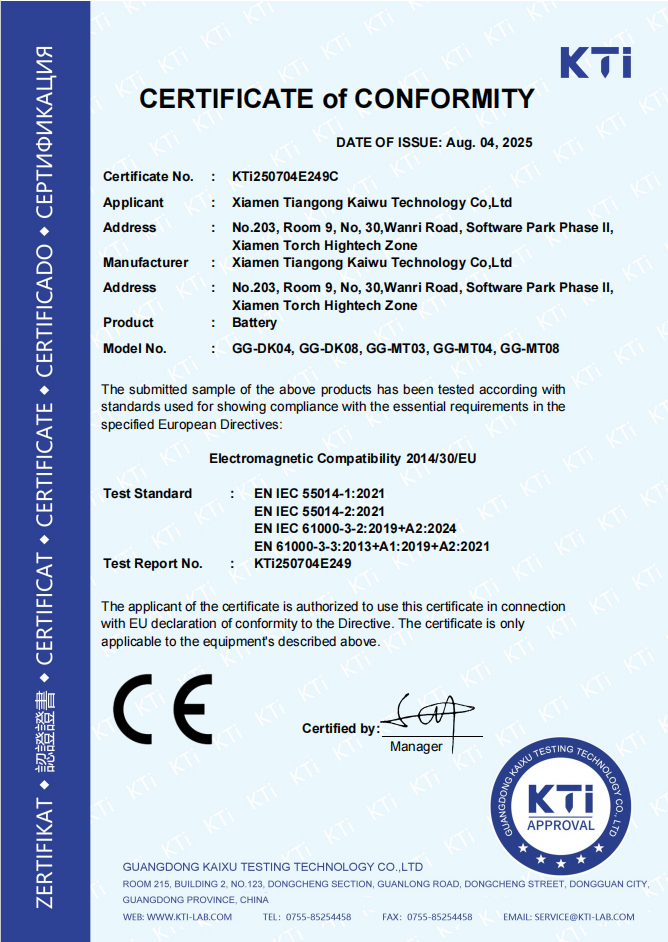
Before placing an order, verify that the supplier holds valid certifications for your target market. For example, Geakita’s products carry:
| Certification | Market | Certificate No. | Issuing Authority |
|---|---|---|---|
| CE (EMC) | EU | KTi250704E249C | KTI |
| UKCA | UK | B‑S2412C5162 | Beide Compliance Laboratory |
| CMA | China | WTS2026‑S0339 | Zhejiang Zhongxie Lide |
Additionally, assess production capacity: Geakita’s monthly output exceeds 180,000 units, ensuring scalability. Evaluate the factory’s three‑level QC system (IQC/IPQC/FQC) and 100% pre‑shipment inspection commitment.
Step 2: Sample Trial – Validate Performance Under Real Conditions
Request trial samples (small‑batch orders as low as 40 units) and test the following parameters:
- Motor technology: Brushless vs. brushed. Geakita’s brushless tools deliver 30% higher efficiency and 50% longer service life.
- Battery runtime: Look for pure copper brushless motors with battery packs like 1300‑2000 mAh × 10‑15 cells.
- Torque and speed: For impact wrenches, models such as the 1000 N·m brushless wrench provide heavy‑duty capability.
- Safety features: Anti‑kickback systems, overload protection, and intelligent BMS.
Compare defect rates: brushless tools from qualified suppliers typically exhibit <0.5% defects vs. 3‑5% for brushed alternatives.
Step 3: Production Monitoring – Inline Quality Control
During mass production, maintain visibility through:
- Material inspection (IQC): A‑grade lithium cells, magnets, and bearings verified against standards.
- Process control (IPQC): Inline torque and electrical monitoring.
- End‑of‑line testing (EOL): Automatic functional and load tests.
Geakita’s production line uses automated assembly and battery‑pack testing, ensuring consistent quality across large volumes.
Step 4: Pre‑shipment Inspection – Third‑Party Verification
Acceptance inspection is the final gate. Geakita offers 100% pre‑shipment inspection by its internal QC team. For extra assurance, third‑party inspection (SGS or TÜV) is available upon request. On‑site factory acceptance can also be arranged.
Step 5: After‑Sales Support – Warranty & Spare Parts
A reliable supplier provides a year‑long global warranty, 7×24 technical support, and timely replacement of defective units. Geakita also maintains a spare‑parts supply chain, minimizing downtime for distributors and end‑users.
Use Case: A Construction Contractor’s Successful Partnership
A construction contractor in the Middle East sourced 5,000+ units of cordless impact wrenches and drills from Geakita. Over two years, the cooperation achieved 99.8% on‑time delivery and a defect rate of only 0.3%, even in 45 °C high‑temperature environments. The supplier’s tier‑A approval for key materials, combined with 100% IQC sampling and defect traceability, eliminated quality surprises.
FAQ: Common Buyer Concerns About Cordless Power Tools Sourcing
Conclusion
Sourcing cordless power tools doesn’t have to be a gamble. By applying a five‑step risk control framework—pre‑qualification, sample validation, production monitoring, pre‑shipment inspection, and after‑sales support—buyers can reduce risks and build lasting partnerships. Suppliers like Geakita demonstrate that transparency, certification, and robust quality systems are the foundation of a successful global supply chain.
For more information on Geakita’s cordless power tools, OEM/ODM services, and quality assurance programs, contact Flora at Flora@gearpioneer.com or visit www.geakita.com.