
- Industry News
- 276
- Gearpioneer-Powering Smart Work EveryWhere
- 14/06/2026
Decoding Cordless Power Tool Specs: How Manufacturing Affects Quality
Learn how to interpret cordless power tool technical parameters like voltage, torque, and battery capacity, and how manufacturing quality impacts reliability. A practical guide for industrial buyers with real-world examples from Geakita.
Decoding Cordless Power Tool Specs: How Manufacturing Affects Quality and Performance
When sourcing cordless power tools for industrial use, procurement managers are often overwhelmed by technical specifications printed on product sheets. Voltage, torque, battery capacity, motor type—what do these numbers really mean for daily operation? And more importantly, how does the manufacturing process behind the tool guarantee that these specifications translate into real-world reliability and longevity? This guide helps buyers cut through the noise, interpret critical parameters, and evaluate manufacturing quality with confidence.
Why Technical Parameters and Manufacturing Quality Matter
Every cordless power tool specification represents a design trade-off. A high torque figure is useless if the motor overheats after 20 minutes. A large battery capacity means nothing if the cells are low-grade and degrade within months. For industrial buyers, understanding the relationship between parameters and production quality is essential to avoid costly downtime and frequent replacements.
Common Buyer Concerns When Interpreting Cordless Power Tool Specs
- How do I know if the stated torque is real or exaggerated?
- What is the difference between brushed and brushless motors, and which one should I choose?
- How does battery cell configuration affect runtime and safety?
- What certifications should I look for to ensure compliance?
- How can I verify that a supplier’s manufacturing process delivers consistent quality?
Industry Background: The Shift Toward Brushless, High-Capacity Cordless Tools
In the past decade, the cordless power tool market has moved decisively from brushed motors to brushless motor technology. Brushless motors offer up to 30% higher energy efficiency, 50% longer service life, and significantly reduced maintenance (no brush replacement). Leading Chinese manufacturer Geakita (Xiamen Tiangong Kaiwu Technology Co., Ltd.), founded in 2009, has been at the forefront of this transition. With a 40,000 m² factory, 300+ employees, and an annual output of over 1 million units, Geakita produces a wide range of brushless tools including impact wrenches, angle grinders, circular saws, drills, and rotary hammers. In 2024 alone, the company shipped approximately 1.5 million lithium battery tools, generating ¥230 million in sales (¥190 million domestic, ¥40 million export) to markets in Europe, Southeast Asia, and the Middle East.
Step 1: How to Interpret Key Cordless Power Tool Technical Parameters
Voltage & Battery Configuration
Voltage determines the power potential of the tool. Most modern brushless tools run on 21V (or 16.8V for lighter models). The battery configuration (cell count and capacity) directly impacts runtime. For example, Geakita’s Elite series uses 21V brushless pure copper motors paired with 1300–2000mAh per cell and 10–15 cells in series. A 5-cell pack (e.g., 1300mAh * 5) provides moderate runtime for light drilling, while a 10-cell pack (e.g., 2000mAh * 10) delivers extended run for heavy continuous use. Always verify actual battery capacity—some suppliers inflate numbers using low-grade cells.
Torque & Application Fit
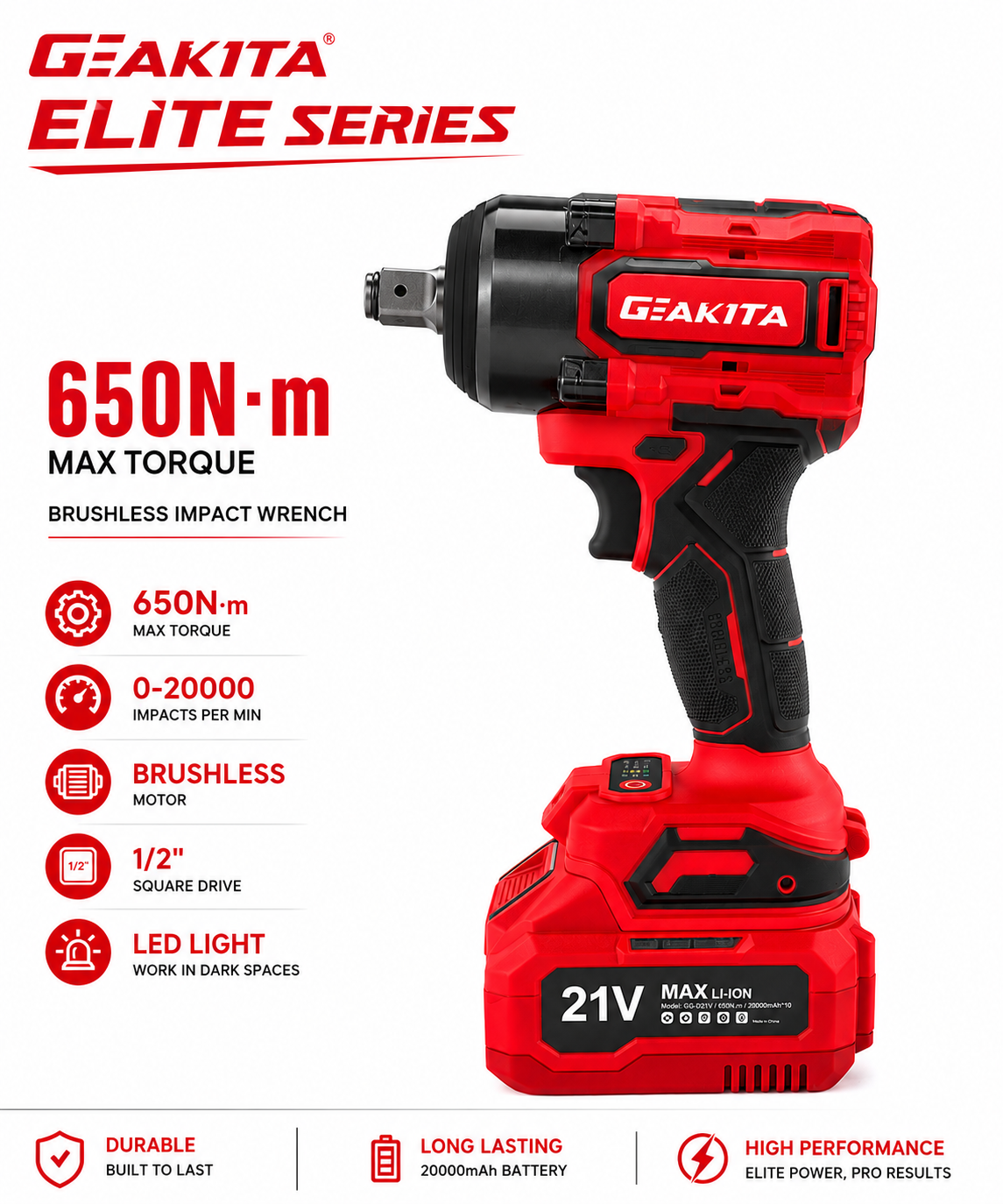
Torque, measured in Newton-meters (N.m), indicates the twisting force available for fastening or loosening. For automotive repair or heavy machinery, an impact wrench with 650 N.m or 1000 N.m (actual torque) is necessary. Geakita offers models like the 650NM impact wrench and the 1000NM heavy-duty wrench (GKR06). For general construction drilling, a brushless impact drill (e.g., PT22) with 35/100/120 N.m torque settings provides flexibility. Key insight: Real torque should be tested under load; always request third-party test reports.
No-Load Speed & Impact Frequency
No-load speed (RPM) and impact frequency (BPM) affect productivity. For example, the 16.8V brushless drill (DK00) operates at 450–2200 RPM with an impact frequency of 7000–24000 BPM. Higher speeds are good for fast drilling in wood; lower speeds with high torque suit steel. The three-function impact feature common in Geakita models allows switching between drilling, screwdriving, and impact modes.
Motor Type: Brushed vs. Brushless
Brushless motors use electronic controllers instead of carbon brushes, eliminating friction and sparking. The result: longer runtime, greater durability, and less heat. Geakita’s entire Elite series and GKR industrial line are equipped with brushless pure copper motors, ensuring 25% higher energy efficiency compared to brushed alternatives. The total cost of ownership over three years is 10–15% lower for brushless tools due to reduced maintenance and longer life.
Step 2: How Manufacturing Quality Impacts Tool Performance
Raw Material Sourcing & Incoming Quality Control (IQC)
High-quality cordless tools start with A-grade lithium-ion cells, pure copper windings, and durable aluminum alloy housings. Geakita performs 100% IQC sampling on key materials (cells, magnets, bearings, cutting tools) and maintains defect traceability. Substandard cells can cause overheating, swelling, or even fires—avoid suppliers that cannot provide UN38.3 compliance for battery transport.
Production Process & In-Process Quality Control (IPQC)
Automated assembly lines with inline torque monitoring, electrical parameter checks, and end-of-line (EOL) testing ensure every unit meets specification. Geakita’s monthly capacity exceeds 180,000 units, with 3-level QC (IQC/IPQC/FQC) and 100% functional load testing before shipment. The result: a field defect rate of only 0.3% compared to the industry average of 3–5% for low-cost generic tools.
Certifications as a Proxy for Manufacturing Discipline
Certifications like CE (EMC Directive 2014/30/EU), UKCA, and CMA demonstrate that a supplier’s products comply with international safety and electromagnetic standards. For example, Geakita holds multiple CE certificates (e.g., number KTi250704E249C for drills and grinders, valid through 2030) tested by KTI laboratory. Buyers should always request valid certificates and cross-check the scope and applicable product models.
Use Case: Real-World Performance in Demanding Conditions
A construction contractor in the Middle East sourced 5,000+ units of Geakita brushless impact wrenches and drills for use in 45°C+ high-temperature environments. Over two years, the tools achieved a 99.8% on-time delivery rate and a 0.3% defect rate. The contractor reported stable torque output, no battery swelling, and minimal maintenance—validating that proper parameter selection combined with rigorous manufacturing delivers field reliability.
Step 3: How to Choose a Supplier That Delivers on Specs
- Ask for actual torque and battery capacity test reports – not just nominal values.
- Verify certifications (CE, UKCA, CMA) and check the certificate number with the issuing authority.
- Request factory audit reports – look for ISO 9001, automated production lines, and IQC/IPQC/FQC processes.
- Order small-batch trial orders – Geakita offers a minimum of 40 units for trial to test performance under your conditions.
- Evaluate after-sales support – a year global warranty, 7/24 technical support, and spare parts availability are strong indicators of supplier confidence.
Frequently Asked Questions
Conclusion
Technical parameters are only half the story in cordless power tools. The manufacturing process—from material selection to assembly and testing—determines whether those specifications are realized in the field. By learning to read specs critically and evaluating supplier quality systems, industrial buyers can reduce risk, lower total cost of ownership, and build a reliable supply chain. For more information or to request product specifications, contact Flora at Flora@gearpioneer.com or visit Geakita.com.