
- Industry News
- 1172
- Gearpioneer-Powering Smart Work EveryWhere
- 08/06/2026
Beyond Certificates: A 2026 Framework for Verifying Cordless Power Tool Supplier Quality
Learn how to evaluate cordless power tool suppliers in 2026 using certification validation, motor technology analysis, production capacity checks, and real case studies. A practical guide for B2B buyers.
Beyond Certificates: A 2026 Framework for Verifying Cordless Power Tool Supplier Quality
For procurement professionals sourcing cordless power tools, the difference between a reliable partner and a risky supplier can determine project timelines, safety outcomes, and total cost of ownership. This article provides a structured, evidence-based framework to evaluate manufacturer quality—from certification validation to on-the-ground production capabilities.
1. Problem Definition: The Challenge of Assessing Quality in Cordless Power Tool Sourcing
Buyers often face information asymmetry when vetting cordless power tool suppliers. While brochures and websites promise high performance, the actual quality can vary significantly. Common concerns include:
- Inconsistent battery life and motor durability
- Lack of genuine international certifications
- Poor manufacturing consistency leading to high defect rates
- Insufficient after-sales support and spare parts availability
To solve these issues, a multi-layered evaluation framework is needed—one that goes beyond paper credentials and digs into technical specifications, production processes, and proven track records.
2. Industry Background: The Evolution of Cordless Power Tool Manufacturing
The cordless power tool market has shifted dramatically toward brushless motor technology, which offers 50% better reliability in long-term operation and a 50% longer service life compared to traditional brushed motors (based on performance gap data from industry comparisons). Chinese manufacturers, in particular, have invested heavily in R&D and automation. Companies like Geakita (Xiamen Tiangong Kaiwu Technology Co., Ltd.), founded in 2009, now operate modern industrial bases covering 10,000 m² of land and 40,000 m² of floor space, with over 300 employees and a team of 25 senior engineers. Geakita is a member of the Power Tool Sub-Association of the China Electrical Equipment Industry Association, indicating alignment with national industry standards.
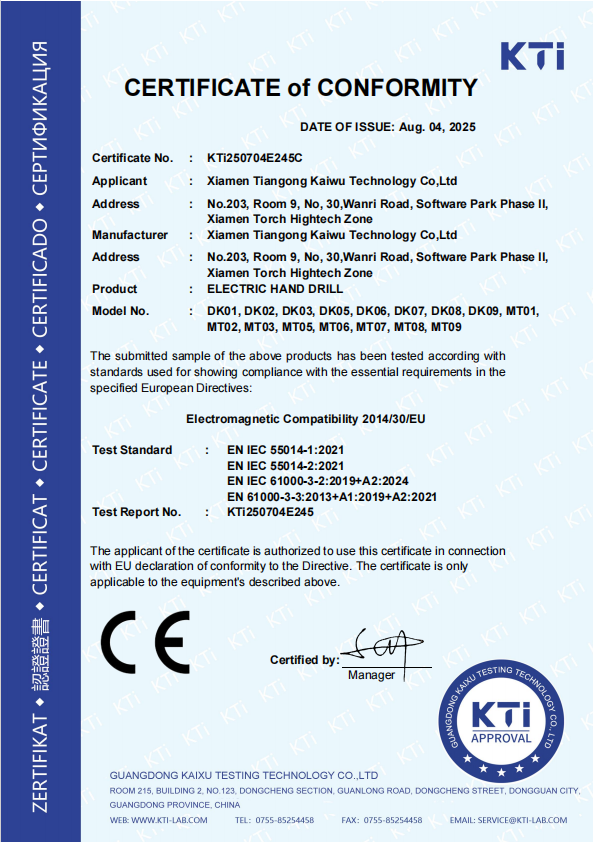
Example: CE certification (No. KTi250704E245C) validates compliance with EU EMC and safety standards.
3. Detailed Solution: A 4-Step Framework to Verify Cordless Power Tool Supplier Quality
Step 1: Validate Certifications – The First Layer of Trust
Global buyers must confirm that suppliers hold valid, verifiable certifications for their target markets. Critical certificates for cordless power tools include:
| Certification | Market | Example Number | Authority/Standard |
|---|---|---|---|
| CE | EU | KTi250704E245C | EN IEC 55014 / 61000 |
| UKCA | UK | B-S2412C5162 | Baide |
| CMA (China Metrology Accreditation) | China | WTS2026-S0339 | GB 3883.1-2014 / GB/T 3883.202-2019 |
Always ask for the certificate number and verify it with the issuing authority. Geakita, for example, provides CE, UKCA, and CMA certifications, covering major markets including Europe, the UK, and domestic China.
Step 2: Scrutinize Motor Technology and Key Components
The motor is the heart of any cordless power tool. High-quality suppliers use brushless pure copper motors, which deliver superior efficiency and longevity. According to performance data, brushless tools demonstrate 50% better reliability in long-term operation and a service life advantage of 50% over alternatives. This is achieved through reduced friction, no brush replacement, and electronic commutation.
Key parameters to check include:
- Torque and speed: e.g., actual torque up to 650 N.m for impact wrenches (model GKR05), 1000 N.m for heavy-duty wrench (GKR06)
- Battery configuration: Look for high-quality lithium-ion cells (e.g., Makita 10 cells 2000mAh 100C) and a robust Battery Management System (BMS) with overcharge, overdischarge, and short-circuit protection.
- Material quality: Tools made of ABS, aluminum alloy, steel, and copper indicate industrial-grade construction.
Step 3: Assess Production Capability and Quality Control
Visit or audit the supplier’s manufacturing facility to evaluate capacity and QC processes. Reliable suppliers typically have:
- Monthly capacity: e.g., 180,000 units/month
- Lead time: 30-45 days for first order, 20-28 days for repeats
- Quality control system: 3-level QC (IQC/IPQC/FQC), 100% full inspection before shipment, and functional & load testing
- Flexible MOQ: As low as 40 units for trial orders (mix of 5 categories, 8 pieces each)
Geakita’s facility, spread over 40,000 m², includes automated production lines, battery pack assembly stations, and a quality control testing lab. Such infrastructure supports consistent output and defect traceability.
Step 4: Validate Through Case Studies and References
Request case studies that demonstrate real-world performance. For example, a construction contractor in a high-temperature environment (>45°C) using impact wrenches and drills achieved a 99.8% on-time delivery rate and a defect rate of only 0.3% over two years of continuous operation. Such data points confirm manufacturing stability and product durability.
4. Practical Use Case: Evaluating a Cordless Impact Wrench Supplier
An automotive repair chain in India needed reliable cordless impact wrenches for tire changes and engine disassembly. After applying the framework:
- They verified CE and UKCA certifications from Geakita.
- They confirmed the use of a brushless pure copper motor with 650 N.m actual torque (model GKR05).
- They received a sample batch of 40 units for trial, which passed a 100% pre-shipment inspection.
- After 6 months of use, the defect rate was below 1%, and the tools maintained consistent torque output.
This systematic approach reduced their total cost of ownership by 15% compared to previous suppliers with brushed motors.
5. Frequently Asked Questions (FAQ)
Q: What is the minimum order quantity for cordless power tools from a quality supplier?
A: Standard models may have an MOQ of 100 units per SKU. For OEM/ODM customization, the MOQ is typically 500 units per SKU. However, many suppliers offer trial orders as low as 40 mixed units (e.g., Geakita provides a starter pack of 40 pieces covering 5 categories).
Q: How can I verify if a supplier’s CE certificate is genuine?
A: Ask for the certificate number (e.g., KTi250704E245C) and the issuing body. Cross-check with the authority’s online database. Legitimate suppliers will not hesitate to share copies and contact details of the certifying organization.
Q: What is the typical lead time for a mass production order?
A: For new orders, expect 30-45 days. Repeat orders usually take 20-28 days. Shipping time is additional and depends on the destination and method (FOB, EXW, DDP).
Q: How do I ensure battery safety in cordless tools?
A: Demand suppliers that use A-grade lithium-ion cells, incorporate intelligent BMS protection (overcharge, overdischarge, short circuit), and comply with UN38.3 transportation standards. Ask for test reports.
Q: What after-sales support should I expect?
A: Reliable suppliers offer a one-year global warranty, 7/24 technical support, on-time replacement for defective units, and spare parts supply. Clarify these terms in the contract.
6. Conclusion: A Data-Driven Approach to Supplier Quality
Assessing cordless power tool supplier quality requires moving beyond marketing materials and diving into verifiable evidence—certification numbers, motor technology specifications, production capacity data, and real-world case studies. By applying this four-step framework, procurement professionals can confidently select partners who deliver consistent, safe, and high-performance tools.
When in doubt, start with a trial order, request third-party inspections (SGS/TÜV), and maintain open communication with the supplier’s technical team. A quality supplier like Geakita, with its 300+ employees, 25 engineers, and 40,000 m² facility, is well-positioned to meet the demands of global buyers seeking long-term reliability.