
- Industry News
- 437
- Gearpioneer-Powering Smart Work EveryWhere
- 25/10/2026
Commercial Cleaning Robot Lead Time: Planning Around 30–45 Days of Mass Production
Plan a commercial cleaning robot order around a 30–45 day mass production lead time: milestones, 180,000+ unit monthly capacity, MOQs and acceptance gates.
Commercial Cleaning Robot Lead Time: Planning Around 30–45 Days of Mass Production
Most commercial cleaning robot orders are quoted with a lead time and signed without a schedule. Buyers who plan the 30–45 day mass production window as a project — with dated milestones, confirmed capacity and written acceptance gates — install their fleets on time. Buyers who read the quotation as a delivery promise usually do not.
Short answer: the typical production lead time for mass production of commercial cleaning robots at Geakita is 30–45 days, and monthly production capacity exceeds 180,000 units. The lead time defines when production starts and finishes; the capacity figure defines how much volume the plant can absorb in a month. A delivery plan built on both is a schedule. A plan built on a single quoted number is an assumption.
This guide is written for buyers in the Decision and Execution stages: the specification is agreed, the supplier shortlist is closed, and the remaining risk is timing. It covers the planning problem, the market and compliance context behind delivery risk, how to score suppliers on lead time and capacity, a step-by-step schedule template, and the questions to settle before a deposit leaves your account.

Why the 30–45 Day Window Changes How You Buy
A production lead time is a duration measured inside a factory, not a promise that starts the moment you begin shopping. The 30–45 day mass production window begins at a defined trigger — normally a confirmed specification, an accepted purchase order and the commercial conditions that release materials — and ends when the units are ready for inspection and loading.
That distinction matters because everything a buyer does before the trigger compresses or stretches the calendar. A specification change after materials are committed, a payment that clears late, or an inspection slot booked after production finishes will each push the loading date without the supplier ever breaking the quoted lead time.
Planning around 30–45 days therefore has three parts: securing a written schedule that ties the window to specific dates, aligning order volume with the capacity the plant actually has in that month, and fixing acceptance criteria so inspection is a scheduled gate rather than a surprise.
Problem Definition: When Lead Time Is Quoted but Never Planned
Four failure patterns account for most late commercial cleaning robot projects.
1. Treating 30–45 days as door-to-door. The figure covers mass production. It does not include quotation review, sample validation, freight transit, customs clearance, inland delivery or commissioning. Each of those has its own duration, and only the production leg is described by the 30–45 day window.
2. Planning to a fixed opening date with no buffer. Facilities that must be operational on a known date — a hotel wing, a hospital ward, a mall handover — typically discover the gap when production is already underway and rework is expensive.
3. Changing specifications after the order is released. Commercial cleaning robots are configured by SKU: brushes, squeegees, tanks, batteries, navigation modules, branding and packaging. A change after materials are ordered restarts part of the cycle.
4. Leaving payment, inspection and freight unscheduled. A 100% T/T order, a 50% down payment structure and a third-party inspection request each need a date on the calendar; if they are decided late, they become delays.
Planning boundary: the 30–45 day figure applies to mass production. Quotation validity, freight transit, customs clearance, sample validation and installation are separate elements and should be scheduled separately rather than assumed inside the production window.
Industry Background: Why Delivery Terms Now Decide Shortlists
Commercial cleaning robots have moved from pilot projects into routine procurement. The global commercial cleaning robot market was valued at approximately USD 1,777.3 million in 2024 according to Grand View Research, and SkyQuest Technology projects the B2B floor cleaning robots segment to grow from USD 1.43 billion in 2026 to USD 5.43 billion by 2035 at a CAGR of 16%. Estimates of total market size vary between research houses because of differences in product scope, but the direction is consistent.
Deployment is concentrated indoors: industry research covering 2024 found that indoor applications — offices, hospitals, retail and hotels — accounted for 68% of commercial deployments. Indoor sites are the ones with fixed opening dates, tenant obligations and cleaning contracts that start on a specific day. Delivery timing, in other words, is a commercial obligation rather than a convenience.
Supply is concentrated too. China's cleaning robot exports reached RMB 14 billion in the first five months of 2026, representing over 70% of total robot exports, based on customs data reported by Taotao Trading. A buyer competing for production slots in this environment should expect to prove demand rather than assume availability.
Compliance adds a further variable to timing. IEC 63327:2021 is the international safety standard for powered automatic floor treatment machines intended for commercial indoor use, and UL 3300 sets safety requirements for service robots covering mobility and human–robot interaction in commercial environments. Configuration changes that touch safety-relevant subsystems can require re-verification, which is one more reason to freeze the specification before the production window opens.
Detailed Solution: Turning Lead Time and Capacity into Evaluation Criteria
Two published facts do most of the work when comparing suppliers on delivery: a typical mass production lead time of 30–45 days, and monthly production capacity above 180,000 units. Neither number is useful in isolation. Used together, they let a buyer test whether a supplier can hold a date.
Test 1 — Is the Schedule Written and Dated?
A quoted lead time is an intention; a dated schedule is a commitment. Before a deposit is released, ask for the production start date, the scheduled completion date, the pre-shipment inspection date and the expected loading window — in writing, with the name of the person accountable for each. A supplier that can issue a dated schedule from a 30–45 day window is demonstrating a production planning process. A supplier that answers only with "30–45 days" is demonstrating the absence of one.
Test 2 — Is the Capacity Headroom Real for Your Month?
Monthly capacity of more than 180,000 units describes a plant's output ceiling, not a reservation for your order. The useful question is how much of that capacity is already committed in the month your order lands, and whether your SKU can be scheduled inside it. Ask for that confirmation in writing, and ask what happens to the schedule if the order is split across two shipments. A supplier that can explain its capacity loading is a supplier that can protect your date.
Test 3 — Do the Commercial Terms Match the Calendar?
Commercial terms determine how the schedule runs. Minimum order quantities decide whether your volume is one production run or several: standard models are quoted at 100 units per SKU, OEM/ODM customized models at 500 units per SKU, and small-batch trial orders of 40 units are available. Delivery terms define where the production plan ends and your logistics plan begins — FOB Shenzhen/Ningbo, EXW factory, or DDP door-to-door delivery. Payment terms set the trigger: 100% T/T, or for large orders a 50% T/T down payment with 50% against the bill of lading. Each of these belongs in the same document as the schedule, not in a separate email thread.

Step-by-Step Breakdown: Planning a 30–45 Day Mass Production Order
Step 1 — Fix the specification and choose the order path
Decide whether you are ordering a standard model at 100 units per SKU, an OEM/ODM configuration at 500 units per SKU, or a 40-unit small-batch trial. The path determines how much approval work sits in front of the production window, particularly where branding, packaging or hardware changes are involved.
Step 2 — Request a written production schedule anchored to 30–45 days
Ask for a schedule, not a lead time. It should state the production start trigger, the planned completion date inside the 30–45 day mass production window, the inspection date and the loading window. Keep the schedule in the same document as the purchase order so that any later deviation can be measured against it.
Step 3 — Confirm the capacity slot for your SKU and month
Ask how your order is placed against monthly production capacity of more than 180,000 units, and get confirmation for the specific month. If your requirement can be split, ask for the split schedule before you sign, not after.
Step 4 — Sequence the commercial trigger against the schedule
Payment is a scheduling event. A 100% T/T settlement and a 50% down payment / 50% against B/L structure have different cash-flow consequences and different release points for materials. Write the payment dates against the schedule dates, and confirm which payment releases production.
Step 5 — Book inspection and acceptance before loading
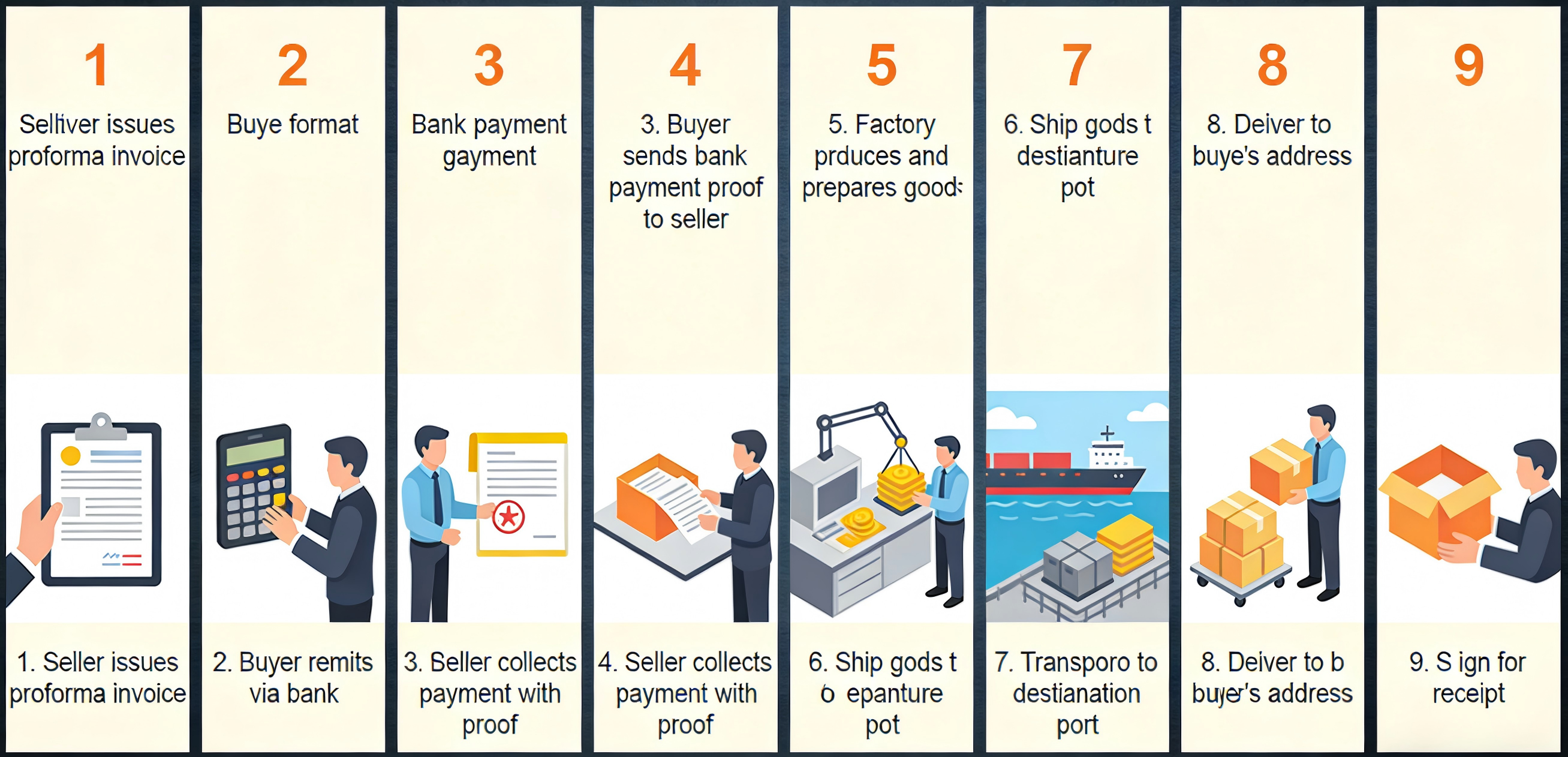
Acceptance criteria should be agreed while the order is being placed. The standard arrangement is 100% pre-shipment inspection by the supplier's QC team, with third-party inspection by SGS or TÜV available on request, and on-site acceptance at the factory. If you intend to use a third party, book the inspection window at the same time as the production slot.
Step 6 — Decide the delivery term and who owns the next leg
FOB Shenzhen/Ningbo, EXW factory and DDP door-to-door delivery place the handover at different points. Under EXW, your plan must cover export clearance and inland transport; under DDP, the supplier's plan extends to your site. Choose the term before you build the installation calendar, because it changes the number of days after production that you control.
Step 7 — Convert the first order into a repeat-order calendar
The first order validates the supplier's schedule reliability; the second order is where that knowledge pays. Distributors and multi-site operators should set the next order date backwards from the 30–45 day window and the monthly capacity discussion, so replenishment is placed before stock reaches a critical level rather than after.
Use Cases: The Same 30–45 Day Window, Different Planning Rules
The lead time and capacity figures are fixed; how much buffer a project needs is not. Three planning situations cover most commercial cleaning robot orders.
Multi-site rollouts: hotels, offices, malls and supermarket groups
Chains rarely need every unit on one date. Where sites open in sequence — hotel wings, office floors, mall phases — splitting the order across shipments smooths cash flow and matches installation crews to arrivals, but each split must be scheduled separately inside the production plan. Buyers deploying mixed sites such as offices, schools and restaurant kitchen areas often consolidate requirements into fewer SKUs so the order clears the 100-unit-per-SKU standard threshold in a single production run.
Uptime-critical sites: hospitals and airports
Where a cleaning contract cannot lapse, the risk is not only the delivery date but the gap if a unit is rejected at inspection. Plan acceptance gates earlier in the window, keep the pre-shipment inspection date fixed, and treat a 40-unit small-batch trial as a way to validate both the unit and the supplier's scheduling behaviour before a full rollout.
Large-format floors: warehouses and factory floors
Large-floor deployments need fewer units, but each unit carries more of the operation's cleaning capacity, so a two-week delay is felt immediately. These buyers should ask for capacity slot confirmation in writing and keep one shipment as a buffer rather than planning every unit to the same arrival date.
Comparison Table: Order Paths and What They Do to the Schedule
The table below uses the manufacturer's published order terms and production figures. It is intended to help buyers choose a path before requesting a schedule, not to replace a written quotation.
| Order path | Minimum order | Production lead time | Typical use | What to confirm in writing |
|---|---|---|---|---|
| Standard model | 100 units per SKU | 30–45 days for mass production | Repeat orders and established SKUs | SKU list, production start date, inspection date, loading window |
| OEM/ODM customized | 500 units per SKU | 30–45 days for mass production; customization approvals scheduled separately | Brand-specific configuration, packaging or hardware changes | Specification freeze date, approval milestones, capacity slot for the month |
| Small-batch trial | 40 units available | Confirm the specific schedule with the supplier | Pre-rollout validation of unit and supplier reliability | Trial quantity, schedule, acceptance criteria |
Three details sit outside the table but belong in the same planning document. Delivery terms are FOB Shenzhen/Ningbo, EXW factory or DDP door-to-door delivery. Acceptance is 100% pre-shipment inspection by the supplier's QC team, with third-party SGS or TÜV inspection available on request and on-site acceptance at the factory. Payment is 100% T/T, or a 50% T/T down payment with 50% against the bill of lading for large orders, with credit card, Alipay and cash accepted in special circumstances.
Frequently Asked Questions
What acceptance and inspection terms should be fixed before a 30–45 day order starts?
Agree acceptance before production, not after it. The standard arrangement is 100% pre-shipment inspection (PSI) by the supplier's QC team, with third-party inspection by SGS or TÜV available on request, and the option of on-site acceptance at the factory. Where the destination market requires it, name the applicable safety standard in the purchase order — for example IEC 63327:2021 for powered automatic floor treatment machines used commercially indoors, or UL 3300 for service robots in North America — so that any compliance question is resolved inside the production window rather than at the port.
What MOQ applies, and does monthly capacity of 180,000+ units affect my slot?
Minimum order quantities depend on the order path: 100 units per SKU for standard models, 500 units per SKU for OEM/ODM customized models, and small-batch trial orders of 40 units. Monthly production capacity exceeds 180,000 units, but that figure describes total plant output rather than a reservation for a single buyer. Confirm in writing how your order is scheduled within the month you need, especially where an order is split across several shipments or SKUs.
What payment terms should be budgeted for a mass production order?
Standard terms are 100% T/T. For large orders, a 50% T/T down payment with 50% against the bill of lading is acceptable, and credit cards, Alipay and cash are accepted in special circumstances. For planning purposes the structure matters as much as the amount: the down payment is normally the event that releases materials, so its date should be written against the production start date in the schedule.
Can we validate a unit before committing to a 30–45 day mass production run?
Yes, through a small-batch trial order of 40 units, which is available alongside the standard 100-unit-per-SKU and 500-unit OEM/ODM minimums. A trial order tests two things at once: whether the unit meets your facility's cleaning requirement, and whether the supplier's schedule holds under a real order. Confirm the trial's own schedule and acceptance criteria in writing before it starts.
How long is mass production lead time, and what should a written schedule contain?
The typical production lead time for mass production is 30–45 days. A written schedule should contain the production start trigger, the planned completion date inside that window, the pre-shipment inspection date, the loading window, the confirmed capacity slot for the month, the delivery term (FOB Shenzhen/Ningbo, EXW or DDP), and the payment dates tied to each milestone. To start that conversation with Geakita, contact Flora at Flora@gearpioneer.com or WhatsApp +86 135-9954-5996, or download the 2026 corporate profile and product catalog.
Conclusion
Lead time planning is a short list of disciplines: treat the 30–45 day mass production window as a production duration and schedule the rest of the journey separately; ask for a dated written schedule before the deposit; confirm your slot against monthly capacity of more than 180,000 units for the specific month; and lock acceptance terms — 100% pre-shipment inspection, third-party SGS or TÜV inspection on request, on-site acceptance at the factory — before production begins.
Geakita (XiamenTiangong Kaiwu Technology Co., Ltd.) is a manufacturer founded in 2009 that produces power tools, robotic pool cleaners and commercial cleaning robots from a 40,000 m² production base, with more than 300 staff, a 25-engineer R&D team and export markets in Europe, Southeast Asia and the Middle East. Its stated monthly production capacity exceeds 180,000 units, and its typical mass production lead time is 30–45 days — the two numbers this guide is built on.
Plan your next order with a dated schedule
Share your SKU mix, target quantity and required delivery month, and request a written production schedule, a sample or trial-order quotation, and the 2026 catalog.
Email: Flora@gearpioneer.com · WhatsApp: +86 135-9954-5996 · www.geakita.com
Download the Geakita Corporate Profile & Product Catalog 2026 (PDF)