
- Industry News
- 820
- Gearpioneer-Powering Smart Work EveryWhere
- 25/10/2026
Cordless Power Tools: How to Read a Spec Sheet Before You Select a Model
Technical guide to cordless power tool specifications: motor type, battery cell configuration, torque, speed, chuck size, capacity and compliance before you select a model.
Cordless Power Tools: How to Read a Spec Sheet Before You Select a Model
A cordless power tool's usable capability is set by four specification families, not by voltage alone: motor type (brushed or brushless), battery configuration (cell count and cell capacity), the torque–speed–impact trio, and the chuck or working capacity that decides which accessories the tool can actually drive. Reading those four together is what turns a specification list into a selection decision.
Geakita (Xiamen Tiangong Kaiwu Technology Co., Ltd.) is a Chinese manufacturer founded in 2009 that builds cordless power tools alongside robotic pool cleaners and commercial cleaning robots. Its cordless range spans 12V, 16.8V and 21V platforms across drills, impact drills, impact screwdrivers, impact wrenches, rotary hammers, angle grinders and a circular saw. Because the published data sheets for those models carry the same parameter fields in the same format, the range works as a practical dataset for explaining how cordless specifications should be interpreted.
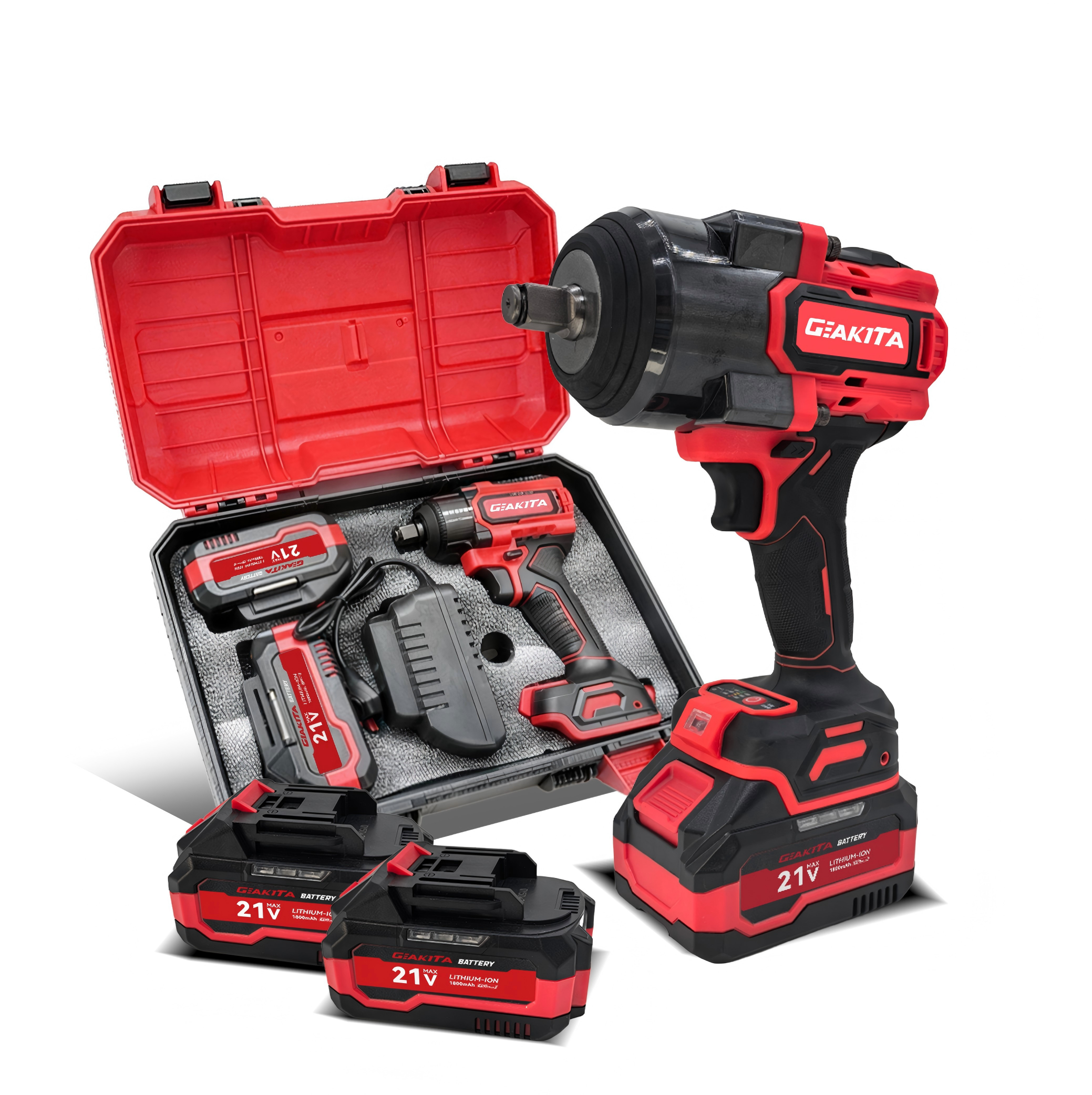
Geakita GKR05: a 21V pure copper brushless impact wrench rated at 650 N.m with a 0–4000 r/min no-load speed and a 10-cell 2000mAh pack.
Problem Definition: Why a Voltage Rating Cannot Carry a Selection Decision
Voltage identifies a battery platform. It does not measure output. Inside a single 21V platform at Geakita, the published actual torque ranges from 55 N.m on the PT02-1 brushless impact drill through 80 N.m on the PT-21 and 150 N.m on the PT24, and reaches 650 N.m on the GKR05 impact wrench and 1000 N.m on the GKR06. Every one of those tools carries the same 21V label, and none of them is interchangeable on the job.
The second source of confusion is battery shorthand. A data sheet line such as “1300mah*4cells” or “2000mah*15cells” describes pack architecture, not a runtime promise. The 16.8V DK-05 lists four cells at 1300mAh; the 21V PT24 lists fifteen cells at 2000mAh; the GKR05 and GKR03 list a Makita-format 10-cell 2000mAh pack. Buyers who compare only the milliampere-hour number, and ignore the cell count and voltage class, compare packs that behave very differently under load.
The third failure is treating torque as a single number without its speed context. The GKR05 quotes 650 N.m against a 0–4000 r/min no-load speed, while the heavier GKR06 quotes 1000 N.m against 0–3200 r/min. Higher fastening capability is delivered with a lower free speed, which changes how the tool feels in a production cycle.
The fourth failure is ignoring the interface: a 10mm three-jaw metal ratchet chuck and a 13mm three-jaw metal ratchet chuck accept different accessory ranges, and a rotary hammer's drilling capacity — concrete Σ26mm, steel Σ13mm, wood Σ26mm on the RH01 and RH02 — is a separate specification from its motor.
The fifth failure is a missing compliance line. Cordless tools and their battery packs are regulated products, and a specification sheet that omits the standard reference is incomplete regardless of how strong the torque figure looks.
Industry Background: Where Cordless Capability Now Sits
Cordless has become the mainstream format of the professional tool market rather than a niche inside it. Grand View Research valued the global cordless power tools market at USD 13.44 billion in 2024 and projected it to reach USD 32.58 billion by 2033. Global Market Insights publishes a smaller 2024 figure of USD 12.2 billion for the same category; the gap between the two estimates is largely a definition question, since some studies include batteries and chargers while others separate them, and some include garden machinery while others do not. Buyers using market data in a business case should state which definition they are using.
The category mix explains which parameters dominate buyer conversations. Drilling and fastening tools held a 36.51% revenue share of the cordless market in 2024, according to Horizon Databook and Grand View Research data, which is why chuck size, torque stages and drilling capacity are the most frequently compared fields. Angle grinders form a separate market valued at USD 3.2 billion in 2024 by Strategic Market Research, where disc diameter and no-load speed replace chuck size as the defining parameters. China's power tools market reached USD 5.30 billion in 2024 by Fortune Business Insights' estimate, and the country functions as a major global export hub for cordless lithium technology.
Regulation sets the floor for all of it. IEC/UL 62841-1 is the primary safety standard for electric motor-operated hand-held tools and lawn and garden machinery, and lithium-ion cells used in power tools must comply with IEC/UL 62133, the standard for secondary cells and batteries for portable applications. Those two references, not the marketing headline, are what a technical buyer should look for first on a specification sheet.
Detailed Solution: The Five Specification Families That Decide Performance
1. Motor type: brushed versus brushless pure copper
Motor construction is the single largest variable inside one voltage class. On a comparable 21V, five-cell battery configuration, the brushless PT02-1 is rated at 55 N.m actual torque while the brushed 21V 9996 is rated at 30 N.m — a difference produced by motor type rather than by battery size. The pattern holds lower down the range: the brushed 12V 9868 delivers 28 N.m from a three-cell 1300mAh pack and has no impact function, whereas the 16.8V brushless DK-05 combines a brushless pure copper motor with a four-cell 1300mAh pack.
For a buyer, motor type governs heat build-up and service life under repeated duty, and it is the first line to check when two quotations for a visually similar tool diverge. Both motor types remain in the Geakita catalogue because brushed versions still serve price-sensitive and light-duty programmes, while brushless versions serve continuous professional use.
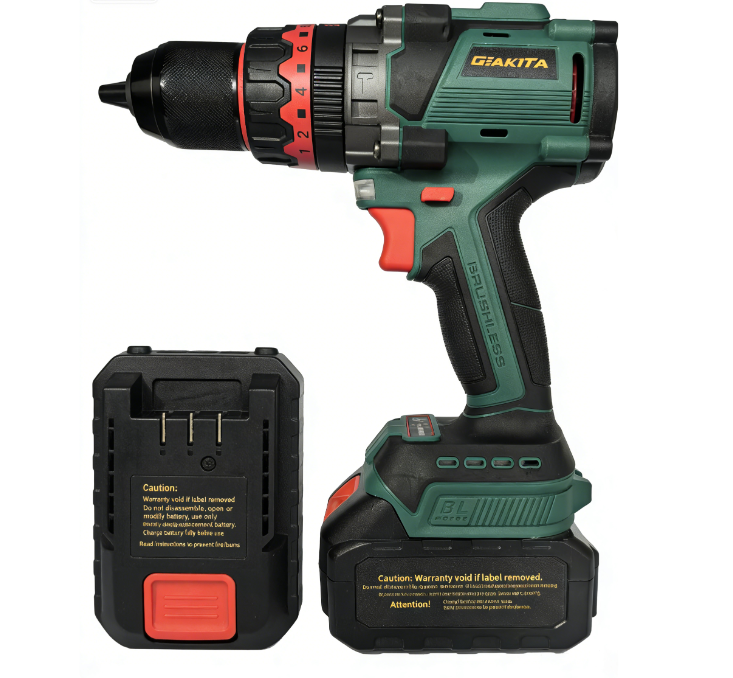
PT24: 21V brushless pure copper impact drill, 150 N.m actual torque, 2000mAh x 15 cells, 13mm three-jaw metal ratchet chuck.
2. Battery configuration: cell count multiplied by cell capacity
Because the same 21V label appears on packs from five to fifteen cells, cell count — not voltage — is the runtime and current-delivery variable inside a platform. The Geakita range shows the spread clearly: PT12 and PT02-1 at 1300mAh x 5 cells, PT-21 at 1500mAh x 10 cells, PT24 at 2000mAh x 15 cells, DK03 at 1300mAh x 8 cells in 16.8V, DK02 at 1500mAh x 4 cells, and the 21V impact wrench platform listed at 1500–2000mAh across 10–15 cells.
Two engineering consequences follow. A pack with more cells in parallel can deliver higher current for high-torque tools such as the PT24 and GKR06; a pack with fewer, smaller cells keeps the tool lighter and cheaper but limits sustained load. This is why a specification sheet that lists only “21V” for a battery has effectively told the buyer nothing about runtime.
3. Torque, speed and impact frequency as one system
The three values only mean something together. In the 21V impact drill family, actual torque rises 60 N.m (PT12), 80 N.m (PT-21), 150 N.m (PT24) while the no-load speed band stays at 450–2000 r/min — the same band across all three, so the torque step is delivered by motor and battery rather than by gearing. In the wrench family, the step to 650 N.m (GKR05) brings a 0–4000 r/min no-load speed, and the step to 1000 N.m (GKR06) brings 0–3200 r/min.
Impact frequency is the drilling counterpart. The 16.8V DK02 and DK03 quote 7000 impacts per minute in low gear and 24000 in high gear, alongside a 0–120 N.m no-load torque range and 24 gears plus three functions. The QZ01 and QZ02 16.8V impact screwdrivers apply the same idea to fastening with three torque levels of 35/100/120 N.m and a stepless 0–1200/2400/3000 r/min speed range; the 21V GKR03 brushless screwdriver uses the same 35/100/120 N.m three-level structure at 1200/2400/3000 r/min.
4. Chuck type and working capacity: the accessory interface
Chuck specification decides which bits and discs the tool can use at all. PT01 and PT02-1 use a 10mm three-jaw metal ratchet chuck; PT12, PT-21 and PT24 use the 13mm version; the 12V 9868 and 21V 9996 brushed drills also use a 10mm three-jaw metal ratchet chuck. A 13mm chuck widens the shank range, which matters when one tool must cover several fastener sizes.
Working capacity is quoted separately from chuck size. DK02 and DK03 list a 13mm chuck with steel capacity of 13mm and wood capacity of 50mm; DK00 lists steel 13mm and wood 60mm at 450/2200 r/min; the RH01 and RH02 rotary hammers list concrete Σ26mm, steel Σ13mm and wood Σ26mm with a 0–2000 r/min no-load speed and 0–4500 min frequency. On the cutting side the JM01-02 and JM03 angle grinders take a 100mm disc with a 16mm inner diameter and run at 12000 RPM, and the CS01 cordless circular saw quotes a 21000 r/min no-load speed.
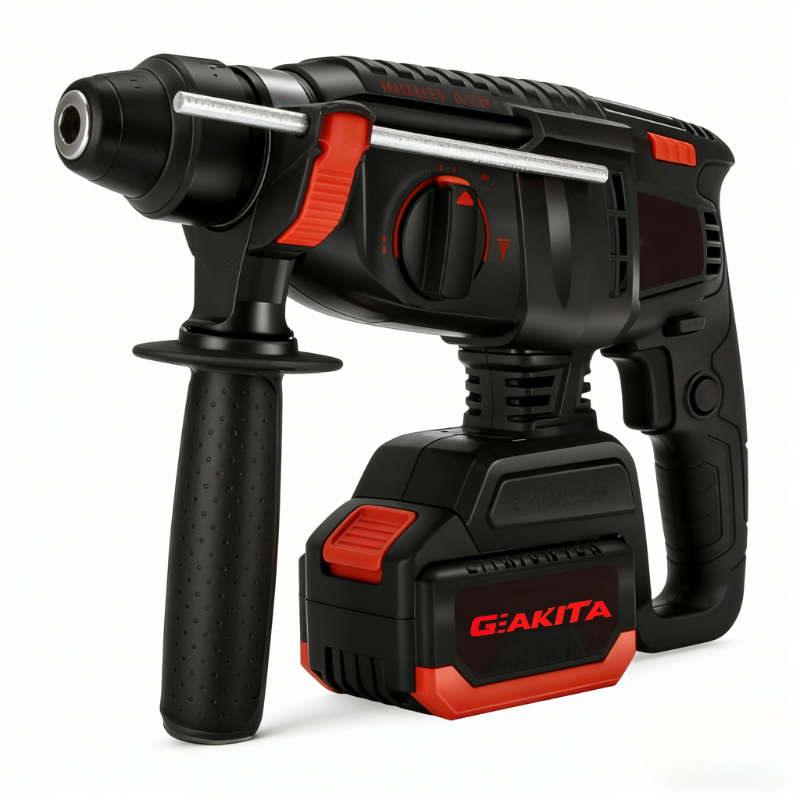
RH-02: 21V brushless rotary hammer, 2000mAh x 10 cells, concrete Σ26mm, steel Σ13mm, wood Σ26mm.
5. Weight and compliance: the lines buyers read last and need most
Weight is quoted inconsistently across the industry, so the reference point matters. The DK01 brushless drill lists 1.15kg; the DK00 lists 1.6kg; the JM01-02 angle grinder lists 1.6kg with one battery fitted. For overhead or single-hand work, that difference is a duty-cycle decision, not a comfort detail.
Compliance is the final field. IEC/UL 62841-1 covers the tool, IEC/UL 62133 covers the lithium-ion cells inside the pack, and the applicable market determines which national transposition of those standards a supplier must document. A data sheet that lists torque and cell count but not the standard reference leaves the buyer to verify compliance separately.
Step-by-Step Breakdown: A Six-Step Specification Workflow
The workflow below converts the five families into a repeatable selection sequence. It works for a single tool purchase and for a multi-model assortment.
- Define the operation and the torque band. Fastening a defined fastener class is a torque problem; drilling a defined hole is a capacity problem. On the Geakita range, a light assembly task fits the 55–60 N.m band (PT02-1, PT01, PT12), a general production task fits 80–150 N.m (PT-21, PT24), and heavy structural fastening fits the wrench family at 650 N.m (GKR05) or 1000 N.m (GKR06).
- Choose the voltage platform. The catalogue spans 12V, 16.8V and 21V. The 12V 9868 (28 N.m, three-cell pack, no impact) and the 16.8V DK-05 sit at the light end; 21V covers the PT, QZ, GKR, RH and JM families. Packs are not interchangeable across voltage classes, so platform choice fixes the rest of the programme.
- Choose the motor type. Compare the brushed 21V 9996 at 30 N.m with the brushless PT02-1 at 55 N.m on a comparable five-cell pack; where duty is continuous, brushless is the specification to defend.
- Check the chuck against the accessory plan. 10mm chucks on PT01, PT02-1, 12V 9868 and 21V 9996; 13mm chucks on PT12, PT-21, PT24, DK02 and DK03. If the accessory kit includes larger shanks, the 13mm body is the correct starting point.
- Check capacity against the actual hole or cut. Steel 13mm and wood 50mm on DK02 and DK03; wood 60mm on DK00; concrete Σ26mm on RH01 and RH02; a 100mm disc at 12000 RPM on JM01-02 and JM03; 21000 r/min on the CS01 circular saw.
- Confirm battery configuration and compliance documentation. Fix the pack (for example 2000mAh x 15 cells on PT24 versus 1300mAh x 5 cells on PT12), then confirm IEC/UL 62841-1 for the tool and IEC/UL 62133 for the cells before the purchase order is signed.
Decision rule: when two quotations differ on price but match on voltage, compare them on four fields before anything else — motor type, cell count and capacity, actual torque with its no-load speed, and chuck diameter. A price gap that disappears once those four fields are aligned is not a price gap; it is a specification gap.
Use Cases: Matching the Specification to the Task
Assembly and light fastening. The QZ01 and QZ02 16.8V impact screwdrivers provide three torque levels of 35/100/120 N.m with a stepless 0–1200/2400/3000 r/min range, forward and reverse rotation and an LED light — the combination required when one station drives mixed fastener sizes. The 21V GKR03 brushless screwdriver applies the same three-level structure with a Makita-format 10-cell 2000mAh pack and a hex clip.
General drilling and driving. The PT12 (60 N.m, 13mm chuck, 24+3 settings), PT-21 (80 N.m) and PT24 (150 N.m, 2000mAh x 15 cells) cover the intermediate band, while the 16.8V DK02 and DK03 cover steel 13mm and wood 50mm with 7000/24000 impacts per minute.
Heavy fastening. The GKR05 and GKR06 are specified for railway engineering and maintenance, automotive and transportation, construction and steel structures, heavy machinery manufacturing, energy and petrochemicals, shipbuilding and marine engineering, mining and metallurgy, and light industry and DIY — the applications where a 650 N.m or 1000 N.m wrench replaces manual tooling.
Concrete and masonry. The RH01 and RH02 rotary hammers cover concrete Σ26mm, steel Σ13mm and wood Σ26mm at 0–2000 r/min with a 0–4500 min frequency and a docking charger, which is the anchor tool when a site package must include drilling into masonry.
Cutting and grinding. The JM01-02 brushless and JM03 angle grinders run a 100mm disc at 12000 RPM; the CS01 cordless circular saw quotes 21000 r/min no-load speed for timber work.
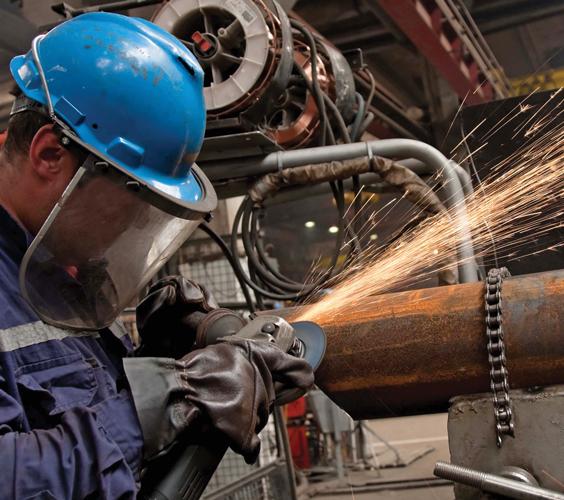
Factory maintenance and manufacturing: the duty environment where motor type and battery cell count decide whether a tool holds its rated output across a shift.
Comparison Table: Geakita Cordless Models by Published Specification
The table below reproduces specification fields exactly as they appear in the model data sheets. Blank or unlisted fields are marked — rather than filled by assumption.
| Model | Tool type | Voltage | Motor | Torque / speed | Battery configuration | Chuck / capacity |
|---|---|---|---|---|---|---|
| 12V 9868 | Brushed drill | 12V | Brushed pure copper | 28 N.m; 450–2000 r/min; no impact | 1300mAh x 3 cells | 10mm three-jaw metal ratchet; 18+1 settings |
| 21V 9996 | Brushed impact drill | 21V | Brushed pure copper | 30 N.m; 450–2000 r/min | 1300mAh x 5 cells | 10mm three-jaw metal ratchet; 18+1 settings |
| PT02-1 | Brushless impact drill | 21V | Brushless pure copper | 55 N.m; 450–2000 r/min | 1300mAh x 5 cells | 10mm three-jaw metal ratchet; 23+1 settings |
| PT12 | Brushless impact drill | 21V | Brushless pure copper | 60 N.m; 450–2000 r/min | 1300mAh x 5 cells | 13mm three-jaw metal ratchet; 24+3 settings |
| PT-21 | Brushless impact drill | 21V | Brushless pure copper | 80 N.m; 450–2000 r/min | 1500mAh x 10 cells | 13mm three-jaw metal ratchet; 24+3 settings |
| PT24 | Brushless impact drill | 21V | Brushless pure copper | 150 N.m; 450–2000 r/min | 2000mAh x 15 cells | 13mm three-jaw metal ratchet; 24+3 settings |
| DK03 | Brushless impact drill | 16.8V | Brushless | 0–120 N.m; 450/2000 r/min; 7000/24000 BPM | 1300mAh x 8 cells | 13mm chuck; steel 13mm, wood 50mm |
| GKR03 | Brushless screwdriver | 21V | Brushless pure copper | 35/100/120 N.m; 1200/2400/3000 r/min | 2000mAh x 10 cells | Hex clip |
| GKR05 | Brushless impact wrench | 21V | Brushless pure copper | 650 N.m; 0–4000 r/min | 2000mAh x 10 cells (Makita format) | — |
| GKR06 | Brushless heavy-duty wrench | 21V | Brushless pure copper | 1000 N.m; 0–3200 r/min | 2000mAh x 10 cells (Makita format) | — |
| RH02 | Brushless rotary hammer | 21V | Brushless pure copper | 0–2000 r/min; 0–4500 min frequency | 2000mAh x 10 cells | Concrete Σ26mm; steel Σ13mm; wood Σ26mm |
| JM03 | Angle grinder | 21V | — | 12000 RPM no-load | — | 100mm disc; 16mm inner diameter; 1.6kg with one battery |
Parameter decoding reference
| Parameter | What it governs | How it reads on a Geakita data sheet |
|---|---|---|
| Voltage | Battery platform class and pack compatibility | 12V, 16.8V, 21V lines; packs are not interchangeable between classes |
| Motor type | Heat behaviour and sustained output | “Brushless Pure Copper” versus “Brushed Pure Copper” |
| Actual torque | Fastening and drilling load capability | 28 N.m (12V 9868) to 1000 N.m (GKR06) |
| No-load speed | Cycle speed and control resolution | 450–2000 r/min on PT drills; 0–4000 r/min on GKR05 |
| Impact frequency | Hammering action in drilling | 7000 BPM low gear / 24000 BPM high gear on DK02 and DK03 |
| Torque settings | Repeatability of drive depth | 18+1, 20+1, 23+1, 24+3; three levels of 35/100/120 N.m on GKR03 |
| Chuck | Accessory shank compatibility | 10mm or 13mm three-jaw metal ratchet chuck |
| Capacity | Maximum hole or cut size | Steel 13mm / wood 50mm (DK02, DK03); concrete Σ26mm (RH02) |
| Battery configuration | Runtime and current delivery | 1300mAh x 4 cells (DK-05) to 2000mAh x 15 cells (PT24) |
| Weight | Fatigue across a shift | DK01 1.15kg; DK00 1.6kg; JM01-02 1.6kg with one battery |
FAQ
1. Which safety and battery standards apply to cordless power tools?
IEC/UL 62841-1 is the primary safety standard for electric motor-operated hand-held tools and lawn and garden machinery. Lithium-ion cells used in power tool packs must comply with IEC/UL 62133, the standard for secondary cells and batteries for portable applications. A supplier data sheet should be read alongside the compliance documentation for the destination market, because the standard reference applies to the tool and the pack separately.
2. How much torque should a buyer specify from a 21V cordless drill or impact wrench?
Torque should be selected from the fastener or hole requirement, then checked against published figures. Within the Geakita 21V brushless range, actual torque runs from 55 N.m (PT02-1) and 60 N.m (PT12) through 80 N.m (PT-21) to 150 N.m (PT24) for impact drills, and from 650 N.m (GKR05) to 1000 N.m (GKR06) for impact wrenches. Higher-torque bodies are published with lower no-load speeds — 0–4000 r/min on the GKR05 against 0–3200 r/min on the GKR06 — so torque and speed must be specified as a pair.
3. Which specification choices drive the cost of a cordless tool the most?
Four fields account for most of the difference between two visually similar tools: motor type (brushless pure copper versus brushed pure copper), battery configuration (1300mAh x 4 cells on the DK-05 against 2000mAh x 15 cells on the PT24), chuck construction and diameter (10mm versus 13mm three-jaw metal ratchet), and the accessory set shipped with the tool. Comparing quotations with those four fields aligned is the only way to separate a genuine cost difference from a specification difference.
4. Can a buyer validate a specification before committing to a volume order?
Yes. Request a sample in the exact configuration that will be ordered — same model, same motor type, same battery cell count and capacity, same chuck — and verify the delivered unit against the published data sheet fields: actual torque, no-load speed, torque setting count, chuck diameter and drilling capacity. Samples can be requested from Geakita at Flora@gearpioneer.com or +86 135-9954-5996 (WhatsApp available on the same number).
5. What should be confirmed before an order schedule is issued?
Configuration freeze comes first: model, motor type, battery cell count and capacity, chuck, packaging and manual language. Capacity context supports that step — Geakita operates a manufacturing facility with 40,000 square metres of floor space, more than 300 staff and a 25-engineer R&D team, and serves Europe, Southeast Asia and the Middle East with export accounting for 20% of total sales. Once the configuration is frozen, request the current production schedule against that specific configuration rather than against the model name alone. The full model and specification list is available in the Geakita Corporate Profile & Product Catalog 2026 (PDF).
Conclusion
A cordless power tool is only as good as the specification match behind it. Voltage sets the platform; the motor decides how much of that platform's output survives continuous work; the battery cell count and capacity decide how long it survives; torque paired with no-load speed and impact frequency decides whether it suits the task; and the chuck plus working capacity decide whether the right accessory can be fitted at all. Compliance documentation, IEC/UL 62841-1 for the tool and IEC/UL 62133 for the cells, closes the list.
Geakita's range makes the logic visible because the same parameter fields repeat across a 12V to 21V span, from the 28 N.m brushed 12V 9868 to the 1000 N.m brushless GKR06. Reading those fields in sequence — motor, battery, torque and speed, chuck and capacity, weight, compliance — converts a specification sheet into a purchasing decision that can be defended to an engineer and to a finance team at the same time.
Next step: validate the specification on a sample
Request a sample in the exact configuration you intend to order, or ask for the 2026 catalogue covering the full cordless range — drills, impact drills, impact screwdrivers, impact wrenches, rotary hammers, angle grinders and the CS01 circular saw.
Email: Flora@gearpioneer.com · Tel / WhatsApp: +86 135-9954-5996
Catalogue download: GEAKITA Corporate Profile & Product Catalog 2026 · Website: www.geakita.com

Geakita technical and sales team: specification review, sample configuration and documentation requests.