
- Industry News
- 484
- Gearpioneer-Powering Smart Work EveryWhere
- 21/10/2026
MOQ Planning for Commercial Cleaning Robot Buyers: What 5 Categories × 8 Items Means for Your Order
What a minimum order of at least 5 power tool categories × 8 items (40 items total) means for commercial cleaning robot buyers, and how to plan and negotiate the basket.
MOQ Planning for Commercial Cleaning Robot Buyers: What 5 Categories × 8 Items Means for Your Order
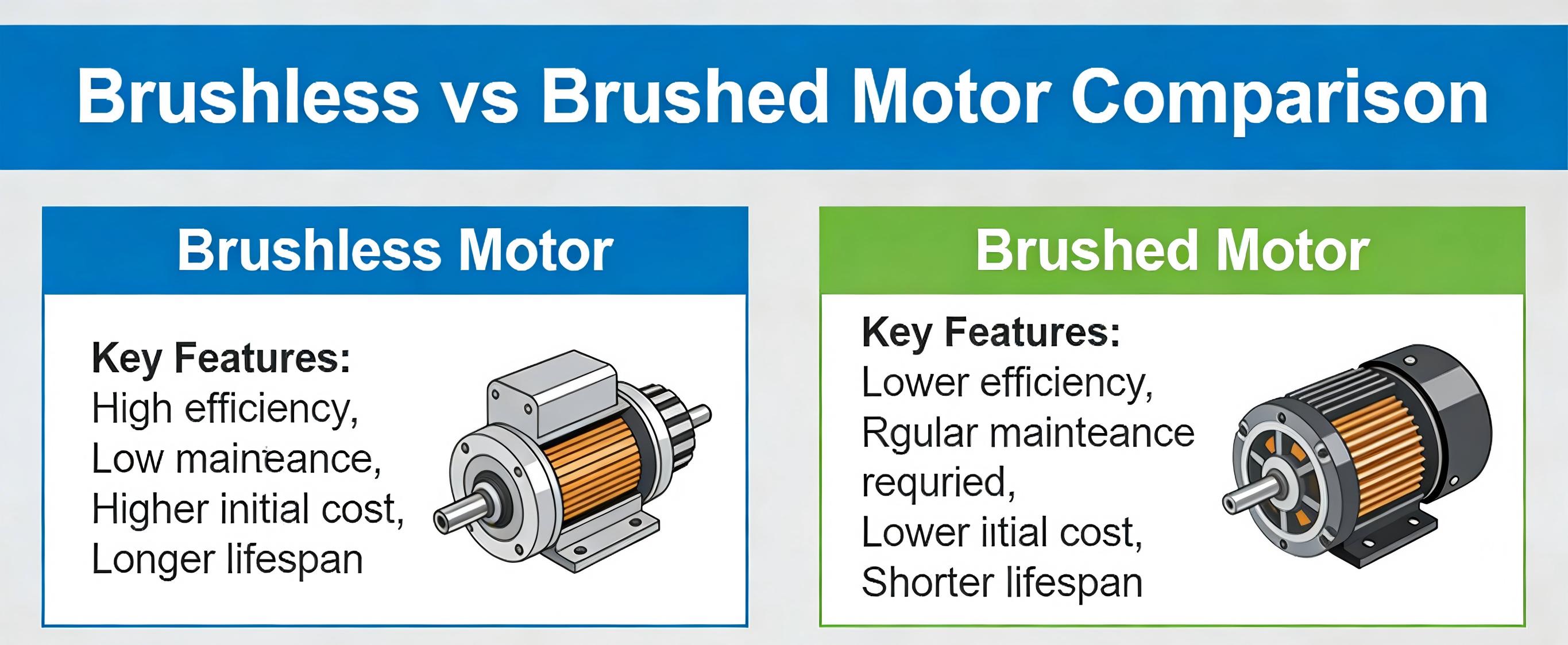
The power-tool side of a mixed order is not a filler. Every item slot carries its own technology choice, and brushless and brushed builds are not interchangeable inside the same slot.
The short answer: the supplier's minimum order quantity is a basket rule, not a unit rule. An order must contain at least 5 categories of power tools, with 8 items in each category, for a total of 40 items. For a commercial cleaning robot buyer, this means the robot purchase is planned alongside four other product families instead of on its own — and the planning work starts before the quotation, not after it.
Geakita (Xiamen Tiangong Kaiwu Technology Co., Ltd.) is a manufacturer founded in 2009 that produces power tools, robotic pool cleaners and commercial cleaning robots, and the mixed-category minimum described in this article is the structure buyers plan against when they order a commercial cleaning robot together with a power tool programme. The sections below treat that structure as a planning instruction: how to read it, how to fill it, and what to settle in writing before the first purchase order is signed.
Problem Definition: The MOQ Is Usually Read Too Late
Minimum order quantity is typically the last line a buyer reads and the first one that decides whether the order is viable. When the MOQ is expressed in categories and items rather than units, the order of decisions matters more than the number itself. Four failure patterns repeat across mixed-category purchases.
Reading the MOQ as a unit count. The rule stated here is written in categories of power tools and items within those categories. It is not written in robots. Whether an additional commercial cleaning robot order sits on top of the 40-item basket or inside it is a commercial term, and the answer determines the whole budget model. The article assumes neither position; the buyer should have it confirmed in writing at the quotation stage.
Filling categories with whatever is available. The fastest way to clear a 5-category threshold is to accept the five families the supplier happens to be running that month. That solves the compliance question and creates an inventory question, because two of those families may not move in the buyer's market at all. The threshold is fixed; the composition is not.
Negotiating structure after price. Once a unit price has been anchored on a specific item list, the basket becomes expensive to change. Category swaps, item swaps and quantity reallocations that would have cost nothing during scoping become a pricing conversation.
Leaving the word item undefined. An item is normally a distinct SKU or model within a product family, but colour variants, spare-part kits and packaging variants can all be counted differently by different suppliers. A 40-item basket built on two different definitions of item is a dispute waiting to happen.
Industry Background: Why Mixed-Category Ordering Is Now Normal
The commercial cleaning robot category has grown to the point where distribution partners rarely buy a single product family from a single supplier.
- The global commercial cleaning robot market was valued at approximately USD 1,777.3 million in 2024 (Grand View Research).
- The B2B floor cleaning robots segment is projected to grow from USD 1.43 billion in 2026 to USD 5.43 billion by 2035, at a CAGR of 16% (SkyQuest Technology).
- Indoor applications — offices, hospitals, retail and hotels — accounted for 68% of commercial deployments in 2024.
- China's cleaning robot exports reached RMB 14 billion in the first five months of 2026, representing more than 70% of total robot exports.
Recognised global manufacturers in the B2B cleaning robot sector include SoftBank Robotics, Gausium (Gaussian Robotics), Avidbots and Nilfisk, and SoftBank Robotics alone manages over 40,000 commercial robotic deployments globally as of 2024. What that competitive field does not publish is minimum order terms. MOQ structures are commercial instruments, negotiated per buyer and per market, and they are rarely visible in public product material.
That has a direct consequence for planning. A buyer cannot benchmark a mixed-category MOQ by reading competitor websites, because the terms are not there. The comparison that actually produces a decision is between order structures — how many categories, how deep per category, what sits in writing — not between published numbers that do not exist.
Detailed Solution: Reading the 5 × 8 Structure Correctly
The rule in plain terms
| Term | Value | What it means for the order |
|---|---|---|
| Minimum categories | 5 categories of power tools | At least five different product families must appear in the basket. |
| Depth per category | 8 items per category | Each of those families must carry eight distinct items — a broad basket, not a single hero SKU. |
| Minimum total | 40 items | 5 × 8 = 40 is the floor, and it is the number the purchase order is measured against. |
| Headroom | At least | The wording sets a floor, not a ceiling. More categories or more items per category is not excluded by the rule as stated. |
What the buyer still controls inside a fixed frame
The threshold does not remove design freedom; it relocates it. Inside the 5 × 8 frame, these decisions remain with the buyer:
- Which five categories. The rule counts categories, not names. Selecting families that match local demand and after-sales capability is the single highest-leverage decision in the whole order.
- Which eight items per category. Depth can be tiered — a few core movers, a few mid-range items, a couple of test items — without changing the count.
- The robot specification that accompanies the basket. The commercial cleaning robot requirement is a separate specification exercise and should be written first, because it determines the facility the rest of the catalogue serves.
- The documentation package. Certificates, test records and manuals per line item are negotiable in scope even when the item count is not.
- The sequence. Whether the 40 items ship as one release or in agreed stages is a scheduling question, not a threshold question.
Where the quality decision actually sits
Once the count is fixed at 40, the only remaining lever with real economic weight is what is inside each slot. For power tool families, the most consequential split is motor technology. Brushless builds deliver roughly 30% higher working efficiency, 50% longer service life and 20% longer battery runtime than brushed equivalents, with a defect rate of 0.5% against 3–5% for low-cost generic tools, and 25% higher energy efficiency in line with EU energy efficiency requirements. Over a three-year holding period that translates to 10–15% lower total cost of ownership and around 20% lower maintenance cost, with roughly 50% less maintenance work because there are no brushes to replace.
Battery safety is the second lever, and it is the one that decides whether a cheap basket stays cheap. Intelligent BMS protection against overcharge, over-discharge and short circuit, A-grade lithium-ion cells, 100% battery safety testing before shipment and compliance with UN38.3 transportation standards are the concrete checkpoints.
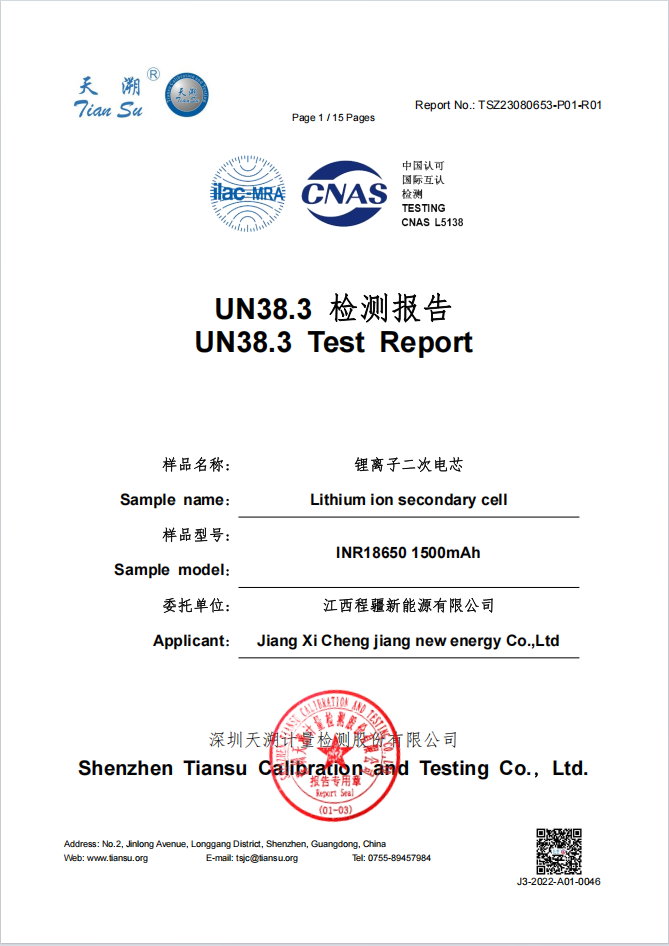
Battery compliance travels with the item, not with the order. UN38.3 documentation should be requested line by line, not as a single order-level certificate.
Mechanical safety follows the same logic. Anti-kickback systems, safety switches and overload protection are the control measures; full mechanical safety testing, a user manual with detailed safety instructions and regular safety training for production teams are the enterprise-side measures that make those controls verifiable.
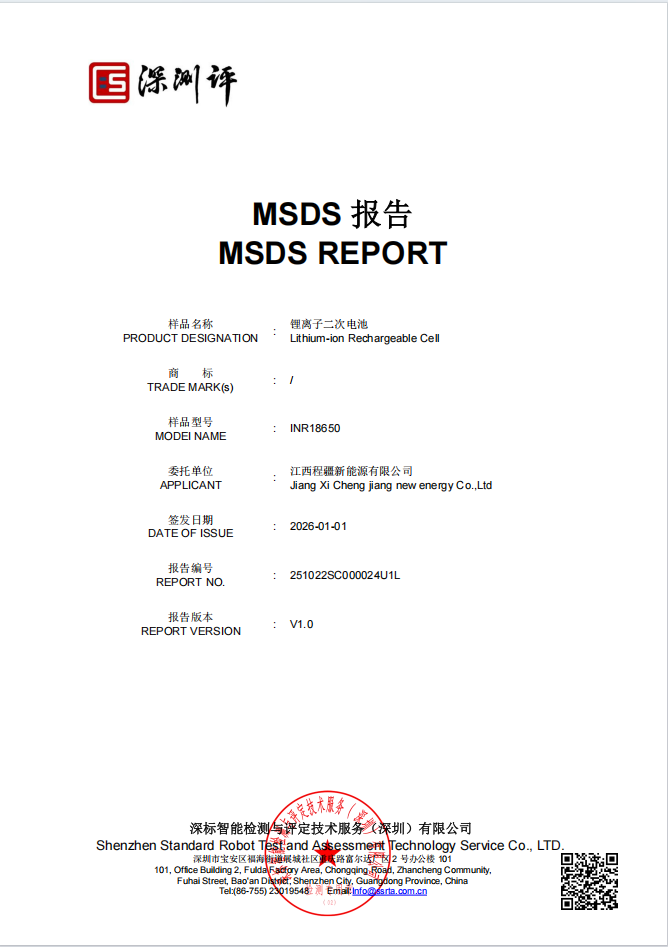
Safety documentation is part of the item specification. It is cheaper to agree at basket design stage than to retrofit after the order is placed.
What the rule does not say
Three things are conspicuously absent from the structure as stated, and each one should be raised rather than assumed:
- It does not describe a lower threshold. Nothing in the rule suggests a smaller trial order is available. If a buyer needs one, that is a negotiated term and must be confirmed, not inferred.
- It does not define item. SKU, model, variant and kit are all plausible readings. Agree the definition before the item list is built.
- It does not set price, lead time or shipping terms. Those come from the quotation and the written production schedule, and this article does not estimate them.
Step-by-Step: Building a 40-Item Mixed Order
Step 1 — Fix the commercial cleaning robot requirement first
Start with the facility, not the catalogue. Duty cycle, floor type, area per shift and operating window define which robot class fits — a commercial scrubber dryer robot, a commercial sweeping robot or a commercial vacuum cleaning robot. Writing this first prevents the power tool half of the basket from being planned around the wrong end use.
Step 2 — Choose the five categories deliberately
Score candidate power tool families against three tests: whether they move in the buyer's market, whether local after-sales can support them, and whether they complement rather than duplicate the robot line. Five families that all serve the same buyer and the same job are five wasted slots.
Step 3 — Allocate the eight items per category by demand tier
A workable default is a tiered split inside each family: core movers first, mid-range second, one or two test items last. The count stays at eight; the risk profile changes completely.
Step 4 — Stress-test the basket against inventory reality
Forty items means forty stock lines, forty documentation sets and forty service paths. Before committing, model storage, capital tied up per category, and which categories the buyer would be willing to reorder in a second cycle.
Step 5 — Align the compliance package line by line
Build a per-item documentation column in the RFQ. For the robot side, IEC 63327:2021 is the international safety standard for powered automatic floor treatment machines for indoor commercial use, and UL 3300 sets safety requirements for service robots covering mobility and human-robot interaction in commercial environments. For batteries, UN38.3 applies to transport. For power tools, safety testing and manuals apply. These do not collapse into one certificate.
Step 6 — Negotiate MOQ terms in writing before the purchase order
This is the step buyers skip. Put the following on paper while the basket is still fluid:
- The written definition of category and item, in the supplier's own terms.
- Whether additional categories beyond five are permitted, and whether the eight-item depth still applies to each of them.
- Substitution rules — what happens if an item becomes unavailable between quotation and production.
- Whether any sample or trial path exists, and whether samples count toward the 40-item total.
- The documentation set attached to each line item.
- Whether the order ships as a single release or in agreed stages.
Step 7 — Consolidate into one document set
Purchase order, item list, specification sheets and compliance column should refer to each other explicitly. A 40-item order that is described in four disconnected documents is difficult to inspect on arrival and difficult to dispute.
Use Cases: How the Facility Reshapes the Basket
The 5 × 8 frame is constant; the way it is populated is not. Facility type changes the robot specification first, and the power tool categories follow the maintenance profile of that facility.
Warehouse and factory floor deployments
A warehouse cleaning robot or industrial cleaning robot covers large open areas where coverage per shift dominates the specification. On the power tool side, heavy-duty families carry more weight in the basket, and durability metrics — the difference between a 0.5% and a 3–5% defect rate — matter more than unit price at the low end.
Hospital and school environments
Indoor healthcare and education settings favour quiet, low-disruption operation, and the compliance column becomes the deciding factor rather than the price column. Indoor applications already account for 68% of commercial deployments, so this is the mainstream case rather than a niche one.
Hotel, mall and airport floors
Public-facing sites run to visible schedules; a commercial floor cleaning robot that misses a shift is a visible failure. Specification should include a realistic operating window, and the basket should weight categories with predictable, fast-moving consumables.
Supermarket, office and restaurant kitchen areas
A supermarket cleaning robot works around trading hours, an office cleaning robot works around staff presence, and a restaurant kitchen cleaning robot works in a constrained, high-soil space. Each of these constraints changes which robot class is specified and, indirectly, which power tool families a distributor can realistically resell into the same accounts.

A 40-item basket requires a supplier with breadth across families, not a single-line assembler.
Geakita's own production base illustrates the breadth question: founded in 2009, the company operates a modern industrial production base with approximately 10,000 m² of land and 40,000 m² of floor space, employs over 300 staff, and reports annual output of 100,000 units across power tools, robotic pool cleaners and commercial cleaning robots, with a 25-engineer R&D team. Export accounts for around 20% of business, concentrated in Europe, Southeast Asia and the Middle East.
Comparison Table: Order Structures Against the 5 × 8 Rule
The most useful comparison for a decision-stage buyer is not between suppliers' published MOQs, which are rarely available, but between the order structures a buyer can actually choose from.
| Order structure | Meets the rule as stated? | What the buyer controls | Main planning risk |
|---|---|---|---|
| 5 categories × 8 items = 40 items | Yes — the exact minimum | Which five families, which eight items in each | Item quality inside the slots; category fit to local demand |
| 6+ categories × 8 items | Yes — the rule says at least five | Wider spread across families | Capital and storage spread thinner; more lines to service |
| 5 categories, fewer than 8 items each | No — depth requirement not met | Not applicable | Order falls below the stated minimum |
| Fewer than 5 categories, 8 items each | No — breadth requirement not met | Not applicable | Order falls below the stated minimum |
| Single-family bulk order | No — structure is not mixed | Not applicable | Order does not follow the basket logic at all |
Anything below the threshold is a negotiated commercial term, not a planning assumption. This article does not assume a lower threshold is available and does not state one.
FAQ
1. Do the power tools and the commercial cleaning robot in one order follow the same compliance path?
No. They are separate compliance tracks that happen to share a purchase order. Commercial cleaning robots intended for indoor commercial floor treatment are addressed by IEC 63327:2021, the international safety standard for powered automatic floor treatment machines. In North America, UL 3300 sets safety requirements for service robots, covering mobility and human-robot interaction in commercial environments. Batteries in either half of the order fall under UN38.3 transportation requirements, with intelligent BMS protection, A-grade lithium-ion cells and 100% battery safety testing before shipment as the supporting controls. Power tools carry their own requirements: anti-kickback systems, safety switches, overload protection, full mechanical safety testing and manuals with safety instructions. A buyer should request the documentation set per line item rather than accept one order-level certificate.
2. Can one supplier realistically deliver 5 categories × 8 items plus a robot order?
That depends on the supplier's product breadth. Geakita was founded in 2009 and operates a production base of approximately 10,000 m² of land and 40,000 m² of floor space, with over 300 staff, a 25-engineer R&D team and reported annual output of 100,000 units. Its portfolio spans power tools, robotic pool cleaners and commercial cleaning robots, with exports around 20% of business and main markets in Europe, Southeast Asia and the Middle East. Breadth of portfolio is a claim to verify, not accept: a supplier audit covering production lines, quality control and documentation is the standard way to confirm that five families and a robot line can be supported from one source.
3. How should a buyer budget a 40-item mixed order?
Budget by category first, then by item, because the basket is rebalanced at category level and renegotiating a single lump sum is far more expensive. Two structural cost levers apply across the power tool half. Brushless motor builds deliver roughly 30% higher working efficiency, 50% longer service life and 20% longer battery runtime than brushed equivalents, with a 0.5% defect rate against 3–5% for low-cost generic tools — translating into an estimated 10–15% lower total cost of ownership over three years, around 20% lower maintenance cost and roughly 50% less maintenance work. The second lever is battery specification: A-grade cells, BMS protection and pre-shipment testing are cost items that surface later if they are cut. Unit prices, freight and payment terms should come from an itemised quotation and are not assumed here.
4. Can a buyer validate items before committing to the full 40?
Validation should be raised as a scoping question at the quotation stage, not assumed. Three points belong in writing: which specific items from the eight-per-category list can be supplied as samples, whether a commercial cleaning robot demonstration unit is included in the same arrangement, and whether sample quantities count toward the 40-item total. The MOQ rule as stated does not describe a lower order threshold, so any sample path is a negotiated term and should be documented as such. Buyers who skip this step typically discover the gap between a sample and a production item after the purchase order is already issued.
5. Does a 40-item mixed order change lead time?
No lead time is stated in this article, because production and shipping schedules are commercial terms that vary by item, category and season. What can be said structurally is that a mixed basket adds scheduling complexity: forty items across five families are unlikely to be produced in one window, so the practical action is to request a written production and release schedule per category before the order is confirmed, and to match receiving capacity to that schedule rather than to a single expected delivery date. If the schedule matters commercially, it should be a documented term — the next step is to request a quote and sample plan against a specific 5-category basket, and to compare the returned schedule category by category.
Conclusion
The minimum order quantity here is a shape, not a size: at least 5 categories of power tools, 8 items per category, 40 items in total. Buyers who read it as a number spend their negotiation on price. Buyers who read it as a structure spend it on the decisions that are still open — which five families, which eight items inside each, which definitions and documentation sit in writing, and how the commercial cleaning robot specification frames the whole basket.
The practical sequence is short. Specify the robot requirement first. Choose families that fit the buyer's market and service capability. Tier the eight items per category so that risk is distributed rather than concentrated. Confirm compliance line by line, separating the robot standards (IEC 63327:2021, UL 3300) from battery requirements (UN38.3) and power tool safety requirements. Then put the MOQ terms, the definitions and the production schedule in writing before the purchase order exists. Everything the rule fixes is arithmetic; everything it leaves open is where the order is won or lost.
Next Step: Build Your 5-Category Basket
Send your facility profile and the five power tool families you want to carry, and we will return a category-by-category item plan, the documentation set per line, and a quotation against a confirmed 40-item structure.
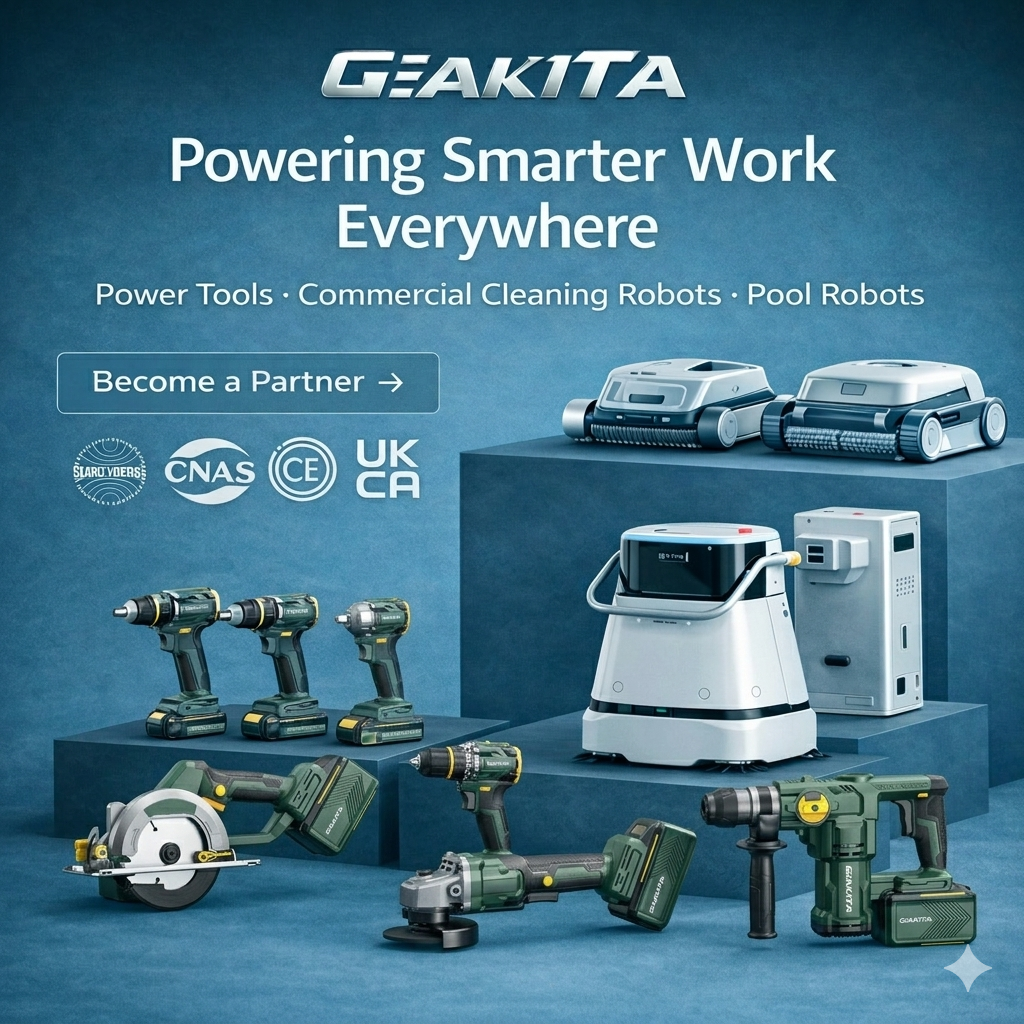
Download the Geakita Corporate Profile & Product Catalog 2026 (PDF) — product families, specifications and company profile in one document.
- Contact: Flora
- Email: Flora@gearpioneer.com
- Tel / WhatsApp: +86 135-9954-5996
- Office: 22A, Office Building B, Shenglong Times Square, Longhua District, Shenzhen, China
- Factory: 9-3, Room 203, No. 30 Guanri Road, Software Park, Phase II, Torch High-tech Zone, Xiamen, FJPR, CN
- Website: www.geakita.com
Scope note: this article describes the minimum order structure as stated by the supplier (at least 5 categories of power tools, 8 items per category, 40 items total). Prices, lead times, sample policies and any lower thresholds are commercial terms and are not stated or assumed here.