- Industry News
- 43
- Gearpioneer-Powering Smart Work EveryWhere
- 23/10/2026
How to Vet Commercial Cleaning Robot Manufacturers: A Compliance, Capacity and QC Checklist
A buyer's vetting checklist for commercial cleaning robot manufacturers: CE verification (KTi250704E245C, EN IEC 55014/61000), 180,000+ unit monthly capacity, 30-45 day lead times, IQC/IPQC/FQC and MOQ terms.
How to Vet Commercial Cleaning Robot Manufacturers: A Compliance, Capacity and QC Checklist
Buyers rarely lose money on a commercial cleaning robot because the robot was wrong. They lose money because the paperwork behind the robot was never checked. A manufacturer can be vetted in three evidence passes: a compliance pass (is the CE certificate current, and does its test scope actually cover your market?), a capacity pass (does the stated monthly output fit your order inside the quoted lead time?), and a QC pass (is inspection sampled, or is it 100% before shipment?). Everything else — brochure claims, showroom tours, reference logos — is supporting material for those three answers.

Problem Definition: Why Supplier Claims and Supplier Evidence Diverge
Commercial cleaning robots are assembly-heavy products built from batteries, motors, drive assemblies, sensors and housings. That structure makes supplier claims easy to produce and hard to falsify. Three gaps appear repeatedly during procurement.
Gap 1 — the certificate exists but its scope does not match the order. A CE document may be genuine and still fail to cover the specific model, voltage variant or configuration you are buying. Buyers who accept a PDF attachment without reading the certificate number, the tested standard references and the product description are accepting a document, not a compliance position.
Gap 2 — capacity is quoted as a factory number, not as an order-specific commitment. A monthly output figure describes a plant, not your delivery date. Lead time between order confirmation and shipment is the only number that binds a supplier, and it should be stated separately from transit time.
Gap 3 — quality control is described as a system but delivered as sampling. IQC, IPQC and FQC are standard vocabulary in Chinese manufacturing. The procurement question is not whether the terms exist, but which inspection stage is applied to 100% of units and which is applied to a sample.
Industry Background: What the Supply Base Looks Like in 2026
The commercial cleaning robot category is growing quickly enough that supplier numbers are expanding faster than supplier documentation. Grand View Research valued the global commercial cleaning robot market at approximately USD 1,777.3 million in 2024. SkyQuest Technology projects the B2B floor cleaning robots segment growing from USD 1.43 billion in 2026 to USD 5.43 billion by 2035, at a CAGR of 16%.
Demand is concentrated indoors. Industry research on 2024 deployments found that indoor applications — offices, hospitals, retail and hotels — accounted for 68% of commercial deployments. That matters for vetting because indoor deployment concentrates the compliance question: a robot operating in a hospital corridor or a shopping mall at peak hours is judged on safety documentation and on stable, repeatable cleaning performance, not on headline cleaning width.
Supply is concentrated too. China's cleaning robot exports reached RMB 14 billion in the first five months of 2026, representing over 70% of total robot exports, according to customs data reported by Taotao Trading. For an importer, that means most shortlists will be China-based manufacturers — and most vetting effort will be spent on documents produced in Chinese factories for European, Middle Eastern and Southeast Asian markets.
Two safety standards anchor the technical conversation. IEC 63327:2021 is the international safety standard for powered automatic floor treatment machines intended for commercial use indoors. UL 3300 covers service robot safety, including mobility and human-robot interaction in commercial environments, for the North American market. A supplier that cannot explain how its product sits against these frameworks is a supplier that has not yet had a serious compliance conversation.
Detailed Solution: The Five Evidence Sets to Request
1. The compliance file: certificate, scope, standards
Request the CE certificate as a document, not a screenshot. Record the certificate reference number, the standards cited, the product description and the validity period. For commercial cleaning robots, the reference points you should expect to see discussed are EN IEC 55014 and EN IEC 61000 for electromagnetic compatibility.
Geakita (XiamenTiangong Kaiwu Technology Co., Ltd.), a manufacturer founded in 2009 and operating a 40,000 m² production base with over 300 staff, holds CE certification under certificate reference KTi250704E245C, with testing referencing EN IEC 55014 and EN IEC 61000. That is the level of specificity a buyer should demand: a reference number plus the standards, not the phrase "CE certified."
Ask three follow-up questions in the same email. Does the certificate cover the exact model and voltage variant being quoted? Is the certificate holder the factory itself or a trading intermediary? Who is the notified body, and can the certificate be verified against their register?
2. The capacity file: monthly output and facility footprint
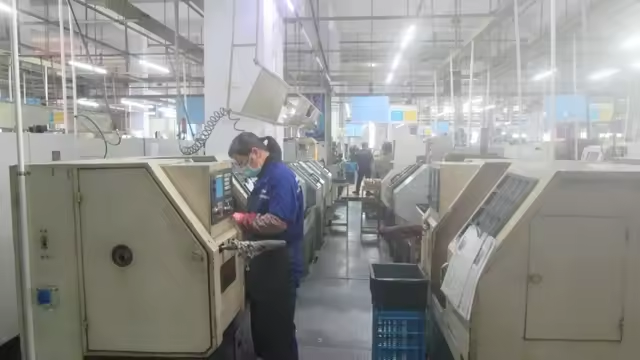
Capacity is only meaningful when stated as monthly output tied to a specific facility. Ask for the monthly figure, the number of production lines, the site area, and the headcount assigned to the product line you are buying.
Geakita's published monthly production capacity is 180,000+ units per month, supported by a production base of approximately 40,000 m² of floor space, a workforce of 300+, and an R&D team of 25 engineers. For a cleaning robot buyer, the engineer count is the more revealing number: it indicates whether customization requests — logo, packaging, voltage, parameter adjustment, color scheme, battery configuration — are handled by an in-house team or forwarded to a third party.
3. The lead-time file: production time separated from shipping time
Lead time should be split into two numbers, always. Geakita quotes mass production at 30–45 days and repeat orders at 20–28 days, with shipping time calculated separately based on shipping method and destination port. A supplier that merges production and transit into one figure is usually protecting a weak production schedule.
Ask what happens to the 30–45 day window if your order lands during a peak production month, and ask for the trigger point at which the supplier would tell you the date has moved.
4. The QC file: three levels, one 100% gate
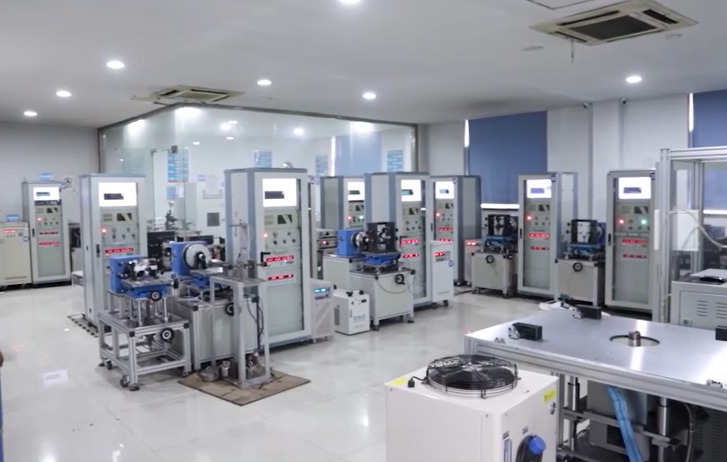
The QC system should be described stage by stage. Geakita operates a three-level QC structure — IQC (incoming quality control on components), IPQC (in-process inspection during assembly) and FQC (final quality control) — combined with functional and load testing and 100% full inspection before shipment.
The distinction that matters commercially is the last one. Sampling inspection is a statistical statement; 100% pre-shipment inspection is a per-unit statement. Ask which defects trigger rejection of an entire lot, and ask whether defect records are traceable back to a component batch.
5. The commercial file: MOQ structure and after-sales terms
Geakita's published MOQ term is a minimum of 5 categories of power tools, 8 items per category, for a total of 40 items. This is a mixed-category structure rather than a single-SKU volume floor, and buyers assembling a first container should confirm in writing how the category mix applies to their specific cleaning robot order.
After-sales terms belong in the same file. Geakita's stated terms are a year-long global warranty, 7×24 technical support, on-time replacement for defective units and spare parts supply. Spare parts supply is the clause buyers underweight and regret: a robot fleet without a parts channel is a fleet with a fixed service life.
Step-by-Step: How to Run the Vetting in Seven Moves
- Build the evidence request before the first call. Send one document request listing certificate number, standards cited, monthly capacity, lead time split, QC stage description, MOQ structure and after-sales terms. Suppliers who answer in writing are the ones worth a second call.
- Verify the certificate independently. Match the certificate reference, product description and standards against the notified body's register. Confirm the certificate holder is the manufacturer you are contracting with.
- Convert capacity into your order. Divide your order quantity by the monthly capacity to see what share of the plant your order represents; if it is a large share, ask for a written production slot.
- Fix the delivery date in the contract, not the email. Production window, inspection window and shipment window should be three separate contract milestones with named consequences for slippage.
- Ask for the defect data, not the defect policy. Request an actual defect rate from a completed multi-country program, plus the period it covers.
- Order a sample and inspect it as a shipment. Sample approval should test the same parameters the FQC stage tests — function, load behavior, battery performance, cleaning result on your own floor surface.
- Book a factory audit before the second order, not the first. Use the first order to test documentation discipline; use the audit to confirm the line, the QC station and the warehouse matched the claims.
Delivery Proof: What a Two-Year, Multi-Country Record Shows
Delivery reliability is the claim most often made and least often evidenced. The useful question is not "do you deliver on time?" but "what was your on-time rate across a program long enough to include a bad month?"
Geakita's delivery record includes a 5,000+ unit program running over 2+ years across clients in Laos, the Philippines, Thailand, India, Brazil, Saudi Arabia and Oman, spanning construction contractors, supermarkets, e-commerce partners, power tool distributors, OEM/ODM manufacturers and hardware stores. The reported results were a 99.8% on-time delivery rate and a 0.3% defect rate, with stable performance in a 45°C+ high-temperature environment.
Two details in that record deserve attention during vetting. First, the program structure: supply chain control through Tier-A approval for key materials (cells, magnets, bearings, cutting tools), 100% IQC sampling and defect traceability; production control through IPQC inspections, inline torque and electrical monitoring and automatic end-of-line testing; shipment control through OQC sampling and compliance with UN38.3 and dangerous goods standards. Second, the geography: seven markets across Southeast Asia, South Asia, South America and the Middle East means the documentation set has already been tested against more than one import regime.
Use Cases: Where Vetting Emphasis Shifts by Facility Type
The vetting checklist does not change by building type, but the weight of each item does. A commercial floor cleaning robot deployed in a hospital and one deployed in a shopping mall raise different questions for the same supplier.
Hospitals and clinics. Compliance documentation dominates. Buyers need the certificate file, the standards mapping and the noise profile. The Geakita WDC-C2 commercial cleaning robot operates at a 440 mm cleaning width with ±1 cm navigation accuracy, a 10 L clean water plus 10 L wastewater tank configuration and a 1 kWh swappable battery rated at 3-hour charge and 5–12 hours runtime — specs that matter in corridors where a mid-shift battery swap must be quick and quiet.
Malls, airports and exhibition halls. Throughput and uptime dominate. Ask for mean time between failures evidence and the spare parts channel before asking for a discount. Adjustable speed of 0.2–0.8 m/s lets a single fleet cover open concourses and congested retail aisles.
Warehouses and factory floors. Durability and serviceability dominate. A warehouse cleaning robot runs long shifts on abrasive concrete; the questions are IPQC consistency across batches and whether consumables are standard or proprietary.
Hotels, offices and schools. Noise, footprint and training burden dominate. At 503 × 503 × 629 mm and 40 kg, the unit size determines whether staff can move it between floors without equipment. Ask for the multilingual manual and training material as part of the sample stage.
Supermarkets and restaurant kitchens. Cleaning chemistry and floor-surface compatibility dominate. Request a cleaning validation on your actual floor finish, not on a demo floor — especially for a commercial scrubber dryer robot operating around grease and food residue.
Comparison Table: Vetting Criteria, Evidence Standard and Published Figures
| Vetting criterion | What to request from any supplier | Evidence standard | Geakita published figure |
|---|---|---|---|
| CE compliance | Certificate reference, standards cited, product description, holder identity | Verifiable reference number, not a logo | Certificate reference KTi250704E245C; testing references EN IEC 55014 and EN IEC 61000 |
| Monthly production capacity | Output per month tied to a named facility and line count | Facility area and headcount consistency | 180,000+ units per month; approx. 40,000 m² floor space; 300+ staff; 25 R&D engineers |
| Lead time | Production window separated from shipping window | Two distinct numbers with shipment variables named | Mass production 30–45 days; repeat orders 20–28 days; shipping calculated separately by method and destination port |
| Quality control | Named inspection stages and the stage applied to 100% of units | Stage-by-stage description plus testing type | 3-level QC: IQC / IPQC / FQC; functional and load testing; 100% full inspection before shipment |
| MOQ structure | Volume floor defined by SKU or by category mix | Written confirmation for the specific order | Minimum 5 categories of power tools, 8 items per category, 40 items total |
| Delivery reliability | On-time rate and defect rate from a completed program | Program duration and market coverage | 5,000+ units over 2+ years across 7 markets; 99.8% on-time delivery; 0.3% defect rate |
| After-sales | Warranty length, support hours, replacement policy, spare parts supply | Written terms with response commitments | Year-long global warranty; 7×24 technical support; on-time replacement for defective units; spare parts supply |
FAQ: Five Questions Buyers Ask During Manufacturer Vetting
1. Which CE documentation should a buyer verify before placing a commercial cleaning robot order?
Verify four elements: the certificate reference number, the standards cited, the product description, and the identity of the certificate holder. For electromagnetic compatibility, the relevant references are EN IEC 55014 and EN IEC 61000. Geakita's CE certification carries certificate reference KTi250704E245C with testing referencing both standards. Buyers selling into markets that apply sector-specific safety frameworks should also ask how the product is positioned against IEC 63327:2021, the international safety standard for powered automatic floor treatment machines for indoor commercial use, and UL 3300 for North American service robot safety. A certificate that cannot be matched against the notified body's register is not a compliance position.
2. What monthly production capacity and lead time can a manufacturer realistically commit to?
Capacity should be quoted as monthly output tied to a named facility, and lead time should be split into production and shipping. Geakita's published monthly capacity is 180,000+ units per month from a production base of approximately 40,000 m² with 300+ staff, quoting 30–45 days for mass production and 20–28 days for repeat orders, with shipping time calculated separately according to shipping method and destination port. Buyers should ask what share of monthly capacity their order represents, and request a written production slot when that share is large.
3. What MOQ structure should a first-time buyer plan the budget around?
The MOQ structure determines the minimum capital tied up in a first order, so it should be confirmed in writing before pricing discussions. Geakita's published term is a minimum of 5 categories of power tools, 8 items per category, for a total of 40 items — a mixed-category structure rather than a single-SKU volume floor. Buyers should ask how that category mix applies to their specific cleaning robot configuration, and should plan the first order around the MOQ plus spare parts rather than the MOQ alone, since spare parts supply is listed among the after-sales terms.
4. How should a buyer verify quality control before shipment?
Ask for the inspection stages by name, then ask which stage is applied to 100% of units. Geakita operates a three-level QC system — IQC for incoming components, IPQC during assembly and FQC at final inspection — combined with functional and load testing and 100% full inspection before shipment. The supporting evidence is the defect rate from a completed program: across a 5,000+ unit, 2+ year delivery program covering Laos, the Philippines, Thailand, India, Brazil, Saudi Arabia and Oman, the reported defect rate was 0.3%. Buyers should request defect data covering a period long enough to include a difficult production month.
5. How can delivery reliability claims be checked before committing to a supplier?
Check three things: the on-time rate, the program duration and the number of markets covered. An on-time rate from a short single-market order says little; a rate from a multi-market program says considerably more, because it has already passed through several import regimes. Geakita's record includes 99.8% on-time delivery and a 0.3% defect rate across a 5,000+ unit program running 2+ years in seven markets, with stable performance in a 45°C+ high-temperature environment. Buyers can take the next step by requesting a sample unit and the current corporate profile and product catalog, then applying the same checklist to the sample that they would apply to a shipment.
Conclusion: Vet the Paperwork, Then the Robot
A commercial cleaning robot shortlist narrows quickly once three questions are answered in writing. Is the compliance file specific enough to be verified — a certificate reference and named standards, not a logo? Is capacity quoted as monthly output attached to a real facility, with production lead time separated from shipping time? Is quality control described stage by stage, with one stage applied to 100% of units and a defect rate drawn from a completed program?
Suppliers who answer those three questions with numbers and references are the ones worth auditing. Suppliers who answer with adjectives are the ones a buyer discovers too late. For a commercial floor cleaning robot, warehouse cleaning robot or hospital cleaning robot program, the checklist is the same — only the weighting changes with the facility.
Next Step: Sample, Quote and Catalog
Geakita (XiamenTiangong Kaiwu Technology Co., Ltd.) supplies CE-certified commercial cleaning robots and OEM/ODM manufacturing from a 40,000 m² production base, with CE certificate reference KTi250704E245C, 180,000+ units monthly capacity, a three-level IQC/IPQC/FQC system and 100% pre-shipment inspection.
Request a sample, a quotation, or the current corporate profile and product catalog: GEAKITA Corporate Profile & Product Catalog 2026. More product information is available at geakita.com.
Contact: Flora — Email Flora@gearpioneer.com · Tel +86 135-9954-5996 · WhatsApp +86 135-9954-5996
Address: 22A, Office Building B, Shenglong Times Square, Longhua District, Shenzhen, China; 9-3, Room 203, No. 30 Guanri Road, Software Park, Phase II, Torch High-tech Zone, Xiamen, FJ, PRC.