
- Industry News
- 458
- Gearpioneer-Powering Smart Work EveryWhere
- 22/06/2026
Beyond the Brochure: A Practical Framework for Evaluating Cordless Power Tool Suppliers in 2026
A comprehensive framework for evaluating cordless power tool suppliers, covering manufacturing capacity, quality control, certifications, customization, and after-sales support. Featuring Geakita as a proven partner.
Beyond the Brochure: A Practical Framework for Evaluating Cordless Power Tool Suppliers in 2026
When sourcing cordless power tools for your distribution network or project, glossy product catalogs and attractive price lists can be misleading. The true measure of a supplier lies in its manufacturing capability, quality assurance, certification compliance, and ability to deliver consistent performance under real-world conditions. This guide provides a structured framework to help industrial buyers, procurement managers, and distributors evaluate cordless power tool suppliers beyond the brochure.
Introduction
The global cordless power tool market continues to expand, driven by demand for portability, efficiency, and battery technology advancements. However, the abundance of suppliers—from small workshops to large OEMs—creates a challenge: how do you identify a partner that can meet your quality standards, customization needs, and delivery timelines? This article presents a systematic approach to supplier evaluation, using a real-world example from Geakita (Xiamen Tiangong Kaiwu Technology Co., Ltd.), a leading Chinese manufacturer with over 300 employees and a 40,000 m² production base.
What Is Cordless Power Tool Supplier Evaluation?
Cordless power tool supplier evaluation is the process of assessing a manufacturer’s ability to produce, certify, and support cordless power tools—including impact wrenches, angle grinders, drills, screwdrivers, rotary hammers, and more—according to specific technical, commercial, and compliance requirements. It involves examining production capacity, quality control systems, certification documentation, customization flexibility, after-sales service, and proven track record with similar buyers.
Why a Structured Evaluation Matters
- Risk Reduction: Avoids costly recalls, delayed shipments, and performance failures.
- Cost Optimization: Identifies suppliers with lower total cost of ownership through higher efficiency and lower defect rates.
- Market Compliance: Ensures products meet CE, UKCA, CMA, and other target market regulations.
- Scalability: Confirms the supplier can handle volume growth and customization demands.
Industry Background
Cordless power tools are used across construction, automotive repair, manufacturing, agriculture, and DIY segments. Key product categories include impact wrenches (e.g., 21V brushless impact wrench with 650 Nm torque), angle grinders (21V, 100mm disc, 12000 RPM), circular saws, cordless rotary hammers, and drills. Leading suppliers differentiate through brushless motor technology, pure copper windings, high-capacity lithium-ion batteries (1300–2000mAh), and global certifications. The shift from brushed to brushless motors has improved efficiency by 25% and reduced maintenance by 50%.
Detailed Solution: A Five-Dimension Evaluation Framework
1. Manufacturing Capability & Capacity
A supplier’s production scale directly impacts lead time and consistency. Look for:
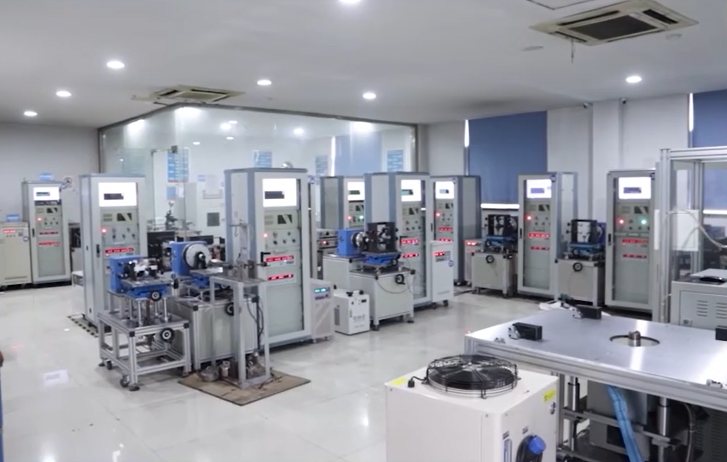
- Factory size and equipment (e.g., modern workshops, automated lines).
- Monthly capacity (e.g., 180,000+ units/month for Geakita).
- Workforce and R&D team (25 engineers, 300+ staff).
- Lead time: mass production 30–45 days; repeat orders 20–28 days.
2. Quality Control System
Effective QC prevents defects. Geakita implements a 3-level QC (IQC/IPQC/FQC) with 100% pre-shipment inspection. Key indicators:
- Defect rate: 0.5% vs. industry average 3–5%.
- Battery safety: A-grade cells, intelligent BMS, UN38.3 compliance.
- Mechanical safety: anti-kickback, overload protection, full safety testing.
| Parameter | Geakita | Low-Cost Generic |
|---|---|---|
| Motor Type | Brushless Pure Copper | Brushed / Copper-wound |
| Efficiency | 25% higher | Standard |
| Defect Rate | 0.5% | 3–5% |
| Maintenance | 50% less (no brush replacement) | Regular brush service needed |
| TCO over 3 years | 10–15% lower | Higher due to repairs |
3. Certification & Compliance
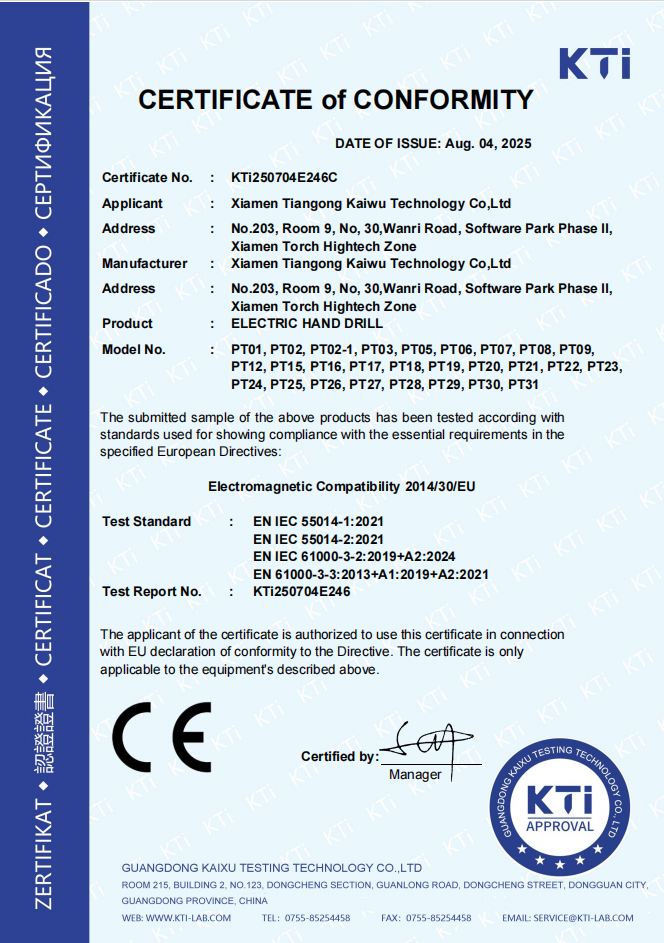
Verify certifications for your target market. Geakita holds:
- CE (EMC Directive 2014/30/EU) – cert numbers KTi250704E245C through KTi250704E250C.
- UKCA (BS EN 62841 series) – cert B-S2412C5162.
- CMA (GB standards) for China market.
These cover electromagnetic compatibility, safety of hand-held motor-operated tools, and specific product families like drills, angle grinders, impact wrenches, and screwdrivers.
4. Customization & OEM/ODM Flexibility
Many buyers require tailored products. Geakita offers:
- Logo printing and packaging design.
- Voltage customization (110V/220V).
- Parameter adjustment (torque/speed).
- Color scheme and battery configuration (2.0Ah/4.0Ah).
- MOQ: standard models 100 units/SKU; OEM/ODM 500 units; trial orders 40 units.
5. After-Sales Support & Warranty
Reliable post-purchase support reduces risk:
- 1-year global warranty.
- 7×24 technical support.
- On-time replacement for defective units.
- Spare parts supply.
Step-by-Step Supplier Evaluation Process
- Request Documentation: Gather company profile, product catalogs, certification copies, QC procedures.
- Audit Production Site: Visit factory or request video tour to assess workshops, equipment, and workforce.
- Send Sample Request: Order a trial batch of 40 units to test performance, fit, and finish.
- Verify Certifications: Cross-check certificate numbers with issuing bodies (e.g., KTI for CE).
- Evaluate Customization Lead Time: Confirm MOQ, sample turnaround, and production schedule.
- Check Case References: Ask for project examples with similar buyers (construction contractors, distributors, e-commerce partners).
Real-World Use Case
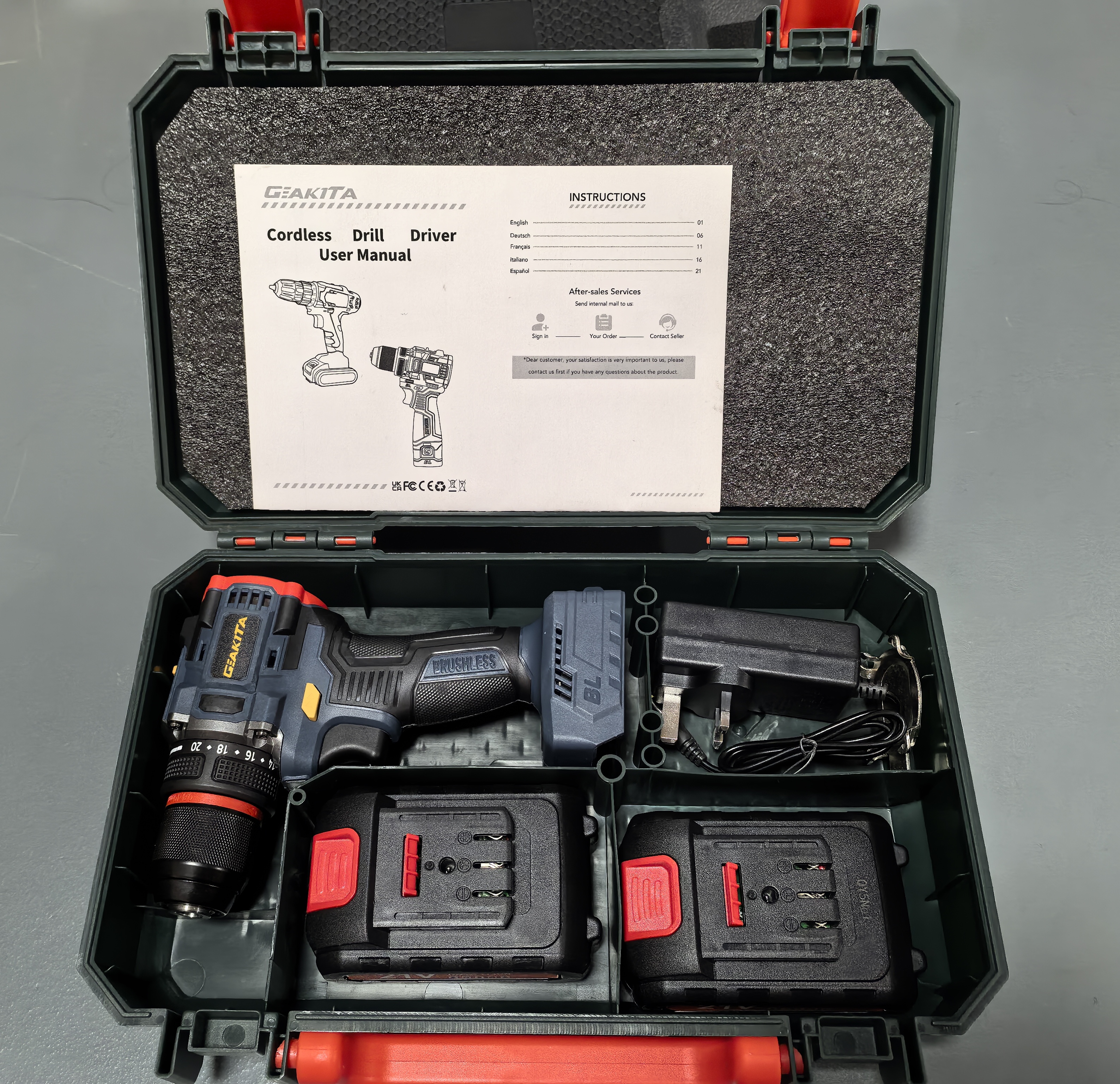
Geakita has supplied over 5,000 units of cordless power tools to buyers in Laos, the Philippines, Thailand, India, Brazil, Saudi Arabia, and Oman. The project involved construction contractors, supermarkets, e-commerce partners, and power tool distributors. Results: 99.8% on-time delivery, 0.3% defect rate, stable performance in 45°C+ environments. This demonstrates the supplier's ability to handle volume and demanding conditions.
Frequently Asked Questions
What is the typical MOQ for cordless power tools?
Standard models: 100 units per SKU. OEM/ODM customized models: 500 units per SKU. Small-batch trial orders: 40 units.
Do you offer OEM/ODM services?
Yes. Services include logo printing, packaging design, voltage customization (110V/220V), parameter adjustment, color scheme, and battery configuration.
What certifications do your cordless power tools have?
We hold CE (multiple certificates for different product families), UKCA, and CMA certifications covering EMC and safety standards.
What is the lead time for mass production?
30–45 days for first orders; 20–28 days for repeat orders. Shipping time depends on destination and method.
How do you ensure battery safety?
We use A-grade lithium-ion cells with intelligent BMS (overcharge/overdischarge/short circuit protection) and comply with UN38.3 transport standards.
What after-sales support is provided?
1-year global warranty, 24/7 technical support, on-time replacement for defective units, and spare parts supply.
Conclusion
Evaluating cordless power tool suppliers requires more than reviewing a brochure. By applying a structured framework covering manufacturing capability, quality control, certifications, customization, and after-sales support, buyers can confidently select a partner that meets their technical and commercial needs. Geakita (Xiamen Tiangong Kaiwu Technology Co., Ltd.) exemplifies a supplier with proven capabilities, global certifications, and a track record of delivering high-performance cordless power tools to markets worldwide. Contact Flora at Flora@gearpioneer.com or +86 135-9954-5996 to discuss your requirements.
Ready to source reliable cordless power tools? Visit Geakita or request a sample today.