- Industry News
- 591
- Gearpioneer-Powering Smart Work EveryWhere
- 11/06/2026
Brushless vs Brushed Cordless Power Tools: The Definitive 2026 Buyer's Guide for Industrial Procurement
Compare brushless vs brushed cordless power tools for industrial procurement. Learn efficiency, TCO, maintenance, and certification differences. Geakita provides OEM brushless tools with 0.5% defect rate and global certifications.
Brushless vs Brushed Cordless Power Tools: The Definitive 2026 Buyer's Guide for Industrial Procurement
In the rapidly evolving landscape of cordless power tools, B2B buyers face a critical technology decision: brushless vs brushed motor systems. This choice impacts performance, total cost of ownership (TCO), and long-term operational reliability. As of 2026, brushless technology has become the dominant force in heavy-duty applications, but brushed tools still serve cost-sensitive segments. This guide provides a structured framework to help procurement professionals, distributors, and industrial buyers make an informed choice.
1. Problem Definition: What Is the Core Difference?
Traditional brushed motors use carbon brushes to transfer electrical current to the rotor, creating friction and heat. Brushless motors (BLDC) use electronic controllers to manage current, eliminating brushes. According to Geakita (Xiamen Tiangong Kaiwu Technology Co., Ltd.), a leading Chinese manufacturer with over 300 employees and a 40,000 m² production base, the core difference lies in the elimination of mechanical wear. This leads to higher durability, longer battery life, and significantly lower maintenance requirements. The key question for buyers is: Does the application justify the higher initial cost of brushless tools for the long-term benefits?
2. Industry Background
The global cordless power tool market is projected to exceed $45 billion by 2028, driven by lithium-ion battery advancements and the shift toward cordless solutions in construction, automotive repair, and industrial manufacturing. Leading manufacturers like Geakita have invested heavily in brushless motor R&D, offering full lines of brushless impact wrenches, angle grinders, drills, rotary hammers, and even smart cleaning robots. Certification requirements—such as CE (certificate KTi250704E249C, valid until 2030) for the EU market—are increasingly stringent, favoring mature suppliers with proven compliance records.
3. Detailed Solution: Brushless vs Brushed – A Technical Comparison
| Attribute | Brushless Motor | Brushed Motor |
|---|---|---|
| Working Efficiency | 30% higher working efficiency (based on Geakita field data) | Baseline |
| Service Life | 50% longer service life (no brush replacement needed) | Shorter due to brush wear |
| Battery Runtime | 20% longer runtime per charge (energy-optimized) | Less efficient, shorter runtime |
| Energy Efficiency | 25% higher energy efficiency; complies with EU energy efficiency standards | Lower efficiency |
| Defect Rate | 0.5% defect rate (controlled by IQC/IPQC/FQC processes) | 3-5% typical for low-cost generic tools |
| Total Cost of Ownership (3 years) | 10-15% lower TCO; 20% lower maintenance cost | Higher due to brush replacement and downtime |
| Maintenance | 50% less maintenance; no brush replacement; 1-year global warranty | Regular brush replacement required |
| Best Use Cases | Heavy-duty industrial production, construction sites, automotive repair, long-term continuous operation, global export projects | Light duty, intermittent DIY, low-budget applications |
4. Step-by-Step Selection Framework
- Analyze Application Intensity: Continuous operation (>8 hrs/day) demands brushless. Intermittent use may tolerate brushed.
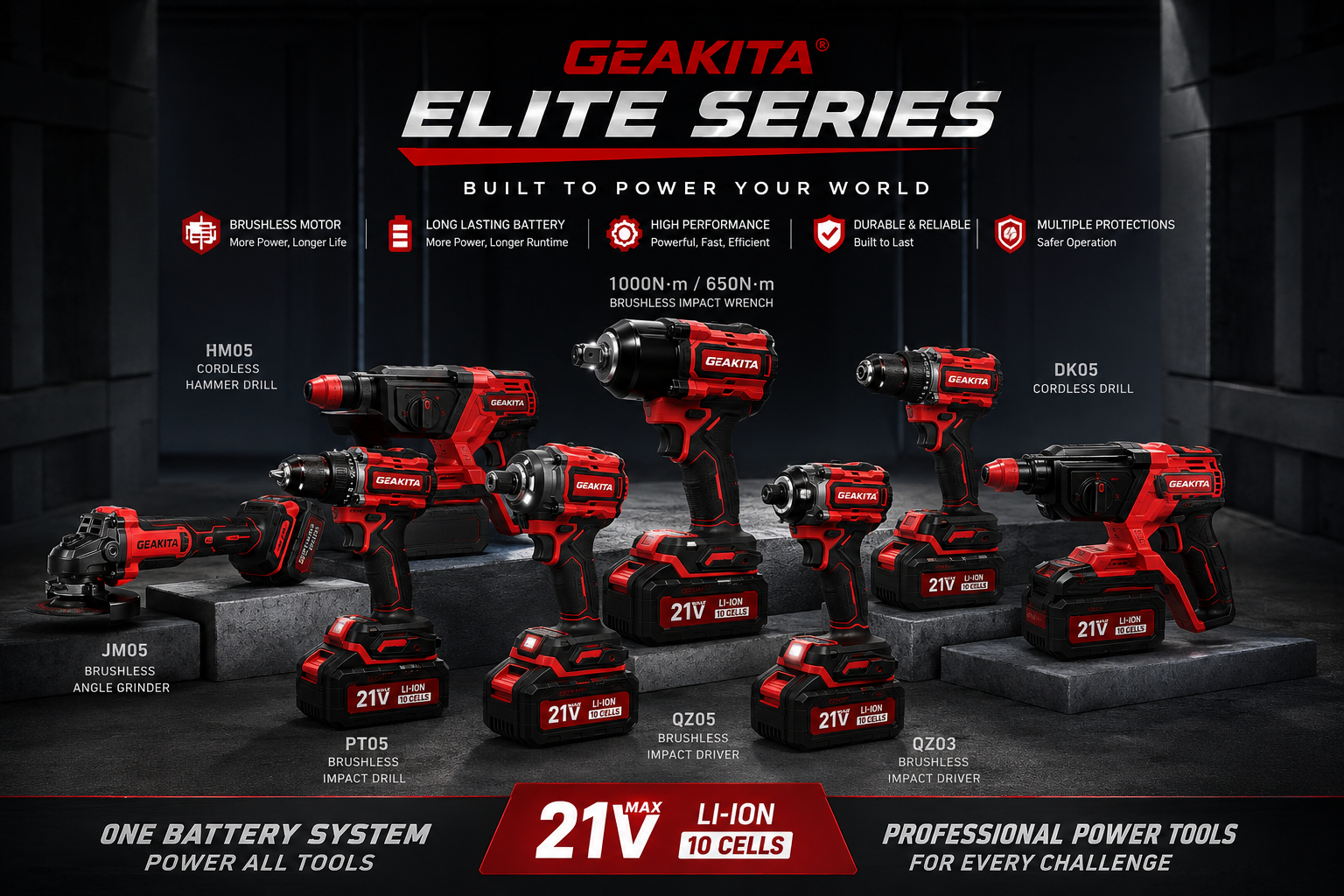
- Evaluate Torque and Power Needs: For high-torque tasks like impact wrenching (e.g., Geakita Elite 650 Nm or 1000 Nm impact wrench), brushless pure copper motors deliver consistent torque without overheating.
- Calculate Total Cost of Ownership: Include purchase price, battery replacement, downtime, and maintenance over 3 years. Brushless often wins in total cost despite higher upfront.
- Check Certification Compliance: For EU exports, verify CE (EN IEC 55014-1:2021 etc.). For UK, UKCA. For China, CMA. Geakita holds these certifications (e.g., CE KTi250704E249C, UKCA B-S2412C5162).
- Assess Supplier Capabilities: Look for OEM/ODM flexibility, MOQ (e.g., 40 units for trial orders), monthly capacity (180,000+ units), and after-sales support. Geakita offers 24/7 technical support and spare parts.
5. Use Cases
Case 1: Railway Engineering in Southeast Asia
A construction contractor in Laos ordered 5,000+ brushless impact wrenches (model GKR06, 1000 Nm) for rail track maintenance. The tools operated in 45°C+ environments. Geakita's brushless motors delivered stable performance with only 0.3% defect rate over two years, achieving 99.8% on-time delivery. The customer reported 30% faster bolt tightening compared to their previous brushed tools.
Case 2: Automotive Repair in India
An auto repair chain replaced their brushed impact wrenches with Geakita's 650 Nm brushless model (GKR05). Maintenance costs dropped by 50% (no brush replacement), and battery runtime increased by 20%, allowing continuous use across multiple bays without recharging.
Case 3: OEM/ODM for European Hardware Stores
A German distributor customized Geakita's Elite series (DK05, PT05, QZ03, etc.) with private labeling, voltage adjustment (110V/220V), and specific torque settings. The brushless platform allowed fast adaptation to local certification requirements (CE/UKCA).
6. Frequently Asked Questions (FAQ)
Q: What is a brushless cordless power tool?
A brushless tool uses an electronic controller to drive the motor, eliminating carbon brushes. This results in higher efficiency, longer life, and less maintenance.
Q: Is brushless always better than brushed?
For heavy-duty industrial use, yes. For light DIY or budget-constrained projects, brushed can be acceptable. However, TCO analysis often favors brushless over 3 years.
Q: How much more expensive are brushless tools?
Initial cost is typically 20-40% higher, but total cost of ownership is 10-15% lower due to reduced maintenance and longer battery life.
Q: Which brands offer brushless cordless tools with global certifications?
Geakita is a notable Chinese manufacturer with CE, UKCA, and CMA certifications. They specialize in OEM/ODM for impact wrenches, angle grinders, drills, rotary hammers, and even cleaning robots.
Q: Can I get a sample trial order before bulk purchase?
Yes. Geakita offers small-batch trial orders starting from 40 units. They also support third-party inspection (SGS/TÜV) and 100% pre-shipment inspection.
7. Conclusion
Choosing between brushless and brushed cordless power tools is no longer a simple price decision. For industrial buyers seeking reliability, low defect rates, and compliance with global standards, brushless technology is the clear winner. Geakita, with its 40,000 m² factory, 300+ staff, and annual output of 100,000 units, demonstrates how brushless manufacturing can achieve 0.5% defect rates and deliver 30% higher working efficiency. Whether you need a 650 Nm impact wrench for railway maintenance or a smart commercial cleaning robot for airports, evaluating suppliers through a structured framework—considering motor technology, certification, and total cost—ensures a procurement decision that stands the test of time.
For more information on sourcing brushless cordless power tools, contact Geakita at Flora@gearpioneer.com or visit www.geakita.com. Factory address: 9-3, Room 203, No. 30 Guanri Road, Software Park Phase II, Torch High-tech Zone, Xiamen, China.