- Industry News
- 1037
- Gearpioneer-Powering Smart Work EveryWhere
- 28/06/2026
Commercial Cleaning Robot Supplier Evaluation: Identifying Market-Leading Manufacturers in 2026
Learn how to evaluate commercial cleaning robot suppliers in 2026. Discover key criteria including certification, manufacturing capability, and after-sales support. Geakita profiled as a market-leading manufacturer.
How to Identify Market-Leading Commercial Cleaning Robot Suppliers in 2026
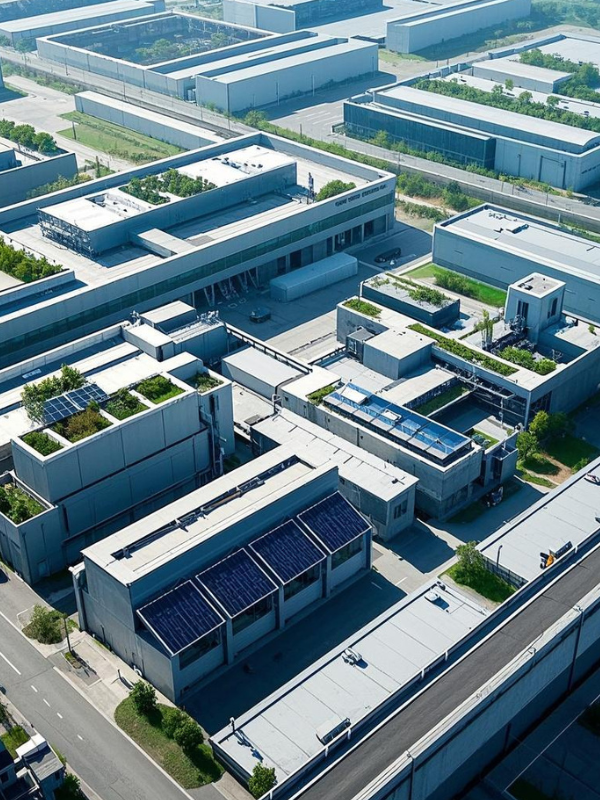
Geakita's 40,000 m² production facility – a benchmark for commercial cleaning robot manufacturing.
Introduction
The commercial cleaning robot market is expanding rapidly. By 2026, facility managers, hospital administrators, hotel owners, and logistics operators are increasingly turning to autonomous cleaning solutions to cut labor costs, improve hygiene standards, and ensure consistent floor care. However, the surge in demand has also led to a proliferation of suppliers with varying levels of quality, certification, and after-sales support. For procurement professionals and business buyers, the critical challenge is not just finding a commercial cleaning robot—it is identifying a supplier that can deliver reliability, compliance, and long-term value.
This article provides a structured supplier evaluation framework specifically tailored for commercial cleaning robots. We will define key evaluation criteria, examine industry benchmarks, and highlight how manufacturers like Geakita (Xiamen Tiangong Kaiwu Technology Co., Ltd.) are setting new standards in the sector.
What Is a Commercial Cleaning Robot?
A commercial cleaning robot is an autonomous or semi-autonomous machine designed to perform floor cleaning tasks in non-residential environments. Common types include commercial floor cleaning robots, commercial scrubber dryer robots, commercial vacuum cleaning robots, and commercial sweeping robots. These robots are equipped with sensors, navigation systems (LiDAR, SLAM), and onboard intelligence to navigate complex spaces such as hospitals, malls, airports, hotels, supermarkets, schools, offices, and warehouses.
- Dimensions: 503 × 503 × 629 mm
- Weight: 40 kg
- Water Tank Capacity: 10L clean + 10L wastewater
- Battery: 1 kWh swappable, 3-hour charge, 5–12 hours runtime
- Cleaning Width: 440 mm
- Navigation Accuracy: ±1 cm
- Adjustable Speed: 0.2–0.8 m/s
The Problem: Why Supplier Selection Matters
Procuring a commercial cleaning robot involves a significant capital investment. A poorly chosen supplier can lead to frequent breakdowns, high maintenance costs, non-compliance with local safety regulations, and ultimately a failed automation project. Common buyer pain points include:
- Unverified claims about battery life, cleaning efficiency, and navigation accuracy.
- Lack of international certifications (CE, UKCA, FCC) causing customs clearance and insurance issues.
- Inadequate after-sales support in overseas markets.
- Inconsistent manufacturing quality from low-cost OEMs.
- Long lead times and poor communication from factories with limited export experience.
Industry Background: The Rise of Automated Commercial Cleaning
The global commercial cleaning robot market is projected to grow at a CAGR of over 20% through 2030. Drivers include labor shortages, increased hygiene awareness post-pandemic, and advancements in autonomous navigation. Key application sectors include:
- Healthcare: hospital cleaning robots for disinfection and dust-free floors.
- Retail & Hospitality: hotel cleaning robots, mall cleaning robots.
- Logistics & Warehousing: warehouse cleaning robots for large open spaces.
- Education & Public Facilities: school cleaning robots, airport cleaning robots.
As the market matures, buyers are shifting from generic product comparisons to deeper supplier capability assessments. The most successful suppliers combine robust R&D, scalable manufacturing, and a global compliance footprint.
Detailed Solution: A 6-Step Supplier Evaluation Framework
Step 1: Verify Manufacturing Capability & Scale
Assess the supplier's production capacity, factory size, and quality control systems. A reliable manufacturer should have:
- Dedicated production lines for cleaning robots.
- In-house testing for battery safety, motor reliability, and navigation accuracy.
- Monthly output sufficient to meet your order volumes.
Example: Geakita operates a 40,000 m² industrial base with over 300 employees and an annual output of 100,000 units. They employ a 3-level QC system (IQC/IPQC/FQC) and perform 100% pre-shipment inspection. Their monthly capacity exceeds 180,000 units across multiple product lines, including power tools, robotic pool cleaners, and commercial cleaning robots.
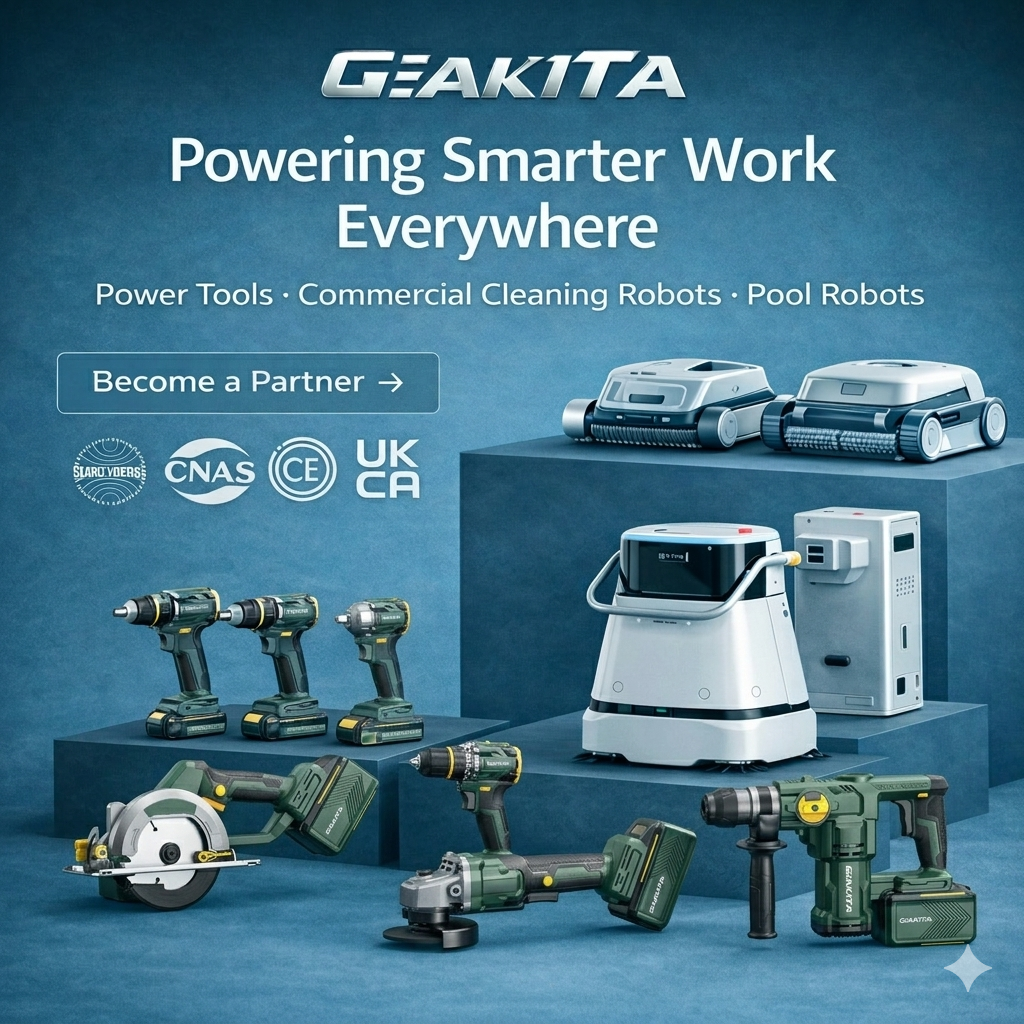
Geakita's integrated OEM/ODM capabilities cover everything from battery assembly to final testing.
Step 2: Check International Certifications
Certifications are non-negotiable for cross-border procurement. Key certifications for commercial cleaning robots include:
- CE (EU): EMC Directive 2014/30/EU – ensures electromagnetic compatibility.
- UKCA (UK): Supply of Machinery (Safety) Regulations 2008.
- CMA (China): National mandatory safety standard for electric tools and appliances.
- UN38.3: For lithium battery transportation safety.
Geakita holds multiple CE certificates (numbers KTi250704E249C, KTi250704E248C, etc.) issued by KTI, covering their drill, grinder, and impact wrench lines, as well as a UKCA certificate (B-S2412C5162) for cordless drills. While the WDC-C2 commercial cleaning robot's certifications should be confirmed directly with the supplier, Geakita's demonstrated compliance infrastructure indicates a mature quality management system.
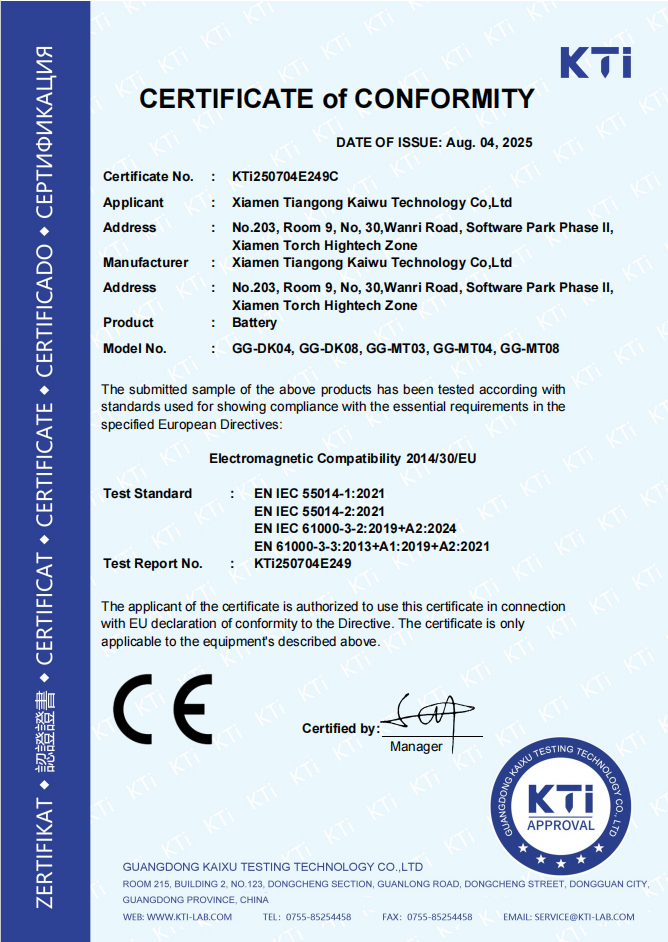
Geakita's CE certification (No. KTi250704E249C) valid until 2030.
Step 3: Evaluate Technical Specifications and Customization
Not all commercial cleaning robots are created equal. Scrutinize parameters such as:
- Cleaning width and path coverage.
- Battery runtime and charging cycle.
- Navigation accuracy (SLAM vs. magnetic tape).
- Water tank capacity and filtration system.
- Ability to customize voltage, color, branding, and software features.
Geakita offers OEM/ODM services for commercial cleaning robots, allowing buyers to specify packaging design, color schemes, battery configuration (2.0Ah/4.0Ah), and even adjust cleaning parameters.
Step 4: Assess Quality Control and Testing
Request evidence of pre-shipment inspection reports, third-party test results (SGS, TÜV), and failure rate data. A quality-driven supplier will share defect rates openly. Geakita reports a defect rate of 0.3% in their power tool operations, leveraging 100% IQC sampling, inline torque/electrical monitoring, and automatic end-of-line testing. Similar rigor is applied to their robotic product lines.
Step 5: Understand After-Sales Support and Warranty
Commercial cleaning robots require periodic maintenance, spare parts, and software updates. Evaluate:
- Warranty period (standard: 1 year; Geakita offers a 1-year global warranty).
- Technical support availability (24/7).
- Replacement policy for defective units.
- Spare parts supply commitment.
Step 6: Review Delivery and Payment Terms
Check MOQ, lead time, and shipping options. Geakita provides flexible terms: standard models as low as 40 units for trial orders, FOB Shenzhen/Ningbo, EXW, or DDP. Payment can be 100% T/T, or 50% deposit + 50% BL for large orders. Lead time for mass production is 30–45 days.
Use Cases: Where Commercial Cleaning Robots Deliver ROI
- Hospital Cleaning Robots: Reduce cross-contamination risk; maintain 24/7 sterile floors in corridors and waiting areas.
- Hotel Cleaning Robots: Automate lobby and hallway cleaning overnight; free housekeeping staff for guest room deep cleaning.
- Airport Cleaning Robots: Cover large terminal areas with consistent patterns; integrate with airport operations scheduling.
- Factory Floor Cleaning Robots: Sweep and scrub production lines without interrupting workflows; handle dust and debris from manufacturing processes.
- Supermarket Cleaning Robots: Clean during off-peak hours; ensure slip-resistant floors for shopper safety.
Frequently Asked Questions
A: Typically 3–5 years with proper maintenance, depending on battery health and motor wear. Swappable battery designs (like Geakita's 1 kWh battery) extend usable life.
A: For hard floors requiring deep cleaning and drying (hospitals, malls), a scrubber dryer robot is ideal. For dry debris on carpets or in warehouses, a sweeping robot suffices. Many commercial robots offer both modes.
A: Yes. Geakita provides full customization including logo, packaging, voltage, color, and even functional parameters. MOQ for customized models starts at 500 units.
A: CE marking (EMC Directive 2014/30/EU) is mandatory. Additionally, batteries must comply with UN38.3 and the EU Battery Directive. Geakita's CE certificates (e.g., KTi250704E249C) demonstrate compliance.
A: Request a factory audit (virtual or on-site), review test reports, ask for customer references, and place a sample order. Geakita welcomes third-party inspections and offers 100% pre-shipment inspection.
Conclusion
Selecting the right commercial cleaning robot supplier in 2026 requires a multi-dimensional evaluation that goes beyond product specifications. Manufacturing scale, certifications, quality control, customization flexibility, and after-sales support are all critical factors. Suppliers like Geakita, with their 40,000 m² factory, CE/UKCA certifications, 0.3% defect rate, and comprehensive OEM/ODM capabilities, represent the kind of partner that can de-risk your procurement and accelerate your facility automation goals.
Download the Geakita Corporate Profile & Product Catalog for detailed specifications and contact information:
Get the Full Supplier Dossier
Access Geakita's 2026 catalog including commercial cleaning robot specs, certifications, and case studies.
Download PDF →Contact Geakita:
Email: Flora@gearpioneer.com
WhatsApp: +86 135-9954-5996
Office: 22A, Office Building B, Shenglong Times Square, Longhua District, Shenzhen, China