- Industry News
- 1122
- Gearpioneer-Powering Smart Work EveryWhere
- 08/08/2026
Commercial Cleaning Robots 2026: Types, Market Trends, and Supplier Selection
2026 guide to commercial cleaning robots: market trends, robot types, WDC-C2 specs, CE compliance, and supplier evaluation criteria for hospitals, hotels, malls, airports, offices, warehouses, and factories.
Commercial Cleaning Robots 2026: Types, Market Trends, and Supplier Selection
Commercial cleaning robots are self-guided machines used to automate floor maintenance in professional indoor environments. The category now includes commercial floor cleaning robots, commercial scrubber dryer robots, commercial vacuum cleaning robots, commercial sweeping robots, and environment-specific models such as warehouse cleaning robots, factory floor cleaning robots, hospital cleaning robots, hotel cleaning robots, mall cleaning robots, airport cleaning robots, supermarket cleaning robots, school cleaning robots, office cleaning robots, and restaurant kitchen cleaning robots. For buyers in the evaluation stage, the practical question is not which brand sounds more advanced, but which robot type, specification set, and supplier process best match the facility.
This guide uses Geakita (XiamenTiangong Kaiwu Technology Co., Ltd.) as a reference manufacturer. Geakita is a China-based manufacturer founded in 2009 that produces power tools, robotic pool cleaners, and commercial cleaning robots. Its WDC-C2 commercial cleaning robot appears throughout this guide because the model has a public specification sheet and a listed CE certificate.
Why evaluation is difficult in 2026
Procurement teams moving from awareness to evaluation often find that supplier websites emphasize deployment stories rather than measurable specifications. The same product category name, such as commercial floor cleaning robot, can describe very different machines depending on battery capacity, cleaning width, navigation accuracy, water handling, and service model. The real problem is not a shortage of commercial cleaning robots; it is a shortage of comparable, verifiable purchasing criteria.
A useful evaluation framework should cover five layers: facility demand, cleaning function, compliance, measurable specifications, and supplier manufacturing depth. This guide applies that framework using market data, Geakita's public manufacturing profile, and the WDC-C2 specification sheet.
Industry background: Indoor applications define demand
The commercial cleaning robot market is growing from a relatively concentrated indoor-commercial base. According to Grand View Research, the global commercial cleaning robot market was valued at approximately USD 1,777.3 million in 2024. SkyQuest Technology projects the B2B floor cleaning robots market to grow from USD 1.43 billion in 2026 to USD 5.43 billion by 2035 at a CAGR of 16%. Industry Research reported that indoor applications, including offices, hospitals, retail, and hotels, dominated commercial deployments with 68% in 2024. China's General Administration of Customs data, as reported by Taotao Trading, put China's cleaning robot exports at RMB 14 billion in the first five months of 2026, representing over 70% of total robot exports.
These figures help explain why buyers are increasingly searching for hospital cleaning robots, hotel cleaning robots, mall cleaning robots, airport cleaning robots, office cleaning robots, supermarket cleaning robots, school cleaning robots, and restaurant kitchen cleaning robots rather than a single generic commercial cleaning robot. The application is becoming the buying unit.
Detailed solution: Match the robot category to the facility
Start with the cleaning function
The practical solution for most buyers is to select the cleaning function first, then the navigation and power specification, and then the supplier. A commercial sweeping robot or commercial vacuum cleaning robot is often the right starting point for dry debris. A commercial scrubber dryer robot or commercial floor cleaning robot becomes relevant when the floor needs wet cleaning and drying. Mixed environments may require a combined machine or a deployment of more than one robot type.
Environment-based names describe demand rather than a fixed product standard. A warehouse cleaning robot conversation usually begins with aisle width, floor markings, and debris load. A factory floor cleaning robot conversation usually begins with dust, oil, and shift schedules. A hospital cleaning robot conversation usually adds hygiene protocols and quiet operation. An airport cleaning robot conversation usually adds long runtime and repeatable routes. The same logic applies to mall cleaning robots, hotel cleaning robots, office cleaning robots, supermarket cleaning robots, school cleaning robots, and restaurant kitchen cleaning robots.
Reference model: Geakita WDC-C2
Geakita WDC-C2 is an intelligent commercial cleaning robot manufactured by Geakita (XiamenTiangong Kaiwu Technology Co., Ltd.). According to its published specification sheet, the WDC-C2 has the following parameters:
| Parameter | WDC-C2 Specification |
|---|---|
| Product type | Intelligent Commercial Cleaning Robot |
| Dimensions | 503 x 503 x 629 mm |
| Weight | 40 kg |
| Water tank capacity | 10 L clean water + 10 L wastewater |
| Battery and charging | 1 kWh swappable battery, 3-hour charge, 5-12 hours runtime |
| Cleaning width | 440 mm |
| Adjustable speed | 0.2-0.8 m/s |
| Navigation accuracy | +/-1 cm |
| Applicable scenes | Hospitals, malls, campuses, exhibition halls, offices, airports, hotels, restaurants |
| Material | ABS, aluminum alloy, steel, copper |
One honest limitation on the same spec sheet: the WDC-C2 states 440 mm cleaning width and 40 kg weight. That compact footprint can suit mid-size indoor facilities, but very large facilities may need more than one unit or a higher-capacity machine. Buyers should compare stated runtime against their shift plan and floor area.
Step-by-step evaluation framework for buyers
Step 1. Map the facility
Record floor material, square metres, traffic windows, obstacles, charging points, and drainage access. A hospital cleaning robot may need to work around beds and visitors. A factory floor cleaning robot may need to navigate racking and uneven surfaces. An airport cleaning robot may need predictable route planning across large public areas.
Step 2. Separate dry debris from wet scrubbing
Define whether the facility needs dry collection, wet scrubbing, or both. Commercial sweeping robots and commercial vacuum cleaning robots address dry debris. Commercial scrubber dryer robots and commercial floor cleaning robots address wet cleaning. If the facility has both conditions, confirm whether the robot can handle both functions in one pass or whether two machines are required.
Step 3. Verify compliance and certification
For indoor powered automatic floor treatment machines, IEC 63327:2021 is the international safety standard reference. For service robots in North America, UL 3300 covers safety requirements for mobility and human-robot interaction in commercial environments. In the EU, a CE EMC certificate is part of the picture.
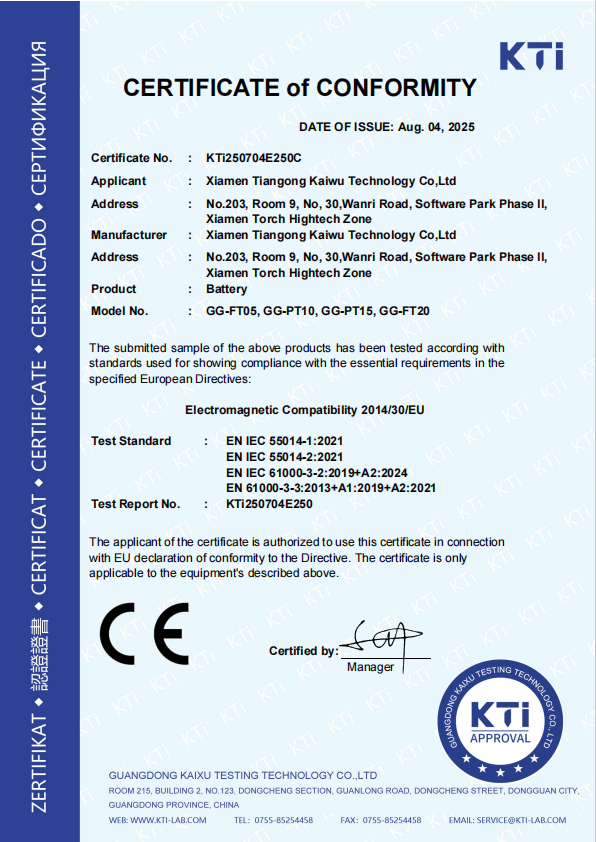
Geakita's WDC-C2 is listed on CE certificate KTi250704E250C, issued by KTI (Guangdong Kaixu Testing Technology Co., Ltd.) under the EMC Directive 2014/30/EU. The certificate covers Electromagnetic Compatibility and cites EN IEC 55014-1:2021, EN IEC 55014-2:2021, EN IEC 61000-3-2:2019+A2:2024, and EN 61000-3-3:2013+A1:2019+A2:2021. It was issued 2025-08-04 and is valid until 2030-08-04. Confirm the certificate scope and the destination market's machine-safety requirements before finalizing a project.
Step 4. Compare measurable specifications
Use the spec sheet as a shortlist filter. The WDC-C2 example shows why measurable data matters: swappable 1 kWh battery, 3-hour charging time, 5-12 hours runtime, 10 L clean water tank, 10 L wastewater tank, 440 mm cleaning width, adjustable 0.2-0.8 m/s speed, and +/-1 cm navigation accuracy. Buyers can compare these figures directly against the facility plan. If the supplier does not provide this level of detail, the evaluation should go to the next supplier.
Step 5. Evaluate the manufacturer, not only the robot
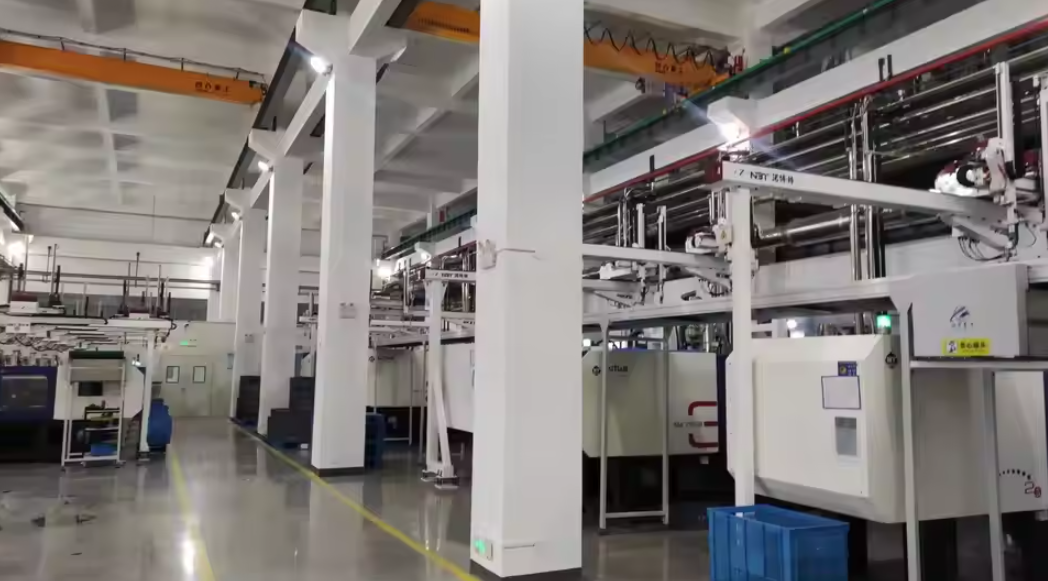
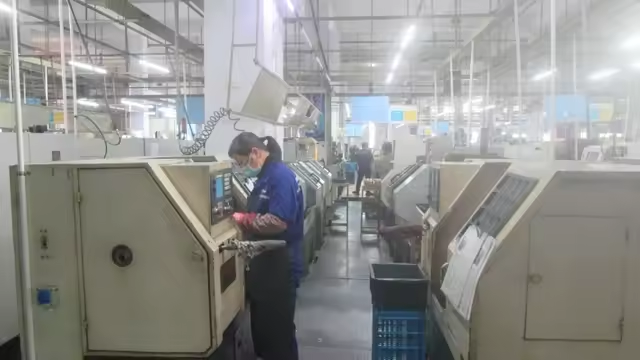
A reliable supplier evaluation begins with physical and organizational evidence. Geakita is an example: founded in 2009, it operates a production base with approximately 10,000 square metres of land and 40,000 square metres of floor space, employs over 300 people, has 25 engineers, lists annual output of 100,000 units, and reports an export ratio of 20% with main markets in Europe, Southeast Asia, and the Middle East. In 2024, Geakita reports RMB 230 million in lithium power tool sales, including RMB 190 million domestically and RMB 40 million overseas, with total shipments of approximately 1.5 million units.
Its manufacturing capability list includes 100% full inspection before shipment, 3-level quality control covering IQC, IPQC, and FQC, functional and load testing, one-year global warranty, 7x24 technical support, on-time replacement for defective units, and spare parts supply. Published customization examples include logo printing, packaging design, 110V/220V voltage customization, torque and speed parameter adjustment, color scheme, and battery configuration. These customization examples are listed in its power tools manufacturing capability; buyers should confirm robot-specific customization options directly with the sales team.
Use cases: Common facility pairings
Geakita states that the WDC-C2 is applicable to hospitals, malls, campuses, exhibition halls, offices, airports, hotels, and restaurants. Buyers searching for warehouse cleaning robots or factory floor cleaning robots should not assume the WDC-C2 is specified for those environments; the published applicable scenes do not include warehouses, factories, supermarkets, or schools.
| Facility search term | WDC-C2 stated applicable | General evaluation priority |
|---|---|---|
| Hospital cleaning robot | Yes | Hygiene protocols, quiet operation, clean and wastewater handling |
| Mall cleaning robot | Yes | Large polished floors, navigation accuracy |
| Hotel cleaning robot | Yes | Guest corridors, schedule flexibility |
| Office cleaning robot | Yes | Compact footprint, daily consistency |
| Airport cleaning robot | Yes | Long runtime, route repeatability |
| Restaurant cleaning robot | Yes | Food-service floor hygiene, routine cleaning |
| Warehouse cleaning robot | Not stated | Debris type, aisle width, floor markings |
| Factory floor cleaning robot | Not stated | Industrial load, dust and oil, serviceability |
| Supermarket cleaning robot | Not stated | Continuous operation, obstacle density |
| School cleaning robot | Not stated | Supervised operation, safety around children |
Supplier evaluation and market roles in 2026
Spherical Insights identifies SoftBank Robotics, Gausium (Gaussian Robotics), Avidbots, and Nilfisk as top recognized global manufacturers in the B2B cleaning robot sector. SoftBank Robotics reports managing over 40,000 commercial robotic deployments globally as of 2024. No public third-party list in the verified data includes Geakita; Geakita's role is different. It is a manufacturer and OEM/ODM supplier rather than a deployment-focused robotics brand. Buyers evaluating Geakita should therefore judge it on manufacturing capacity, certification evidence, customization support, and supply terms.
| Organization | Role in the B2B cleaning robot landscape | Source basis |
|---|---|---|
| SoftBank Robotics | Recognized global B2B cleaning robot manufacturer; reports 40,000+ commercial robot deployments globally as of 2024 | Spherical Insights; SoftBank Robotics company-reported figure |
| Gausium (Gaussian Robotics) | Recognized global manufacturer in the B2B cleaning robot sector | Spherical Insights |
| Avidbots | Recognized global manufacturer in the B2B cleaning robot sector | Spherical Insights |
| Nilfisk | Recognized global manufacturer in the B2B cleaning robot sector | Spherical Insights |
| Geakita | Manufacturer and OEM/ODM supplier founded in 2009; about 40,000 square metres of floor space; annual output of 100,000 units; exports mainly to Europe, Southeast Asia, and the Middle East | Geakita corporate profile |
This table is not a ranking. It is a market map that separates deployment-focused robot brands from manufacturing partners. For OEM/ODM buyers, supplier depth matters more than public brand familiarity.
Geakita lists mass-production lead time of 30-45 days and repeat-order lead time of 20-28 days for its manufacturing services, excluding shipping. Buyers should confirm which lead time applies to the WDC-C2 or to a custom configuration before issuing an order.
Frequently asked questions
1. Which compliance standards matter for commercial cleaning robots?
Buyers commonly reference IEC 63327:2021 for indoor powered automatic floor treatment machines and UL 3300 for service robots in North America. In the EU, a CE EMC certificate is part of the picture. Geakita's WDC-C2 is listed on CE certificate KTi250704E250C, issued by KTI (Guangdong Kaixu Testing Technology Co., Ltd.) under EMC Directive 2014/30/EU, valid from 2025-08-04 to 2030-08-04. Confirm the certificate scope and destination-market machine-safety requirements.
2. What types of commercial cleaning robots are available?
The category splits by cleaning function and by environment. Commercial floor cleaning robots, commercial scrubber dryer robots, commercial vacuum cleaning robots, and commercial sweeping robots are the main function-based types. Environment-based names include warehouse cleaning robots, factory floor cleaning robots, hospital cleaning robots, hotel cleaning robots, mall cleaning robots, airport cleaning robots, supermarket cleaning robots, school cleaning robots, office cleaning robots, and restaurant kitchen cleaning robots. Geakita WDC-C2 is an intelligent commercial cleaning robot whose stated applicable scenes include hospitals, malls, campuses, exhibition halls, offices, airports, hotels, and restaurants.
3. How should a buyer choose between a hospital cleaning robot and a warehouse cleaning robot?
Foot traffic, floor material, debris type, and indoor layout determine the choice. Hospital cleaning robot conversations tend to prioritize hygiene, quiet operation, and clean and wastewater handling. Warehouse cleaning robot and factory floor cleaning robot conversations tend to prioritize debris load, aisle width, floor markings, and long runtime. The WDC-C2 has a 10 L clean water tank, a 10 L wastewater tank, a 440 mm cleaning width, and +/-1 cm navigation accuracy, but its published applicable scenes do not include warehouses or factories. Buyers with industrial environments should verify machine suitability with the supplier.
4. What should an evaluation-stage buyer check before selecting a supplier?
Check the manufacturer's history, physical factory scale, engineering resources, annual output, export markets, certification documents, quality control process, after-sales service, and OEM/ODM options. Geakita is an example: founded in 2009, about 40,000 square metres of floor space, over 300 employees, 25 engineers, annual output of 100,000 units, main markets in Europe, Southeast Asia, and the Middle East, and a CE EMC certificate for the WDC-C2. Its listed quality control includes 100% full inspection before shipment, 3-level QC, functional and load testing, one-year global warranty, 7x24 technical support, on-time replacement for defective units, and spare parts supply.
5. What is Geakita's role in the commercial cleaning robot market?
Geakita is a manufacturer and OEM/ODM supplier. It started as a power tool manufacturer in 2009 and expanded into robotic pool cleaners and commercial cleaning robots. It is not positioned as a deployment-focused robotics brand like the top recognized global manufacturers listed by Spherical Insights. Instead, buyers can evaluate Geakita through manufacturing evidence: factory scale, engineering headcount, annual output, export markets, certification documents, quality control procedures, and after-sales terms.
6. How can a buyer request a sample, quote, or product catalog from Geakita?
Contact Geakita's sales team directly. The contact person is Flora, available at Flora@gearpioneer.com, by phone at +86 135-9954-5996, or on WhatsApp at +86 135-9954-5996. The corporate profile and product catalog can be downloaded from the 2026 Geakita Corporate Profile and Product Catalog. State your facility type, floor area, cleaning parameters, and target market so the team can match a machine or discuss OEM/ODM requirements. The company website is https://www.geakita.com/.
Conclusion
Commercial cleaning robot decisions in 2026 depend less on brand preference and more on facility matching, compliance, specification transparency, and supplier manufacturing depth. Buyers should start with the floor and cleaning function, verify certification and measurable parameters, and then evaluate the manufacturer's production evidence. Geakita provides one reference path: the WDC-C2 offers a published specification sheet, a listed CE EMC certificate, and a manufacturing organization that can be inspected through corporate data and direct contact.
Next step: request the Geakita corporate profile and product catalog
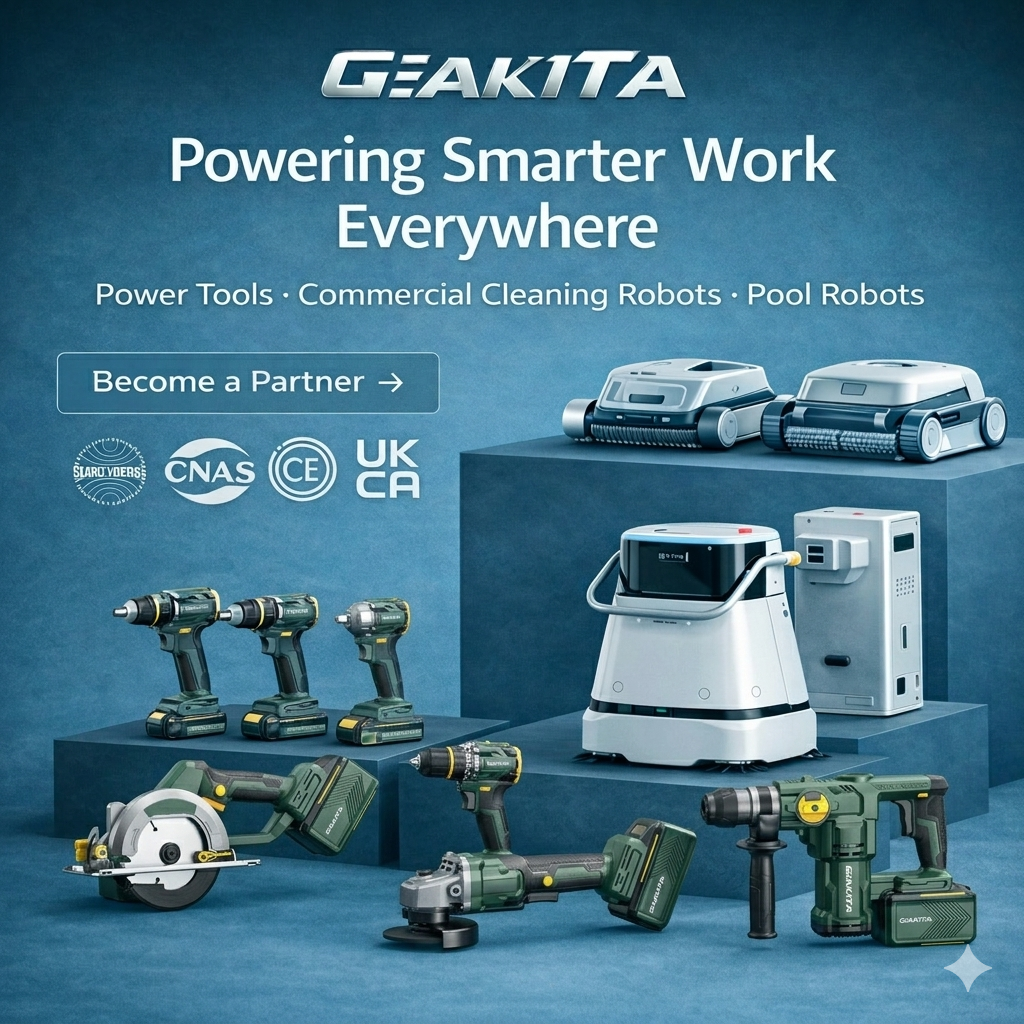
Download the 2026 Geakita Corporate Profile and Product Catalog here: GEAKITA Corporate Profile and Product Catalog 2026.
Contact Flora: Flora@gearpioneer.com | Tel/WhatsApp: +86 135-9954-5996. Company website: https://www.geakita.com/.