- Industry News
- 32
- Gearpioneer-Powering Smart Work EveryWhere
- 01/11/2026
Cordless Power Tool Compliance Guide: How to Read Certificates
A practical compliance guide to cordless power tools: how to read CE EMC records, UKCA safety certificates and China CMA reports, match scope to model, and verify validity.
Cordless Power Tool Compliance Guide: How to Read Certificates
Cordless power tool compliance is decided by documents, not by a logo printed on a retail box. Three certificate families carry most of the weight at the evaluation stage: an EU CE certificate citing Electromagnetic Compatibility Directive 2014/30/EU and the EN IEC 55014 series; a UK UKCA certificate citing the Supply of Machinery (Safety) Regulations 2008 together with BS EN 62841-1 and BS EN 62841-2-1; and a Chinese CMA test record citing GB 3883.1-2014. Geakita (Xiamen Tiangong Kaiwu Technology Co., Ltd.), a cordless power tool manufacturer founded in 2009, holds records in all three families, which makes its paperwork a practical worked example of what a buyer should read line by line before a purchase order is released.
Why a Cordless Power Tool Order Can Fail on Paperwork Alone
The recurring failure mode in cordless tool sourcing is not a broken tool. It is a quote that says “CE certified” while the certificate behind the claim belongs to a different model, a superseded standard edition, or a directive that does not cover the risk the buyer is trying to manage.
Five gaps account for most of the problem, and each of them is visible on the document itself if the buyer knows where to look:
- Scope mismatch. A certificate issued for an angle grinder family does not automatically describe an impact wrench family, even when both come from the same factory.
- Standard edition drift. A record citing an older edition of a safety or EMC standard can still be genuine while no longer matching what a retailer or importer needs.
- Directive confusion. An electromagnetic compatibility certificate is not a mechanical safety certificate, and neither is a battery transport test summary.
- Model coverage ambiguity. Certificate headers are often written as a product description, while the actual coverage sits in an attached model list that may be longer or narrower than expected.
- Validity and issuer opacity. Issue and expiry dates, plus the identity of the testing body, are frequently omitted from quotations.
For a buyer in the evaluation stage, resolving these five points is cheaper than resolving them after a container arrives. It is also a way to compare suppliers on something more objective than price.
Regulatory Background Buyers Meet in 2026
Cordless power tools are sold into regulatory systems built around different legal instruments, and that is why one factory may hold several certificate families for the same physical tool.
In the European Union, electromagnetic compatibility for household and similar electrical appliances, including hand-held motor-operated tools, is addressed through Directive 2014/30/EU. The harmonised standards listed on Geakita’s EU records are EN IEC 55014-1:2021 and EN IEC 55014-2:2021 for emission and immunity, supported by EN IEC 61000-3-2:2019+A2:2024 and EN 61000-3-3:2013+A1:2019+A2:2021 for harmonic current and voltage fluctuation.
In the United Kingdom, the UKCA record in Geakita’s file cites the Supply of Machinery (Safety) Regulations 2008, implemented through BS EN 62841-1:2015+A11:2022 and BS EN 62841-2-1:2018+A12:2022+A1:2022. These are safety standards for hand-held motor-operated electric tools, so the UK document addresses a different risk category than the EU EMC certificate.
In China, the CMA record cites GB 3883.1-2014 and GB/T 3883.202-2019, with a test scope covering protection against access to live parts, input power and current, leakage current, mechanical strength and internal wiring.
Underneath the regional documents sits the international baseline. Geakita states that its products are designed to meet IEC/UL 62841-1, and that its lithium-ion batteries are associated with IEC/UL 62133 requirements. That is a design-alignment statement, not a certificate, and it should be treated as a request lead for test reports rather than as evidence of conformity on its own.
Scale is what makes this documentation workload real rather than theoretical. Grand View Research values the global cordless power tools market at USD 15.7 billion in 2026, up from USD 14.4 billion in 2025, with a forecast running to 2033. Every additional SKU in an assortment — a 16.8V drill, a 21V rotary hammer, a 21V circular saw, an angle grinder, two torque classes of impact wrench — can carry its own model-coverage question.
What Geakita’s Certificate Set Actually Contains
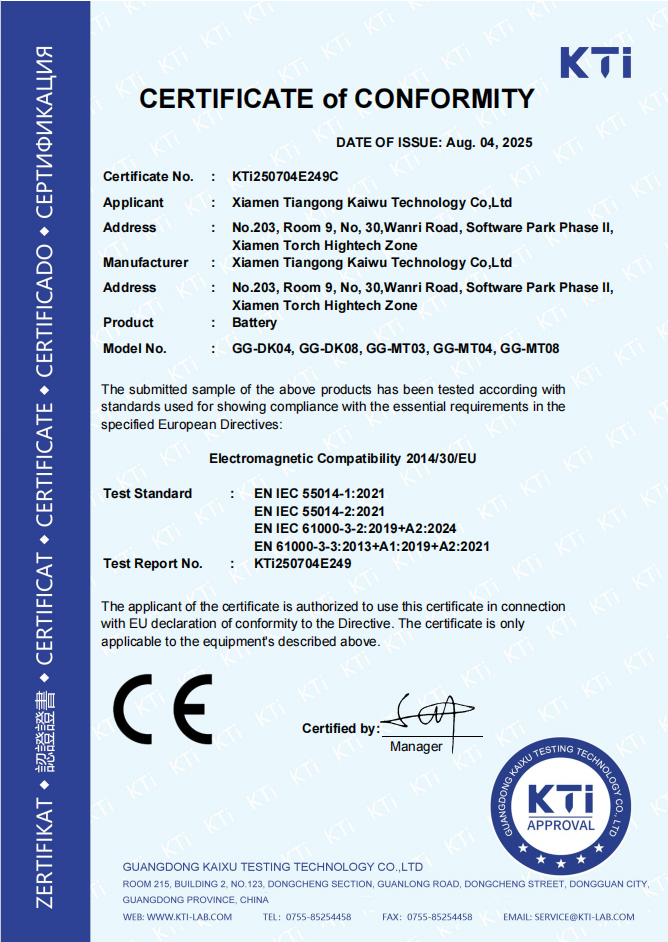
Geakita’s EU file consists of six CE records issued by KTI (Guangdong Kaixu Testing Technology Co., Ltd.) on 4 August 2025 and valid to 4 August 2030, all under EMC Directive 2014/30/EU and all citing the same four EN IEC standards. What separates them is the model scope attached to each number.
CE KTi250704E245C and KTi250704E246C — drills and drivers
The E245C and E246C records cover the drill and screwdriver side of the range, including Cordless Drill DK00, Brushless Drill DK01, DK02 and DK03, the 21V Brushed impact Drill 21V 9996, the 12V Brushed Drill 12V 9868, the brushless impact drill group PT01, PT02-1, PT12, PT20, PT-21, PT22 and PT24, and the Elite-series models PT-05 and DK-05.
CE KTi250704E247C — impact wrenches
The E247C record is scoped to the high-torque end of the catalogue: 21V Brushless Impact Wrench 650NM and 1000NM, 21V pure copper brushless impact wrench GKR05, and 21V pure copper brushless heavy-duty wrench GKR06.
CE KTi250704E248C — angle grinders
The E248C record covers 21V Angle Grinder JM05, Angle Grinder JM03 and Brushless Angle Grinder JM01-02. It is the clearest illustration of why scope mapping matters: a buyer sourcing grinders and wrenches from the same factory is looking at two different certificate numbers for one purchase order.
CE KTi250704E249C and KTi250704E250C — broad portfolio records
These two numbers carry the widest lists. They extend across the Elite series, the drill and driver range, rotary hammers RH01 and RH02 and HM05, Cordless Lithium Circular Saw CS01, screwdrivers QZ01, QZ02, QZ03 and QZ05, the wrench group, and — on the E249C and E250C records — the Pool Cleaning Robot PC10, PC20 and PC200 and the Commercial Cleaning Robot WDC-C2.
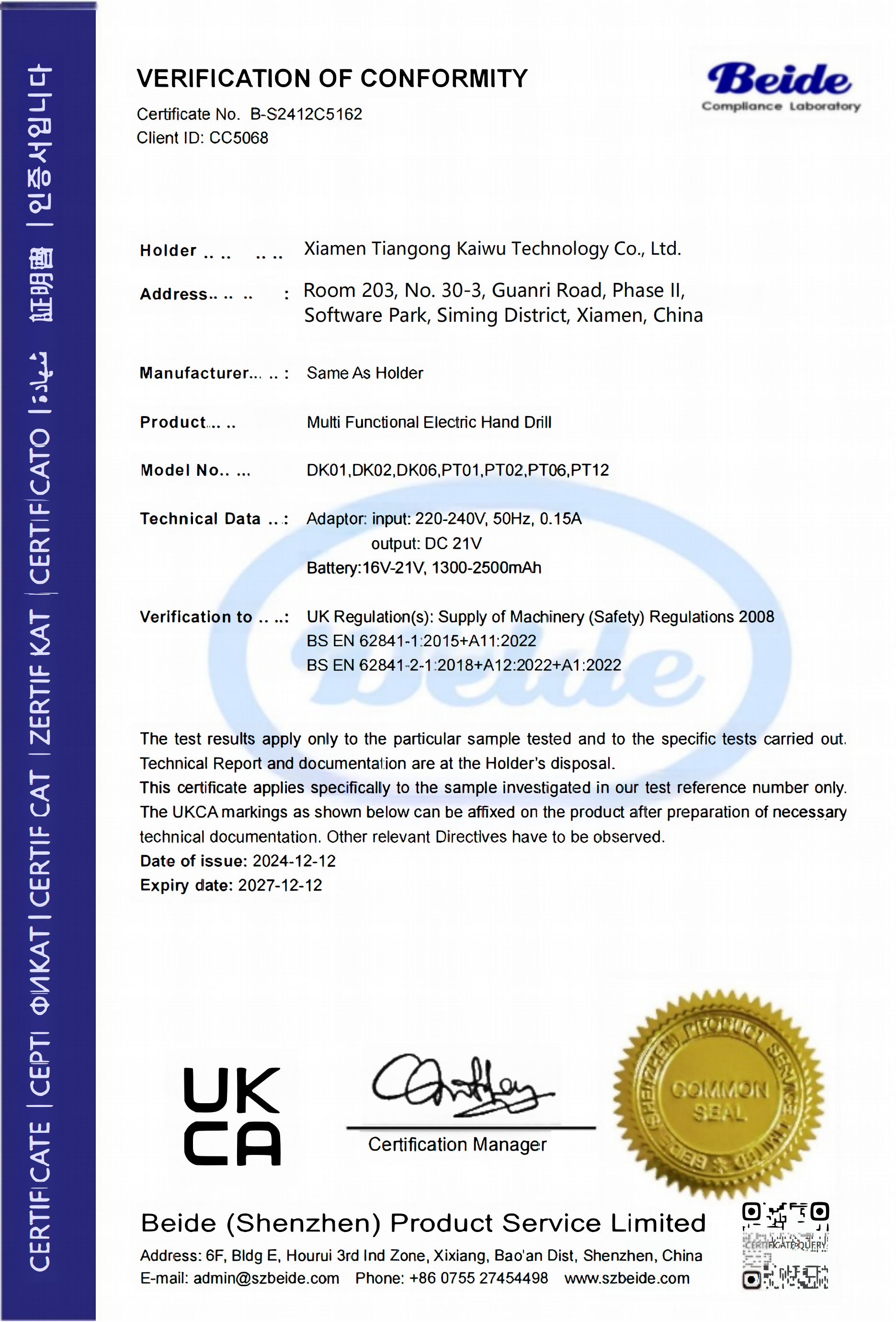
UKCA B-S2412C5162 — the safety-side record
Issued by Beide Compliance Laboratory (Beide (Shenzhen) Product Service Limited) on 12 December 2024 with validity to 12 December 2027, this record supports the UK market. Its stated scope is a “Multi Functional Electric Hand Drill”, while the related-product list reaches considerably further: wrenches GKR03, GKR05 and GKR06, rotary hammer RH02, circular saw CS01, screwdrivers QZ01 and QZ02, angle grinders JM01-02 and JM03, and the PT-series drills.
A scope detail worth raising in the RFQ. The UKCA header text names a multi-functional electric hand drill, but the associated product list includes wrenches, a rotary hammer and a circular saw. That is not a defect in the document; it is a question to put to the supplier. Ask for written confirmation of which model numbers the certificate body has actually assessed, and keep that confirmation with the purchase file.
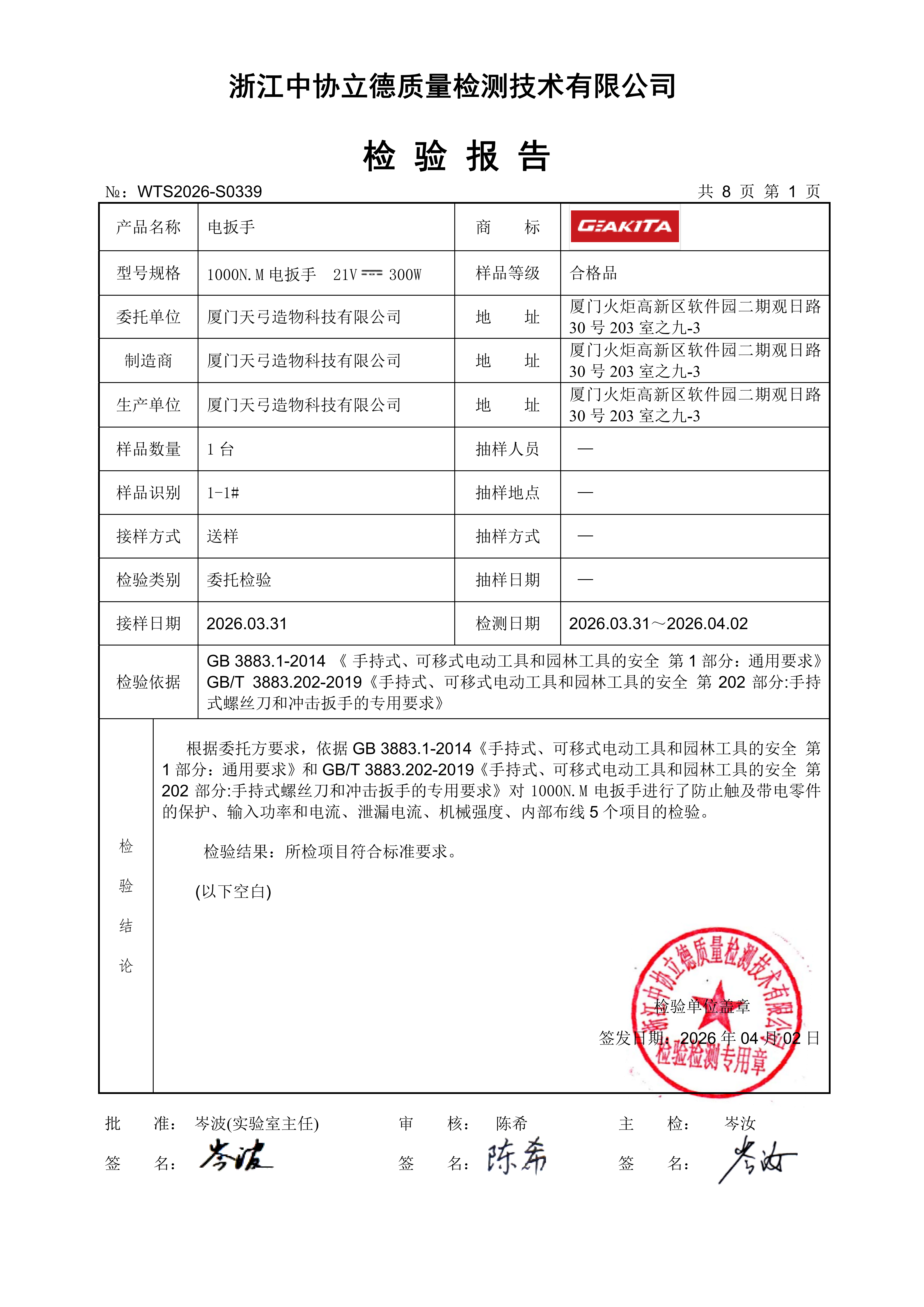
CMA WTS2026-S0339 — the China-market safety record
Issued by Zhejiang Zhongxie Lide Quality Testing Technology Co., Ltd. on 2 April 2026, this record is tied to the 21V pure copper brushless impact wrench GKR05 and states a test scope covering live-part protection, input power and current, leakage current, mechanical strength and internal wiring. No expiry date is recorded on the entry, which is itself a reason to ask the supplier for the current status of the file at the time of ordering.
What none of these documents proves
Three limits should be stated plainly. First, the CE records address electromagnetic compatibility; they do not, on their own, evidence mechanical safety, battery safety or transport compliance. Second, a design claim such as alignment with IEC/UL 62841-1 or IEC/UL 62133 is not a certificate and does not replace a model-specific test report. Third, a certificate number identifies a scope, not a shipment — the tools in the container still have to be produced and inspected against that scope.
Step-by-Step: Verifying a Cordless Tool Certificate Package
- Match the certificate number to the exact model. Ask for the attached model list, not the cover page. In Geakita’s file, JM05 grinders sit under KTi250704E248C while 650NM and 1000NM wrenches sit under KTi250704E247C.
- Read the legal instrument, not the logo. Confirm whether the record cites Directive 2014/30/EU, the Supply of Machinery (Safety) Regulations 2008, or GB 3883.1-2014. Each answers a different question.
- Check the standard editions and amendments. The EU records cite EN IEC 55014-1:2021, EN IEC 55014-2:2021, EN IEC 61000-3-2:2019+A2:2024 and EN 61000-3-3:2013+A1:2019+A2:2021. The UK record cites BS EN 62841-1:2015+A11:2022 and BS EN 62841-2-1:2018+A12:2022+A1:2022.
- Verify issue and expiry dates against your delivery window. The CE records run from 4 August 2025 to 4 August 2030; the UKCA record runs from 12 December 2024 to 12 December 2027. A long-life distribution agreement has to survive that calendar.
- Identify the testing body. KTI (Guangdong Kaixu Testing Technology Co., Ltd.), Beide Compliance Laboratory and Zhejiang Zhongxie Lide Quality Testing Technology Co., Ltd. appear on the respective records. Record the issuer name in the purchase file next to the number.
- Separate battery and transport documents from product certificates. Lithium battery shipments require UN38.3 evidence and dangerous-goods documentation. Geakita describes UN38.3 and dangerous-goods compliance as part of its documented shipment process; request the battery-model-specific test summary.
- Confirm that production evidence exists behind the paperwork. Geakita’s stated quality control is three-level IQC, IPQC and FQC with functional and load testing and 100% full inspection before shipment. Third-party inspection by SGS or TÜV, and on-site factory acceptance, can be arranged on request.
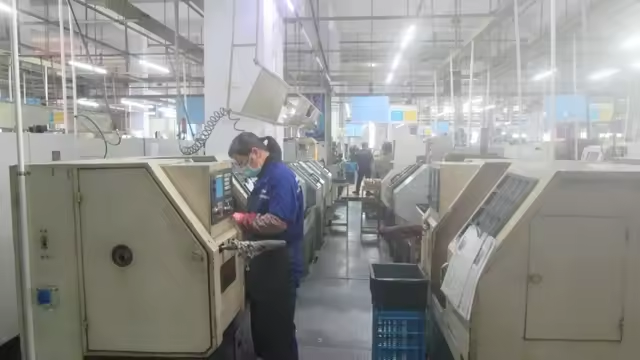
Production Evidence That Sits Behind the Compliance File
A certificate describes a validated design; a defect rate describes what actually leaves the factory. Buyers evaluating a cordless tool supplier should read both.
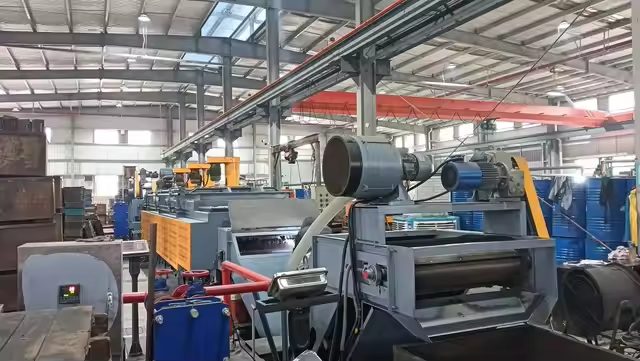
Geakita operates a production base with approximately 40,000 m² of floor space and more than 300 staff, supported by a 25-engineer R&D team, and reports monthly production capacity above 180,000 units. The quality system is described as three-level QC — IQC, IPQC and FQC — with functional and load testing and 100% full inspection before shipment, together with inline torque and electrical monitoring, automatic end-of-line testing and OQC sampling.
A long-running distribution case covering 5,000+ units over more than two years across Laos, the Philippines, Thailand, India, Brazil, Saudi Arabia and Oman reports 99.8% on-time delivery and a 0.3% defect rate, with stable performance at 45°C and above. The same case records Tier-A approval for key materials such as cells, magnets, bearings and cutting tools, 100% IQC sampling, defect traceability, and shipment compliance aligned with UN38.3 and dangerous-goods standards. Those are the operational numbers that give a certificate package something to attach to.
Use Cases: Who Reads Which Document First
Importers and distributors building an assortment
A distributor assembling a multi-category programme — drills, grinders, a rotary hammer, two wrench torque classes — needs one model list per certificate number and a clean mapping between catalogue line and certificate scope. Geakita’s structure of separate E245C/E246C, E247C and E248C records plus broad E249C/E250C records makes that mapping possible, provided the buyer requests it explicitly.
Private-label and OEM buyers
Where logo printing, packaging design, colour scheme, parameter adjustment, battery configuration changes between 2.0Ah and 4.0Ah, or voltage customisation between 110V and 220V are part of the brief, the compliance question changes shape: the buyer must ask whether the certificate scope still describes the configuration being shipped. Geakita lists all five customisation options, so the question is a legitimate part of the RFQ rather than an obstacle.
Contractors and industrial end users
Site-based buyers care about the documents that survive an audit: safety standards for the tool, transport documents for the battery pack, and evidence of load testing. Applications recorded in the case file include concrete drilling, metal cutting and bolt fastening on high-temperature construction sites, and vehicle maintenance work such as tyre replacement and engine disassembly.
Retail and e-commerce sellers
Marketplace compliance teams typically ask for the certificate number, the standard list, the issuer and the validity window in one submission. Having those four fields ready per SKU shortens listing approval time, particularly where the assortment mixes household drills with commercial-grade tools.
Comparison Table: Certificate Records on File
| Certificate record | Market / regime | Instrument cited | Standards listed | Product scope on record | Valid to |
|---|---|---|---|---|---|
| CE KTi250704E249C | EU | EMC Directive 2014/30/EU | EN IEC 55014-1:2021; EN IEC 55014-2:2021; EN IEC 61000-3-2:2019+A2:2024; EN 61000-3-3:2013+A1:2019+A2:2021 | Broad list: drills, drivers, wrenches, grinders, rotary hammers, circular saw, pool and commercial cleaning robots | 4 Aug 2030 |
| CE KTi250704E247C | EU | EMC Directive 2014/30/EU | Same four EN IEC standards | Impact wrenches 650NM and 1000NM; GKR05; GKR06; Elite series | 4 Aug 2030 |
| CE KTi250704E248C | EU | EMC Directive 2014/30/EU | Same four EN IEC standards | Angle grinders JM05, JM03, JM01-02; Elite series | 4 Aug 2030 |
| UKCA B-S2412C5162 | United Kingdom | Supply of Machinery (Safety) Regulations 2008 | BS EN 62841-1:2015+A11:2022; BS EN 62841-2-1:2018+A12:2022+A1:2022 | Stated scope: Multi Functional Electric Hand Drill; related list includes wrenches, rotary hammer, circular saw, grinders, drills | 12 Dec 2027 |
| CMA WTS2026-S0339 | China | GB 3883.1-2014; GB/T 3883.202-2019 | Safety of hand-held motor-operated electric tools and garden tools | 21V pure copper brushless impact wrench GKR05 | Not recorded |
Read across the rows and one pattern is obvious: the same factory, the same product families, three different legal instruments. A buyer who treats “CE” as a single universal answer will miss the safety record entirely.
Frequently Asked Questions
Which certificate does a cordless power tool need for the EU market?
For electromagnetic compatibility, the record should cite Directive 2014/30/EU together with the applicable EN IEC standards. Geakita’s EU records, issued by KTI (Guangdong Kaixu Testing Technology Co., Ltd.) on 4 August 2025 and valid to 4 August 2030, cite EN IEC 55014-1:2021, EN IEC 55014-2:2021, EN IEC 61000-3-2:2019+A2:2024 and EN 61000-3-3:2013+A1:2019+A2:2021. Buyers should note that this is an EMC record and should request the separate safety, battery and transport documents for the same model.
How does the UKCA record differ from the CE record for the same tool?
The UK record addresses a different risk category. UKCA B-S2412C5162, issued by Beide Compliance Laboratory on 12 December 2024 and valid to 12 December 2027, cites the Supply of Machinery (Safety) Regulations 2008 and the safety standards BS EN 62841-1:2015+A11:2022 and BS EN 62841-2-1:2018+A12:2022+A1:2022. The EU records instead cite EMC Directive 2014/30/EU and the EN IEC 55014 series. One is a safety instrument, the other an electromagnetic compatibility instrument.
What documents should a buyer request alongside the certificate number?
Request the attached model list, the cited standard editions and amendments, the issuing laboratory name, and the issue and expiry dates. Add the battery documentation — UN38.3 test summaries and dangerous-goods paperwork — plus production inspection evidence such as IQC, IPQC and FQC records with functional and load testing. Where independent confirmation is needed, Geakita states that third-party inspection by SGS or TÜV and on-site factory acceptance can be arranged on request.
Can a supplier customise tools without creating a compliance gap?
Customisation is possible, but the buyer has to confirm the certificate still describes the configuration being shipped. Geakita lists logo printing, packaging design, colour scheme, parameter adjustment for torque and speed, battery configuration between 2.0Ah and 4.0Ah, and voltage customisation between 110V and 220V. The entry order for a mixed programme is at least five categories of power tools with eight items per category, totalling 40 items — a natural point to request a sample set and check the matching documents before scaling.
How long does a compliance-ready order take to produce and ship?
Geakita reports mass production lead time of 30–45 days and repeat-order lead time of 20–28 days, with shipping time calculated separately according to method and destination port. Monthly production capacity is stated above 180,000 units. Buyers who want to close the documentation loop early can request the certificate file, the current corporate profile and product catalogue, and a sample order together, then confirm the model list before the production slot is booked.
Conclusion: Compliance Is a Reading Task Before It Is a Purchasing Task
Cordless power tools cross borders under several legal instruments at once, and no single certificate answers all of them. The workable approach is structural: map each certificate number to the exact model, read the cited regulation and standard edition, check the issuer and validity window, then separate product certification from battery transport documentation and from factory inspection evidence.
Geakita’s file shows what that looks like in practice — six CE EMC records under Directive 2014/30/EU valid to August 2030, a UKCA safety record under the Supply of Machinery (Safety) Regulations 2008 valid to December 2027, and a China CMA safety record under GB 3883.1-2014 — sitting alongside a stated three-level QC system and a multi-country distribution case reporting 0.3% defect rate and 99.8% on-time delivery.
Request the certificate package before you shortlist
Geakita (Xiamen Tiangong Kaiwu Technology Co., Ltd.) can share the current certificate records, model lists and catalogue for evaluation, together with sample arrangements for a mixed cordless assortment.
Download the Geakita Corporate Profile & Product Catalog 2026, or contact the team directly for a compliance and quotation review.
Contact: Flora · Email: Flora@gearpioneer.com · Tel / WhatsApp: +86 135-9954-5996 · Website: www.geakita.com