
- Industry News
- 181
- Gearpioneer-Powering Smart Work EveryWhere
- 31/10/2026
Supplier Qualification Scorecard for Commercial Cleaning Robots: QC, Capacity and Certifications
A five-dimension supplier qualification scorecard for commercial cleaning robots, scoring CE certification, 3-level QC, 180,000+ monthly capacity and reference projects.
Supplier Qualification Scorecard for Commercial Cleaning Robots: QC, Capacity and Certifications
Short answer: a commercial cleaning robot supplier should be scored on five weighted dimensions — certification and market access (25 points), quality control system (25 points), manufacturing capacity and schedule integrity (20 points), reference projects and delivery record (20 points), and commercial terms with after-sales support (10 points). A working pass mark is 70 of 100, with no single dimension below 50% of its weight. Any dimension that cannot be evidenced in writing is scored zero, not assumed.
Commercial cleaning robot procurement rarely fails at the demonstration stage. It fails six months after the purchase order, when the CE certificate on file turns out to name a different product family, when a repeat order slips past the promised window, or when a defect rate that was described verbally cannot be reconstructed from any inspection record.
A qualification scorecard exists to prevent that outcome. It replaces impressions with weighted criteria, each tied to a document that a buyer can request, read and re-check after delivery. This article is written for buyers in the evaluation-to-execution stage, where the shortlist is already down to two or three manufacturers and the remaining question is which supplier's claims will still hold once the contract is signed.
The reference manufacturer used throughout is Geakita (Xiamen Tiangong Kaiwu Technology Co., Ltd.), a Chinese manufacturer founded in 2009 that produces power tools, robotic pool cleaners and commercial cleaning robots, and exports to Europe, Southeast Asia and the Middle East. Its commercial cleaning robot model is the WDC-C2. Geakita is used here as a worked example of how evidence should be presented — not as an automatic recommendation, because the scorecard is designed to be applied to any shortlisted supplier.
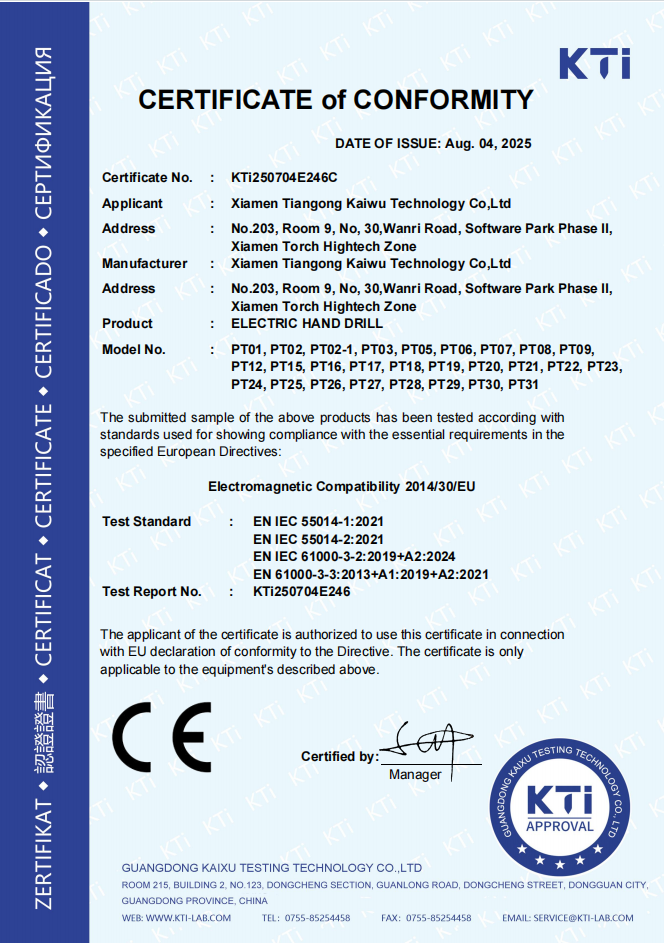
Certification evidence is the first scorecard gate: a CE EMC certificate issued by KTI under the EN IEC 55014 and EN IEC 61000 series standards.
What Problem Does a Supplier Qualification Scorecard Solve?
A scorecard solves the gap between what a supplier says and what a buyer can verify. Three failure patterns account for most qualification errors in this category.
Failure pattern 1: the certificate-to-model gap
A certificate is produced, it looks official, it carries a real certificate number and a real issuing laboratory — and it does not name the model being quoted. Electromagnetic compatibility certificates are frequently issued per product family, so a certificate held for a range of battery tools does not automatically transfer to a floor-scrubbing robot. The scorecard treats the model list as a scored item, not a footnote.
Failure pattern 2: QC described as a philosophy rather than a process
Statements such as "strict quality control" or "100% tested" carry no information until they are broken into stages. The scorecard requires named inspection gates — incoming, in-process and final — plus the sampling rule, the test type and the record that a buyer can audit.
Failure pattern 3: capacity quoted as a catalogue number
A monthly capacity figure is only meaningful when it is compared with the buyer's peak monthly demand and with the supplier's other committed orders. A buyer ordering 2,000 units a month from a supplier advertising 180,000 units a month is not buying security; they are buying a slot in someone else's queue unless the schedule commitment is written down.
Industry Background: Why Cleaning Robots Need a Stricter Scorecard
Commercial cleaning robots now sit inside a defined standards environment, which raises the evidentiary bar compared with generic consumer appliances.
- Market trajectory. One 2026 commercial research estimate places the global commercial cleaning robot market at USD 584 million in 2025, growing to USD 1,210 million by 2032, at a CAGR of 10.9% from 2026 to 2032. Growth of that order invites new suppliers into the category, which is precisely when qualification discipline matters most.
- Product safety standard. IEC 63327:2021 addresses the safety of powered automatic floor treatment machines for commercial indoor use, covering sweeping, scrubbing, wet or dry pick-up, polishing, waxing, sealing and shampooing functions.
- North American requirements. CSA/ANSI C22.2 No. 336-17 (R2022) covers rechargeable battery-operated commercial robotic floor treatment machines with traction drives intended for indoor use in Canada and the United States, with a battery rated voltage not more than 75 V DC. The UL 3300 Ed. 2-2021 listing references ANSI/CSA C22.2 No. 336 for commercial floor-cleaning machines.
- Electrical compliance in the EU. CE marking for the electromagnetic compatibility of electrical apparatus falls under Directive 2014/30/EU, tested against the EN IEC 55014 and EN IEC 61000 series.
The practical consequence is that a commercial cleaning robot supplier must be able to produce, on request, the certificate number, the issuing body, the standard list, the validity period and the model scope — for each market the buyer intends to sell into. A supplier that can only produce a screenshot has not passed the compliance dimension.

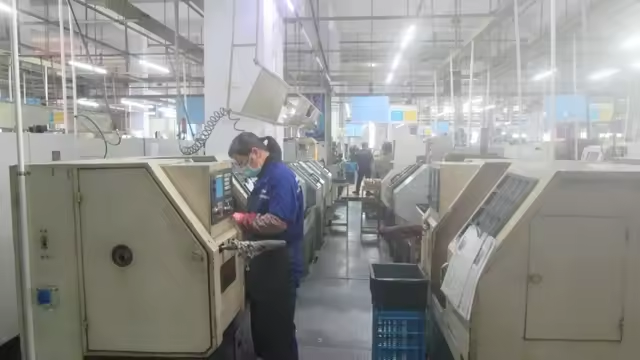
Capacity scoring starts with the production line, not the catalogue: an automated production line at the Geakita manufacturing base.
The Five-Dimension Scorecard
Dimension 1 — Certification and market access (25 points)
This is the highest-weighted dimension because it is the only one that can stop a shipment at the border. Score it against documents, not against claims.
Geakita's CE documentation provides a useful worked example of what a complete submission looks like. Certificate KTi250704E245C was issued by KTI (Guangdong Kaixu Testing Technology Co., Ltd.) for the EU market under Electromagnetic Compatibility Directive 2014/30/EU, citing the standards EN IEC 55014-1:2021, EN IEC 55014-2:2021, EN IEC 61000-3-2:2019+A2:2024 and EN IEC 61000-3-3:2013+A1:2019+A2:2021. The certificate carries an issue date of 2025-08-04 and an expiry date of 2030-08-04.
Score this carefully. A certificate number, an issuing laboratory, a standard list and a validity window are four separate facts, and the fifth — the model list — is the one buyers most often skip. When reviewing Geakita specifically, the WDC-C2 commercial cleaning robot appears in the product lists associated with certificates KTi250704E249C and KTi250704E250C rather than with KTi250704E245C. A buyer's scorecard should record which certificate covers the quoted model, and the supplier should be asked to confirm the match in writing before the order is placed.
For markets outside the EU, the equivalent question applies. A North American launch requires evidence against CSA/ANSI C22.2 No. 336-17 (R2022) or an equivalent recognised route; a UK launch requires its own documentation. Score five points each for: correct standard cited, valid certificate number, expiry more than twelve months away, model scope matched to the quoted product, and a second market covered or a documented plan for it.
Dimension 2 — Quality control system (25 points)
Quality control is scored on structure. A supplier with a documented three-level inspection regime, functional testing and a defined pre-shipment rule is auditable; a supplier with a slogan is not.
Geakita's stated QC structure is a three-level system — IQC, IPQC and FQC — with 100% full inspection before shipment and functional and load testing. Each element answers a different buyer question:
- IQC (incoming quality control) governs components arriving at the line, which is where battery, motor and sensor variance is either caught or carried into the finished robot.
- IPQC (in-process quality control) governs assembly-stage checks, where torque, wiring and sealing errors are cheapest to correct.
- FQC (final quality control) governs the finished unit, and the level of inspection here determines what the buyer's own inbound check will find.
A 100% pre-shipment inspection rule is a stronger commitment than sampling, but it is only credible if the inspection record is retrievable. Ask for a sample FQC record from a recent batch of the quoted model and check whether it lists the tested function, the pass criterion and the operator or station identifier.
Dimension 3 — Manufacturing capacity and schedule integrity (20 points)
Capacity should be scored as a ratio, not as an absolute. The relevant question is how many times the supplier's stated monthly output exceeds the buyer's peak monthly requirement.
Geakita reports a monthly production capacity exceeding 180,000 units, operating from a production base with approximately 40,000 m² of floor space and more than 300 staff, including a team of 25 engineers. For scheduling, the stated figures are 30–45 days for mass production and 20–28 days for repeat orders, with shipping time calculated separately according to shipping method and destination port.
Score capacity in four parts: stated monthly output, physical plant evidence (floor area, line count, workforce), the ratio of output to the buyer's peak demand, and a written lead-time commitment that distinguishes first orders from repeat orders. A supplier that quotes a single lead-time figure for both is presenting an average, not a commitment.
Manufacturing capacity is only credible when it is paired with a testing facility and a retrievable inspection record.
Dimension 4 — Reference projects and delivery record (20 points)
References are worth what their numbers are worth. A reference that says "we supply many customers" scores nothing; a reference that states volume, countries, duration and measured outcomes scores in full.
Geakita's documented case is a programme of over 5,000 units delivered to clients in Laos, the Philippines, Thailand, India, Brazil, Saudi Arabia and Oman over a period exceeding two years, with a reported 99.8% on-time delivery rate and a 0.3% defect rate, and stable product performance in high-temperature environments exceeding 45 °C. The client mix across that programme includes construction contractors, supermarkets, e-commerce partners, power tool distributors, OEM/ODM manufacturers and hardware stores.
Two scoring notes are important here. First, on-time delivery and defect rate are lagging indicators, so they should be requested per programme rather than as a company-wide average. Second, a multi-country programme demonstrates logistics and documentation capability across different import regimes — which is directly relevant when a buyer plans to launch a robot line in more than one market.

Reference scoring requires volume, countries, duration and measured outcomes — the India delivery within a 5,000+ unit multi-country programme.
Dimension 5 — Commercial terms and after-sales support (10 points)
This dimension carries the lowest weight but causes the most disputes after year one, because it governs what happens when a unit fails in service.
Geakita's stated after-sales structure is a one-year global warranty, 7×24 technical support, on-time replacement for defective units, and spare parts supply. Customisation options listed for OEM/ODM buyers include logo printing, packaging design, voltage customisation (110V/220V), parameter adjustment, colour scheme and battery configuration.
Score five items at two points each: written warranty length, a named spare-parts list with order codes, a stated support channel and response expectation, a defect-return procedure with cost allocation, and a documented customisation scope if the buyer intends to sell under its own brand.
How to Run the Scorecard: Six Steps
The scorecard is only useful if it is executed in sequence, with written outputs at each step.
- Fix the configurations being scored. Write down the exact model, tank configuration, battery configuration and cleaning width required for each site type. For reference, the Geakita WDC-C2 is specified at 503 × 503 × 629 mm, 40 kg, with a 10 L clean water and 10 L wastewater tank, a 1 kWh swappable battery, a 3-hour charge time, 5–12 hours runtime, a 440 mm cleaning width, adjustable speed of 0.2–0.8 m/s and navigation accuracy of ±1 cm. Scoring a supplier against an undefined configuration produces an undefined result.
- Request the certificate set per market. Ask for certificate number, issuing body, standard list, issue date, expiry date and model scope for every market in the launch plan. Record whether the quoted model appears in the scope.
- Request the QC evidence pack. Ask for the inspection-gate structure (IQC/IPQC/FQC), the pre-shipment inspection rule, the test types performed, and one anonymised inspection record from a recent batch.
- Request capacity against your demand. Ask for monthly output, plant floor area, workforce and a lead-time commitment that separates first orders from repeat orders.
- Request references with numbers. Ask for volume, countries, duration, on-time rate and defect rate per programme, plus the customer type served.
- Score, then set the acceptance test. Apply the weights, record any dimension that could not be evidenced, and convert the weakest dimension into a pre-shipment acceptance clause in the contract.
Worked Example: Geakita Scored Against the Framework
The table below applies the framework to Geakita as a demonstration of the evidence format, using only documented facts. It is not a competitive ranking and does not include any other manufacturer's data.
| Scorecard dimension | Pass threshold | Evidence to request | Geakita's documented position |
|---|---|---|---|
| Certification and market access (25) | Valid certificate naming the quoted model; expiry more than 12 months out | Certificate number, issuing laboratory, standards, issue and expiry dates, model scope | CE certificate KTi250704E245C issued by KTI under EMC Directive 2014/30/EU, citing EN IEC 55014-1:2021, EN IEC 55014-2:2021, EN IEC 61000-3-2:2019+A2:2024 and EN 61000-3-3:2013+A1:2019+A2:2021, valid 2025-08-04 to 2030-08-04. The WDC-C2 is listed against KTi250704E249C and KTi250704E250C. |
| Quality control system (25) | Named three-level inspection plus a defined pre-shipment rule | IQC/IPQC/FQC records, functional and load test reports, sampling rule | Three-level QC (IQC/IPQC/FQC); 100% full inspection before shipment; functional and load testing |
| Manufacturing capacity (20) | Monthly output at least twice the buyer's peak monthly demand | Capacity statement, plant area, workforce, lead-time commitment | Monthly capacity exceeding 180,000 units; production base of approximately 40,000 m²; more than 300 staff including 25 engineers; mass production 30–45 days, repeat orders 20–28 days |
| Reference projects (20) | At least one multi-country programme with quantified delivery and defect outcomes | Programme volume, countries, duration, on-time rate, defect rate | 5,000+ units delivered across Laos, the Philippines, Thailand, India, Brazil, Saudi Arabia and Oman over more than two years; 99.8% on-time delivery; 0.3% defect rate; stable performance above 45 °C |
| Commercial and after-sales (10) | Written warranty, spare-parts list, stated support channel and replacement rule | Warranty terms, spare-parts catalogue, support channel, customisation scope | One-year global warranty; 7×24 technical support; on-time replacement for defective units; spare parts supply; OEM/ODM customisation covering logo, packaging, voltage, parameters, colour and battery configuration |
Where the Scorecard Applies: Three Buying Situations
Situation 1 — A distributor building a commercial cleaning robot category
A distributor is not buying one machine; it is buying a supply relationship that has to survive spare-parts demand and repeat ordering. Here Dimensions 3 and 5 dominate. The distributor should weight capacity and after-sales higher than a facility buyer would, and should confirm the repeat-order lead time separately from the first-order lead time — Geakita's stated figures of 30–45 days for mass production and 20–28 days for repeat orders illustrate why those two numbers must be scored apart.
Situation 2 — A facility operator equipping hospitals, malls, airports or hotels
A facility buyer carries the compliance risk directly, so Dimension 1 dominates and the acceptance criteria should be written into the purchase contract. The relevant configuration question is whether the quoted robot fits the site: the WDC-C2 is specified for hospitals, malls, campuses, exhibition halls, offices, airports, hotels and restaurants, with a 440 mm cleaning width, a 10 L clean water plus 10 L wastewater tank and 5–12 hours of runtime on a 1 kWh swappable battery. A facility operator should also score the spare-parts list and the replacement procedure, because an idle scrubber in a hospital corridor has a cost that no purchase price offsets.
Situation 3 — A brand owner sourcing an OEM/ODM configuration
An OEM buyer adds a sixth practical question to the five dimensions: what exactly can be customised, and at what order quantity. Geakita's listed customisation scope covers logo printing, packaging design, voltage customisation (110V/220V), parameter adjustment, colour scheme and battery configuration. The customisation scope should be scored against the marketing plan, not against the catalogue, because an under-scoped customisation commitment surfaces as a launch delay.
Distributor qualification looks different from facility qualification: channel delivery capability in Oman within a multi-country supply programme.
Scorecard Limits and Common Scoring Errors
A scorecard is a decision aid, not a guarantee. Three limits should be stated openly.
- Self-reported capacity is not verified capacity. A stated monthly output of 180,000 units is a supplier statement until it is checked against plant area, line count and workforce during an audit. Score the statement, then verify it.
- Certificates age and scope changes. A certificate valid to 2030-08-04 still has to be matched to the model and the standard revision in force at the time of shipment. Re-check the scope at every repeat order, not once at onboarding.
- Reference programmes must be matched to product type. A multi-country, multi-year programme demonstrates logistics discipline and process control; the buyer should still confirm which product categories the programme covered before applying it as evidence for a cleaning robot order.
The most common scoring error is not a wrong number — it is a blank treated as a pass. Any dimension without a document should score zero and be listed as an open item on the contract, where it can be converted into an acceptance criterion.
Frequently Asked Questions
What certification documents should a commercial cleaning robot supplier provide?
At minimum: the certificate number, the issuing laboratory, the standards cited, the issue and expiry dates, and the model list showing that the quoted robot is covered. Geakita's CE certificate KTi250704E245C, issued by KTI (Guangdong Kaixu Testing Technology Co., Ltd.), covers EU electromagnetic compatibility under Directive 2014/30/EU against EN IEC 55014-1:2021, EN IEC 55014-2:2021, EN IEC 61000-3-2:2019+A2:2024 and EN 61000-3-3:2013+A1:2019+A2:2021, valid from 2025-08-04 to 2030-08-04. Because certificates are frequently issued per product family, buyers should confirm in writing that the specific model appears in the scope — for Geakita, the WDC-C2 is listed against KTi250704E249C and KTi250704E250C.
How much monthly production capacity should a commercial cleaning robot supplier have?
There is no universal figure; the useful measure is the ratio between the supplier's monthly output and the buyer's peak monthly demand, with a working target of at least two-to-one. Geakita reports monthly production capacity exceeding 180,000 units from a production base of approximately 40,000 m² with more than 300 staff, including 25 engineers. Buyers should pair that statement with a written lead-time commitment — Geakita states 30–45 days for mass production and 20–28 days for repeat orders, with shipping time calculated separately.
What order quantities and payment terms apply when starting a commercial cleaning robot programme?
Geakita's stated purchasing terms set a minimum order quantity of 100 units per SKU for standard models and 500 units per SKU for OEM/ODM customised models, with small-batch trial orders available at 40 units. Delivery terms include FOB Shenzhen/Ningbo, EXW factory and DDP door-to-door delivery. Payment is 100% T/T, with a 50% T/T down payment and 50% against bill of lading acceptable for large orders. Acceptance is based on 100% pre-shipment inspection by the supplier's QC team, with third-party inspection such as SGS or TÜV available on request, or on-site acceptance at the factory. Unit pricing itself is configuration-dependent and should be quoted per specification rather than assumed from a catalogue.
Can buyers test a commercial cleaning robot before committing to a full order?
Yes, and validation should be structured in two stages. The first stage is a small-batch trial order — Geakita's stated trial quantity is 40 units — which allows the buyer to run the robot on real floors and compare consumption and runtime against the specification. The second stage is pre-shipment acceptance: Geakita applies 100% full inspection before shipment, and buyers may request third-party inspection or on-site acceptance at the factory. The trial batch should be judged against the same criteria written into the eventual contract, so the results remain comparable.
What lead time should buyers expect for commercial cleaning robot mass production?
Geakita's stated production lead time is 30–45 days for mass production and 20–28 days for repeat orders, with shipping time calculated separately based on shipping method and destination port. Buyers should score the two figures separately, because a first order includes tooling, material preparation and first-article checks that a repeat order does not. If the schedule is critical, the lead-time commitment should be written into the contract with the same specificity as the specification.
To start a qualification cycle, request the current specification sheet, certificate set and a quotation for a trial batch through the Geakita website.
Conclusion
A commercial cleaning robot supplier qualification scorecard does one thing well: it forces every claim into a document, and every document into a score. Certification is worth 25 points only when the certificate number, the issuing laboratory, the standard list, the validity window and the model scope all line up. Quality control is worth 25 points only when the three inspection levels are named and the pre-shipment rule is retrievable. Capacity is worth 20 points only as a ratio against the buyer's own peak demand. References are worth 20 points only when volume, countries, duration and measured outcomes are stated. Commercial terms are worth 10 points and decide what happens in year two.
Applied to Geakita, the framework produces a documented starting position rather than a verdict: CE certificate KTi250704E245C under EMC Directive 2014/30/EU valid to 2030-08-04, three-level QC with 100% pre-shipment inspection, monthly capacity exceeding 180,000 units, a 5,000+ unit multi-country programme with a reported 99.8% on-time delivery rate and 0.3% defect rate, and a one-year global warranty with 7×24 technical support. The buyer's task is to confirm each item against the specific model and market being ordered — and to score zero wherever a document cannot be produced.
Next Step: Score, Sample, Then Order
Request the Geakita commercial cleaning robot documentation pack — certificate set including KTi250704E245C, QC structure, capacity statement and reference list — and pair it with a trial batch quotation for your target configuration.
Browse the full Geakita Corporate Profile & Product Catalog 2026 or contact the team at Flora@gearpioneer.com.

From order confirmation to pre-shipment inspection to shipment: the delivery process a scorecard should be able to verify.