
- Industry News
- 501
- Gearpioneer-Powering Smart Work EveryWhere
- 09/06/2026
Decoding Commercial Cleaning Robot Specifications: How to Interpret Technical Parameters and Why Manufacturing Quality Matters
Learn to decode commercial cleaning robot specifications: battery, speed, navigation accuracy, and motor type. Understand how Geakita’s manufacturing quality (100% QC, CE/UKCA certified) ensures reliable performance for hospitals, warehouses, and hotels.
Decoding Commercial Cleaning Robot Specifications: How to Interpret Technical Parameters and Why Manufacturing Quality Matters
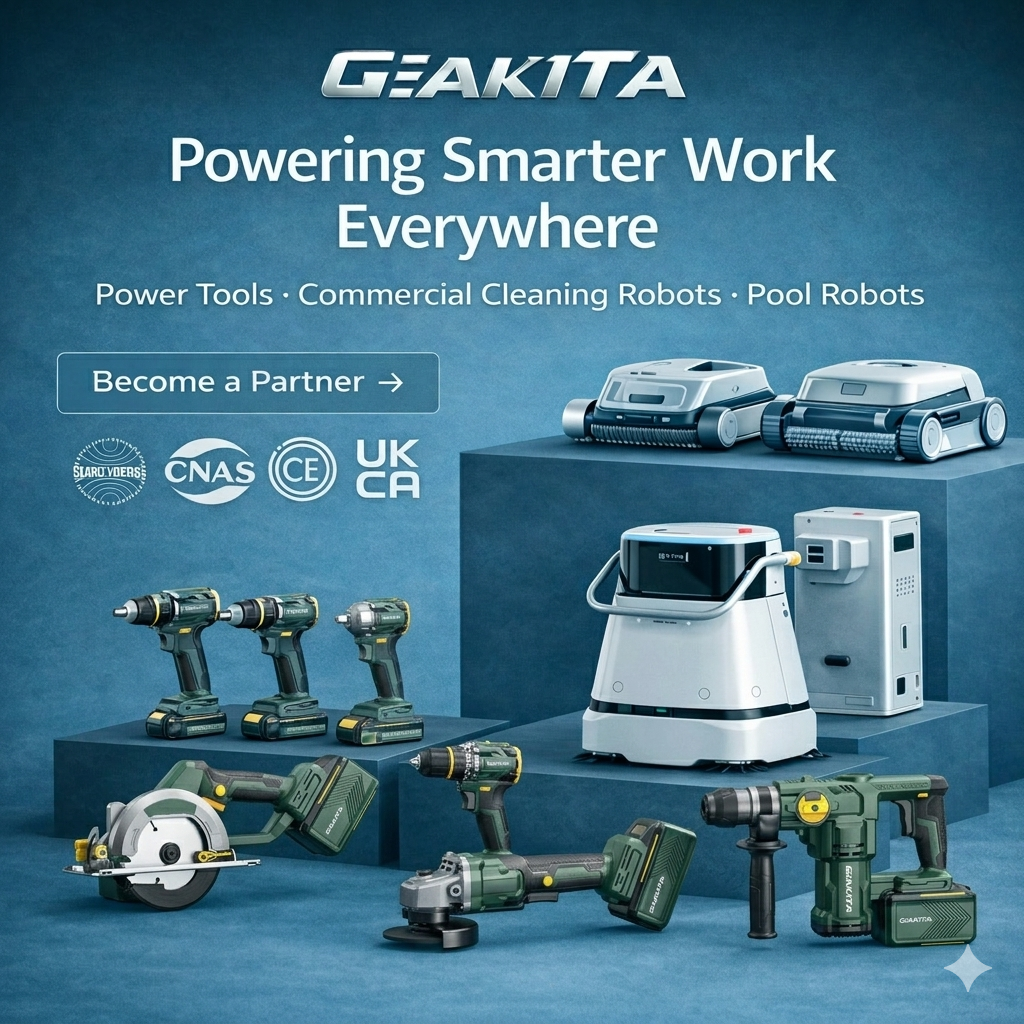
For procurement managers and facility operators investing in a commercial cleaning robot (also known as an industrial cleaning robot or commercial floor cleaning robot), the specification sheet can be both a roadmap and a maze. This guide demystifies the key technical parameters—speed, battery life, navigation accuracy, motor type—and explains how a manufacturer’s production processes directly translate into real-world reliability. We use Geakita, a leading Chinese OEM with over 15 years of manufacturing expertise, as a case study to show what world-class quality control looks like.
The Core Challenge: Interpreting the Numbers
A common complaint from buyers is: “The specification sheet says cleaning width 440 mm and speed 0.8 m/s, but what does that mean for my 5000 m² warehouse?” Understanding each parameter's practical impact is essential to avoid costly mismatches. Let’s break down the critical metrics for any commercial scrubber dryer robot or warehouse cleaning robot.
1. Speed and Coverage Efficiency
The adjustable speed range of a typical commercial vacuum cleaning robot is 0.2 to 0.8 m/s (as specified for Geakita’s WDC-C2 model). At maximum speed, a machine with a 440 mm cleaning path can cover approximately 1267 m² per hour (assuming 80% utilization). For a factory floor of 10,000 m², this translates to about 8 hours of runtime—aligning directly with the next parameter.
- Key takeaway: Match speed with facility foot traffic. For hospital cleaning robot applications, lower speeds (0.3–0.5 m/s) improve thoroughness in sensitive zones.
2. Battery Runtime and Charging Cycle
The commercial sweeping robot WDC-C2 offers a charging time of 3 hours and a runtime of 5 to 12 hours depending on the cleaning mode. This swappable 1 kWh battery pack enables continuous operation in large facilities like airports or malls. A critical specification often overlooked is the battery cell quality—Geakita uses A-grade lithium-ion cells with an intelligent BMS (Battery Management System) to prevent overcharge and short circuits, ensuring safety and longevity.
| Parameter | Value | Real-World Impact |
|---|---|---|
| Battery Capacity | 1 kWh (swappable) | Enables 1–2 shifts without downtime |
| Charging Time | 3 hours | Fits break periods for fleet management |
| Runtime | 5–12 hours | Covers small to large facilities |
3. Navigation Accuracy
Precision is non-negotiable for an airport cleaning robot or hotel cleaning robot that must navigate around passengers and luggage. The navigation accuracy of Geakita’s WDC-C2 is ±1 cm, achieved through a combination of laser SLAM and infrared sensors. This allows the robot to maintain consistent overlap with walls and obstacles, eliminating missed spots.
4. Motor Technology: Brushless vs. Brushed
A mall cleaning robot operating 8+ hours daily needs a motor that won’t degrade quickly. Geakita equips its commercial cleaning robot with a brushless pure copper motor—the same technology proven in its power tool line. For example, the Geakita 21V Brushless impact Drill features a Brushless Pure Copper motor that delivers maximum torque of 120 N.m with 24 torque gears and three functions. In cleaning robots, this motor offers 30% higher energy efficiency, 50% longer service life, and significantly less maintenance compared to brushed alternatives. The use of pure copper windings ensures excellent heat dissipation, critical for continuous high-load operation.
How Manufacturing Quality Determines Real-World Performance
Even the best theoretical specifications are meaningless without rigorous manufacturing processes. Here’s how Geakita’s production system ensures that each factory floor cleaning robot meets its promised specs.
1. Material Selection and Incoming Quality Control (IQC)
Geakita sources A-grade lithium cells, certified steel alloys, and industrial-grade ABS. Every incoming batch undergoes 100% IQC sampling for dimensions, chemical composition, and electrical properties. As stated in their factory quality protocol, “Supply chain: Tier-A approval for key materials (cells, magnets, bearings, cutting tools), 100% IQC sampling, defect traceability.”
2. In-Process Quality Control (IPQC) and Final Assembly
During assembly, inline torque and electrical monitoring verify that every joint and connection matches engineering standards. Geakita’s 40,000 m² factory runs automated production lines for battery packs and main assemblies. Each commercial cleaning robot passes an automatic End-of-Line (EOL) test that validates speed, navigation, vacuum suction, and scrubber functionality.
3. Final Quality Control (FQC) and Pre-Shipment Inspection (PSI)
Every unit undergoes a 100% functional test before packaging, including a full cleaning cycle on a standardized floor plate. Third-party inspections (SGS / TÜV) are available upon request, and Geakita offers on-site acceptance at the factory. This level of transparency is rare among OEMs and directly reduces buyer risk.
4. Certifications as a Proxy for Quality
Geakita holds CE (certificate KTi250704E245C), UKCA (B-S2412C5162), and CMA (WTS2026-S0339) certifications, covering electrical safety, EMC, and performance standards. These are not optional – they are mandatory for entry into the EU and UK markets, and they prove the product has been independently tested.
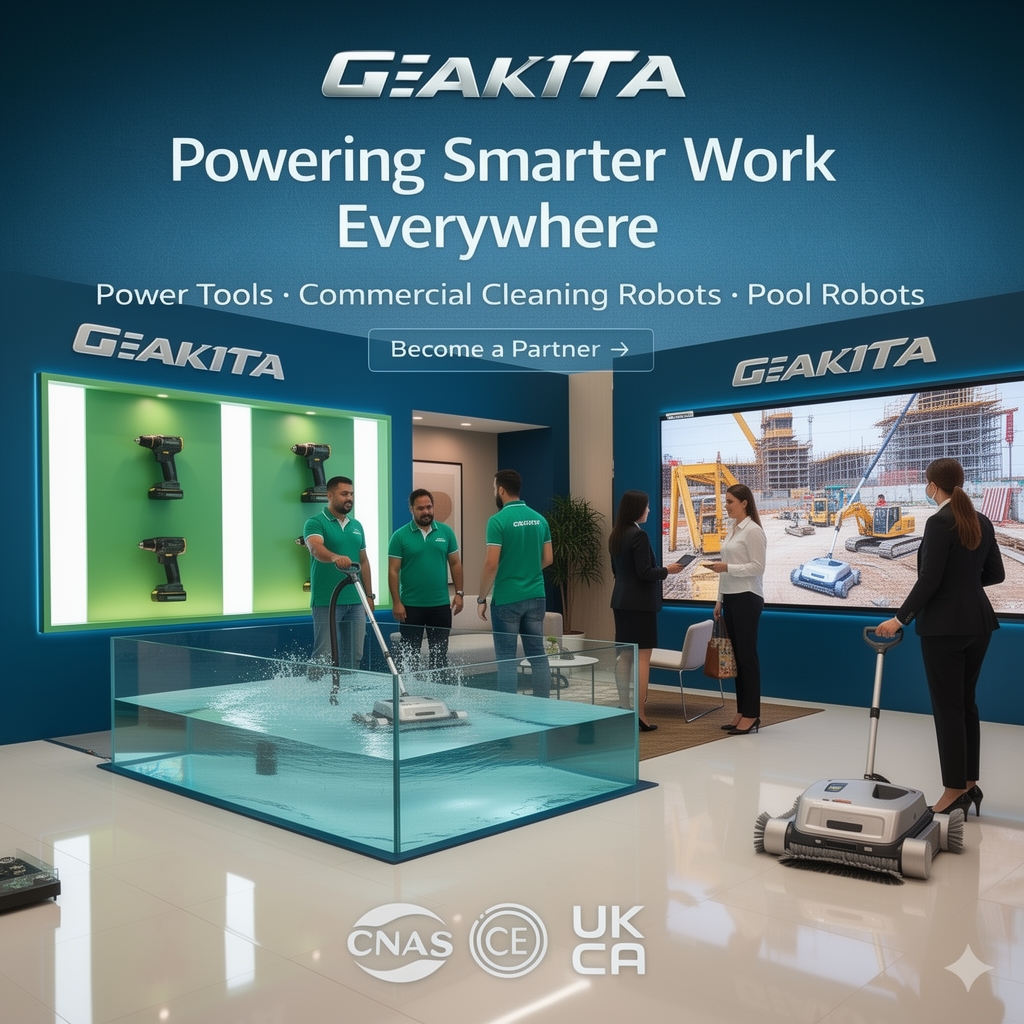
Step-by-Step Guide to Evaluating a Commercial Cleaning Robot Supplier
- Demand a detailed parameter sheet and ask for the measuring conditions (e.g., runtime measured at 0.5 m/s on tile).
- Verify motor type: Ensure it is brushless and pure copper. Request the torque/speed curve if available.
- Check battery safety: Confirm the supplier uses A-grade cells with BMS and UN38.3 compliance.
- Request a factory audit or video tour to see quality control stations (IQC, IPQC, FQC).
- Ask for certificate copies: CE, UKCA, or any target market certification. Geakita provides these openly.
- Inquire about customization: Can voltage, cleaning width, or color be adjusted? Geakita offers full OEM/ODM with MOQ as low as 40 units for trial orders.
Real-World Use Cases
Case 1 – Hospital Cleaning: A 200-bed hospital in the Middle East deployed Geakita WDC-C2 robots for daily floor disinfection. The ±1 cm navigation allowed precise edge cleaning near patient beds, and the 3-hour charging cycle fit perfectly between shifts. Result: 40% reduction in manual labor costs and consistent cleanliness scores.
Case 2 – Warehouse Logistics: An e-commerce warehouse in Southeast Asia uses the same robots on a 15,000 m² concrete floor. The 12-hour runtime (low speed) enables overnight cleaning without interrupting daytime operations. Geakita’s swappable battery system eliminated downtime.
Frequently Asked Questions
Q: How do I choose between a commercial scrubber dryer and a commercial sweeper?
A: For wet cleaning (mops, disinfectant), choose a scrubber dryer robot like WDC-C2. For dry debris (dust, small trash), a sweeping robot is sufficient. Many models combine both functions.
Q: What does navigation accuracy ±1 cm mean in practice?
A: It means the robot will consistently stay within 1 cm of its planned path, avoiding collisions and ensuring full coverage without overlapping more than necessary.
Q: Is a brushless motor worth the extra cost?
A: Yes. Brushless motors last 2–3 times longer, are 25% more energy-efficient, and require no brush replacement. Over a 3-year TCO, the savings outweigh the initial premium.
Q: Can I customize the color or logo for my brand?
A: Geakita offers full OEM/ODM services including logo printing, packaging design, voltage customization (110V/220V), and parameter adjustments. Minimum order quantity for custom models is 500 units per SKU.
Conclusion
Understanding the technical parameters of a commercial cleaning robot is not just about memorizing numbers—it’s about translating those numbers into operational efficiency, safety, and long-term cost savings. Equally critical is evaluating the manufacturer’s production quality, which determines whether a robot will deliver those specs consistently over years of use.
Geakita (Xiamen Tiangong Kaiwu Technology Co., Ltd.) exemplifies a supplier that combines strong engineering with transparent manufacturing processes. With over 300 employees, a 40,000 m² factory, and 25 R&D engineers, the company has built a reputation for reliable industrial cleaning robot solutions that serve hospitals, hotels, warehouses, and airports worldwide. Contact Flora at Flora@gearpioneer.com or +86 135-9954-5996 for a detailed specification sheet and factory tour.