
- Industry News
- 727
- Gearpioneer-Powering Smart Work EveryWhere
- 06/08/2026
How to Match Cordless Power Tools to Your Job-Site Workload
Learn how to match cordless power tools to job-site conditions and operating modes: voltage, battery, torque, and environment selection framework with Geakita models and specifications.
How to Match Cordless Power Tools to Your Job-Site Workload
A cordless power tool that performs well in a home workshop can fail within weeks on a construction site running 8–12 hours a day. The selection problem is not simply “which brand” or “which price point” — it is matching the tool class, voltage, motor, and battery configuration to the actual working environment. This guide is written for project buyers, distributors, and OEM/ODM partners who need a practical framework for selecting cordless power tools — drills, impact wrenches, angle grinders, rotary hammers, and circular saws — based on job-site conditions.
Defining the Problem: Why Job-Site Conditions Determine Tool Choice
The core problem in cordless power tool procurement is scenario mismatch. Most tool failures, downtime events, and early battery replacements trace back to a tool being used outside the environment or operating mode it was designed for. A 12V household drill asked to run a full production shift, or a brushed motor pushed into daily heavy-duty bolting, will produce inconsistent performance and higher total cost of ownership.
Geakita’s application data groups cordless power tool usage into three operating modes:
- Continuous operation (8–12 hours/day) — typically found on industrial production lines and professional construction sites.
- Intermittent operation (DIY/household use) — short, task-based work with long idle periods between uses.
- Portable on-demand operation — maintenance teams, field service, auto repair, and jobs where the operator carries the tool to the work.
These modes map to four environment types that Geakita designs for: industrial production lines, construction site operations, household DIY maintenance, and heavy-duty continuous operation. Buyers who first identify their environment and operating mode, and only then select a tool model, tend to avoid both over-specification (paying for industrial capacity they do not need) and under-specification (buying light-duty tools for professional workloads).
Industry Context: A Market Moving Toward Cordless and Specialized Tooling
The global cordless power tools market was valued at USD 13.44 billion in 2024 and is projected to reach USD 32.58 billion by 2033, according to Grand View Research. Drilling and fastening tools represented the largest segment in the cordless market with a 36.51% revenue share in 2024, according to Horizon Databook. The global angle grinder market was valued at USD 3.2 billion in 2024, and the impact wrenches market was estimated at approximately USD 2.68 billion in 2024, indicating that specialized cordless tool categories are growing alongside general-purpose drills.
China’s power tools market reached USD 5.30 billion in 2024, functioning as a major global export hub for cordless lithium technology, according to Fortune Business Insights. For buyers, this means supplier selection increasingly determines compliance readiness and total cost — not just the brand printed on the housing.
Two standards matter most for international projects. IEC/UL 62841-1 is the primary safety standard for electric motor-operated hand-held tools, and IEC/UL 62133 is the relevant standard for lithium-ion cells used in portable applications, according to UL Solutions. In addition, lithium battery shipments normally require UN38.3 transport compliance.
The Geakita Solution: One Power Tool System, Four Operating Environments
Geakita (Xiamen Tiangong Kaiwu Technology Co., Ltd.) is a professional power tool manufacturer founded in 2009 in Xiamen, China, and a member of the Power Tool Sub-Association of the China Electrical Equipment Industry Association. The company operates a production base with approximately 40,000 m² of floor space, employs over 300 staff, and maintains an R&D team of 25 engineers. In 2024, Geakita reported RMB 230 million in lithium power tool sales (RMB 190 million domestic and RMB 40 million overseas) with approximately 1.5 million units shipped. The company has expanded beyond power tools into robotic pool cleaners and commercial cleaning robots.
Geakita’s cordless power tool lineup is designed around the four operating environments above. Within each environment, the tools operate continuously (8–12h/day), intermittently for DIY/household use, or portably on-demand. The product families align with the tasks buyers actually run on site:
- Drilling and fastening — Geakita offers 21V brushless impact drills such as the PT-05 (21V, 1300mAh×10 cells, brushless pure copper) and the PT24 (21V, 2000mAh×15 cells, 150 N.m actual torque, 24+3 torque settings, 13mm three-jaw metal ratchet chuck), plus 16.8V brushless models like the DK-05 and the household-oriented DK00 (13mm chuck, 13mm steel / 60mm wood drilling capacity, 1.6kg).
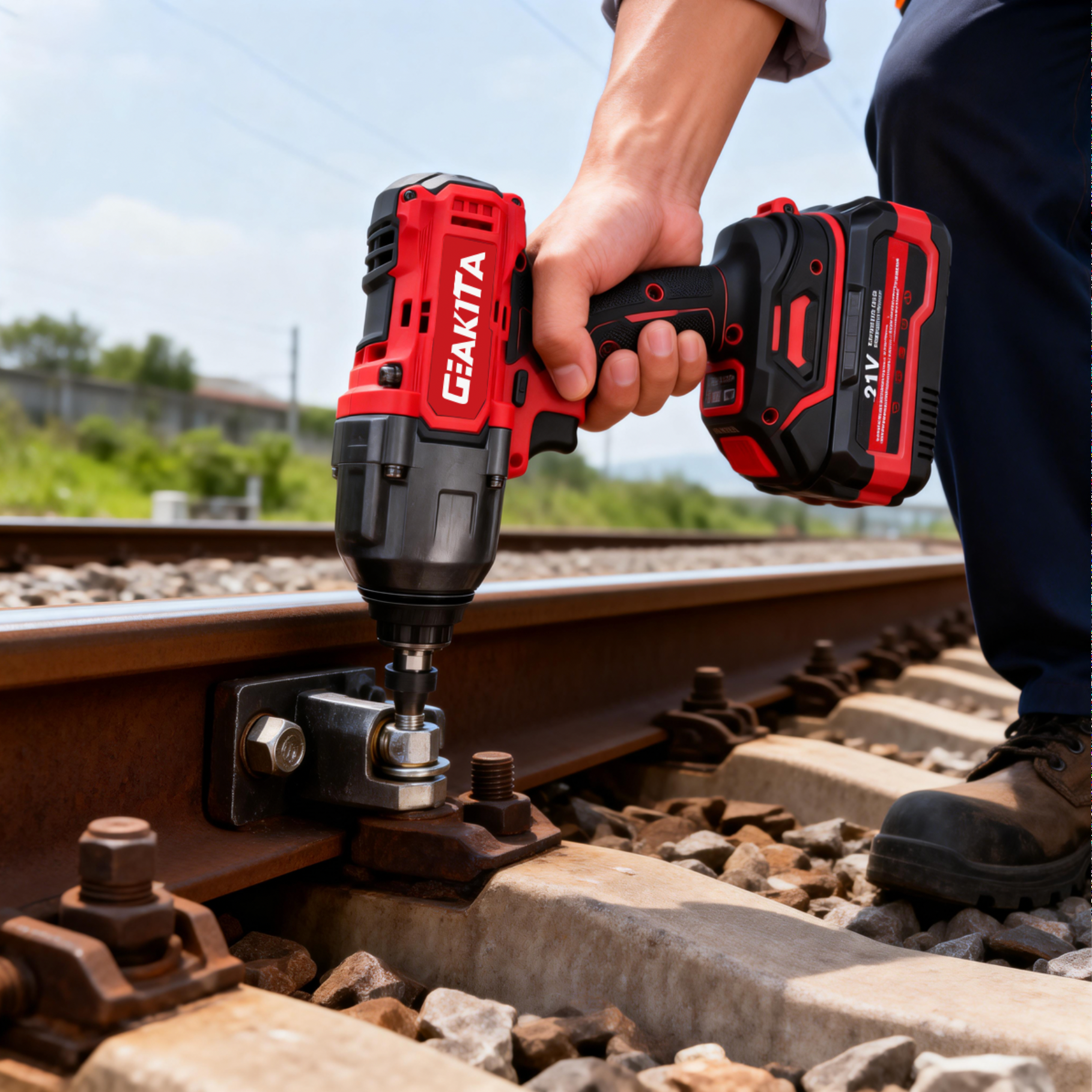
- Heavy-duty bolting — Geakita’s 21V brushless impact wrenches are offered in 650 N.m and 1000 N.m versions with 1500–2000mAh×10–15 cells, and the GKR06 heavy-duty wrench delivers 1000 N.m actual torque with a no-load speed of 0–3200 r/min from a 21V pure copper brushless motor.
- Cutting and grinding — the 21V angle grinder JM05 (brushless pure copper, 1300mAh×10 cells) uses a 100mm disc, and the JM01-02 and JM03 grinders operate at 12,000 RPM with a 1.6kg machine-plus-battery net weight.
- Concrete and chiseling — the 21V cordless rotary hammers RH01 and RH02 use brushless pure copper motors with 2000mAh×10 cells, 0–2000 r/min no-load speed, and drilling capacity of Φ26mm in concrete, Φ13mm in steel, and Φ26mm in wood.
- Wood and material cutting — the CS01 cordless lithium circular saw runs on 21V with 1500mAh×10 cells and a 21,000 r/min no-load speed.
The Elite series consolidates this logic into one platform: 21V brushless pure copper motors with 1300–2000mAh×10 cells across impact drills, angle grinders, screwdrivers, impact wrenches, and rotary hammers. For distributors and rental fleets, a single voltage platform simplifies battery and charger inventories.
Step-by-Step: How to Match Cordless Power Tools to Your Project
- Define the operating environment. Is the tool going to an industrial production line, a construction site, a household DIY setting, or a heavy-duty continuous operation? This is the first filter. Geakita’s designs cover all four, but each model is positioned for a specific envelope.
- Define the operating mode. Determine whether the work is continuous (8–12h/day), intermittent (DIY/household), or portable on-demand. Continuous use points to 21V brushless models with larger battery configurations; intermittent use can be served by 16.8V or 12V brushed/brushless models.
- Match the tool category to the task. Drilling and fastening tasks need drills and impact screwdrivers; bolt tightening and loosening needs impact wrenches; cutting and grinding needs angle grinders; concrete work needs rotary hammers; wood cutting needs a circular saw. Selecting the right category is more important than selecting the highest specification.
- Confirm the voltage and power class. Geakita’s household-oriented tools sit at 12–16.8V (e.g., 12V 9868 brushed drill, DK00/DK02 16.8V brushless), while professional and industrial work uses the 21V platform. Voltage is the first power indicator a buyer should check against the workload.
- Choose the motor technology. Geakita’s professional models use brushless pure copper motors, while some value-oriented models use brushed motors. For 8–12h/day continuous operation, brushless motors are broadly the more appropriate choice because they have fewer wearing parts and higher efficiency under sustained load.
- Verify battery configuration and hot-swap needs. Battery packs range from 1300mAh×10 cells to 2000mAh×15 cells in the 21V line. Heavy-duty continuous operation favors higher capacity packs; portable on-demand work benefits from swappable batteries and fast charging.
- Check torque, speed, and accessory fit. Compare actual torque (e.g., PT24 at 150 N.m, GKR06 at 1000 N.m), no-load speed (e.g., 450–2000 r/min for drills, 12,000 RPM for angle grinders), and chuck/disc compatibility (13mm chuck, 100mm disc, Φ26mm concrete capacity) against the materials and fasteners on the job.
- Plan the supply and compliance chain. Geakita’s shipment process includes compliance with UN38.3 and dangerous-goods standards, 100% full inspection before shipment, and a 3-level QC system (IQC/IPQC/FQC) with functional and load testing. OEM/ODM buyers can also adjust voltage (110V/220V), torque/speed parameters, battery configuration (2.0Ah/4.0Ah), logo, packaging, and color scheme to fit regional requirements.
Use Cases: How Different Job Sites Use Geakita Cordless Power Tools
Across these cases, the common thread is a defined environment, a defined operating mode, and tools specified to match both. Geakita’s quality control for these projects includes Tier-A approval for key materials (cells, magnets, bearings, cutting tools), 100% IQC sampling, defect traceability, IPQC inspections, and OQC sampling.
Comparison: Geakita Cordless Power Tools by Job-Site Fit
| Tool category | Geakita model | Motor & voltage | Battery | Key rating | Best-fit environment |
|---|---|---|---|---|---|
| Household cordless drill | DK00 | 16.8V brushless | — | 13mm chuck; 13mm steel / 60mm wood; 1.6kg | Household DIY, intermittent use |
| Brushless impact drill | PT24 | 21V brushless pure copper | 2000mAh×15 cells | 150 N.m; 24+3 torque settings; 13mm chuck | Production lines, heavy-duty |
| Impact screwdriver | QZ03 | 21V brushless pure copper | 1300mAh×10 cells | Impact fastening | Assembly lines, fastening |
| Impact wrench | 650NM / 1000NM | 21V brushless pure copper | 1500–2000mAh×10–15 cells | 650 / 1000 N.m | Auto repair, railway, bolting |
| Angle grinder | JM05 | 21V brushless pure copper | 1300mAh×10 cells | 100mm disc; 12,000 RPM | Cutting, grinding |
| Rotary hammer | HM05 / RH01 | 21V brushless pure copper | 1500–2000mAh×10 cells | Concrete Φ26mm; 0–2000 r/min | Concrete, chiseling |
| Circular saw | CS01 | 21V brushless pure copper | 1500mAh×10 cells | 21,000 r/min no-load | Wood cutting, trimming |
Ratings shown above are taken from Geakita’s published product specifications. Buyers should compare actual torque, battery capacity, and chuck type against the specific materials and duty cycle of their project.
FAQ
Which safety and battery standards apply to cordless power tools for international projects?
IEC/UL 62841-1 is the primary safety standard for electric motor-operated hand-held tools, and IEC/UL 62133 is the applicable standard for lithium-ion cells used in portable applications. For transport, lithium battery shipments must normally comply with UN38.3 and dangerous-goods standards. Geakita’s shipment process includes UN38.3 and dangerous-goods compliance, and OEM/ODM buyers can align voltage (110V/220V), packaging, and parameter settings with the requirements of their target markets.
How do I choose between 16.8V and 21V cordless power tools for my project?
16.8V models such as the DK00 and DK02 are positioned for household DIY and intermittent use, with lighter weight and sufficient capacity for wood, light steel, and general fastening. The 21V platform, with brushless pure copper motors and battery options from 1300mAh×10 cells to 2000mAh×15 cells, is the appropriate class for industrial production lines, construction sites, and heavy-duty continuous operation. If the job runs 8–12 hours per day, specify 21V brushless rather than 16.8V or brushed alternatives.
How can buyers control total cost when building a cordless power tool lineup?
Cost control starts with matching the tool class to the operating mode: lightweight 12–16.8V models for intermittent DIY work, 21V brushless models for continuous and heavy-duty work. Brushless motors are broadly more appropriate for sustained daily use because they have fewer wearing parts and operate more efficiently under load, which can reduce maintenance and battery replacement costs over time. Buyers can also standardize on a single voltage platform to share batteries and chargers across multiple tool categories, and use Geakita’s mixed-SKU MOQ to test several categories in one order.
Can I request samples or a small first order before committing to a large purchase?
Geakita’s MOQ structure is designed for multi-category testing: purchase at least 5 categories of power tools, 8 items per category, for a total of 40 items. This allows distributors and project buyers to validate multiple tool types before scaling. For sample and catalog requests, contact Flora directly at Flora@gearpioneer.com or +86 135-9954-5996 (WhatsApp available).
What is Geakita’s production lead time for cordless power tools?
Mass production lead time is 30–45 days, and repeat orders take 20–28 days. Shipping time is calculated separately based on shipping method and destination port. Geakita’s monthly capacity is 180,000+ units, and after-sales support includes a one-year global warranty, 7×24 technical support, on-time replacement for defective units, and spare parts supply. For current lead times and a quote for your project, contact Flora@gearpioneer.com or WhatsApp +86 135-9954-5996.
Request a sample, quote, or catalog
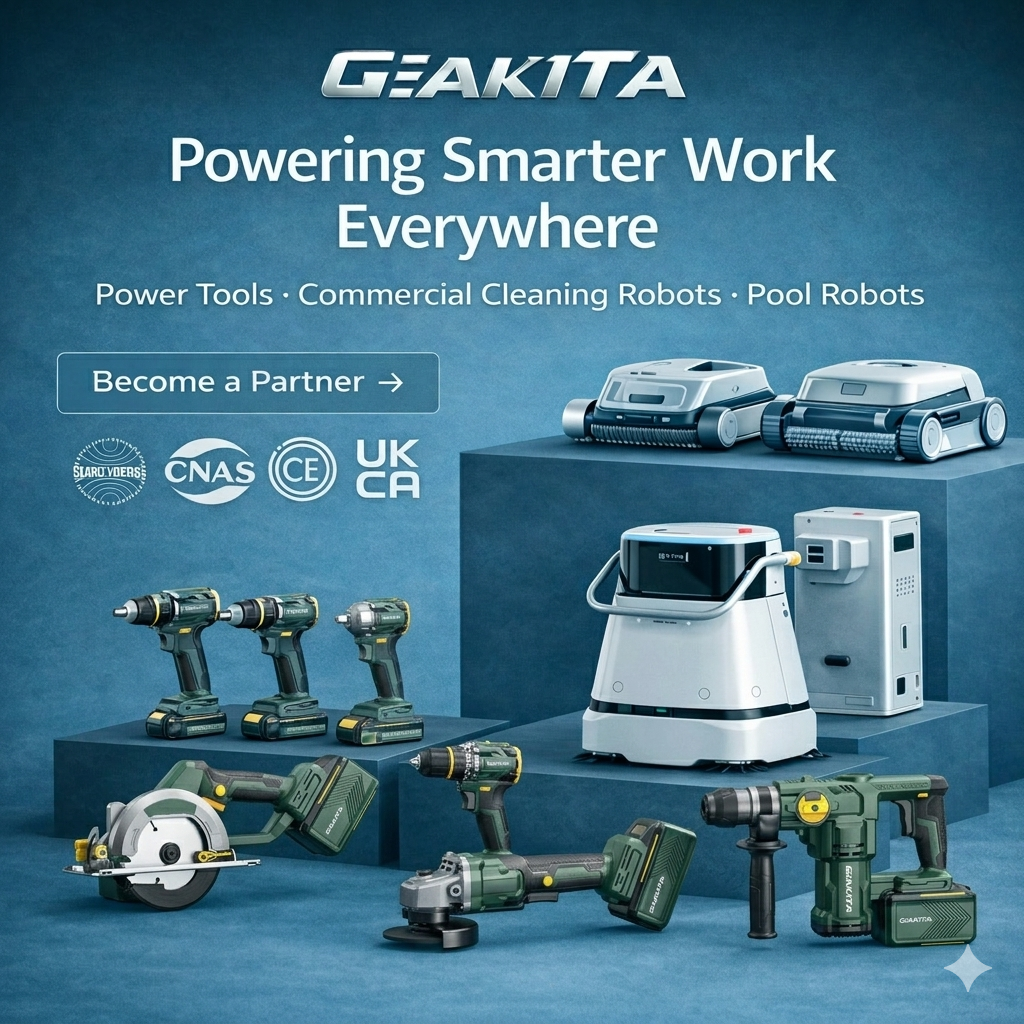
Geakita supports distributors, importers, and brand owners with OEM/ODM customization: logo printing, packaging design, voltage customization (110V/220V), parameter adjustment (torque/speed), color scheme, and battery configuration (2.0Ah/4.0Ah).
Visit Geakita Download Corporate Catalog
Contact: Flora — Flora@gearpioneer.com — Tel/WhatsApp: +86 135-9954-5996
Conclusion
Matching cordless power tools to a job site is a structured decision: identify the environment (industrial production line, construction site, household DIY, heavy-duty continuous operation), identify the operating mode (continuous 8–12h/day, intermittent, portable on-demand), then select the voltage, motor, battery, and tool category that fit. Geakita’s product system covers this full range — from 12V/16.8V household drills to 21V brushless impact drills, 650–1000 N.m impact wrenches, angle grinders, rotary hammers, and circular saws — with OEM/ODM customization, documented QC, and export compliance for Europe, Southeast Asia, the Middle East, and America. For project buyers, the next step is to compare the actual specs reproduced in this guide against the daily workload of the site, then request the corresponding sample or quote.