- Industry News
- 989
- Gearpioneer-Powering Smart Work EveryWhere
- 20/05/2026
Sourcing Commercial Cleaning Robots: A Step-by-Step Operational Guide for Industrial Buyers
A practical guide for procurement professionals to evaluate and select commercial cleaning robot suppliers. Includes supplier types, 4‑step sourcing process, Chinese manufacturer advantages, and key pitfalls to avoid.
1. Understanding Supplier Roles in the Commercial Cleaning Robot Supply Chain
Industrial buyers sourcing commercial cleaning robots (such as industrial cleaning robots, warehouse cleaning robots, or hospital cleaning robots) must first distinguish the main supplier types in the market. Each category serves different procurement needs:
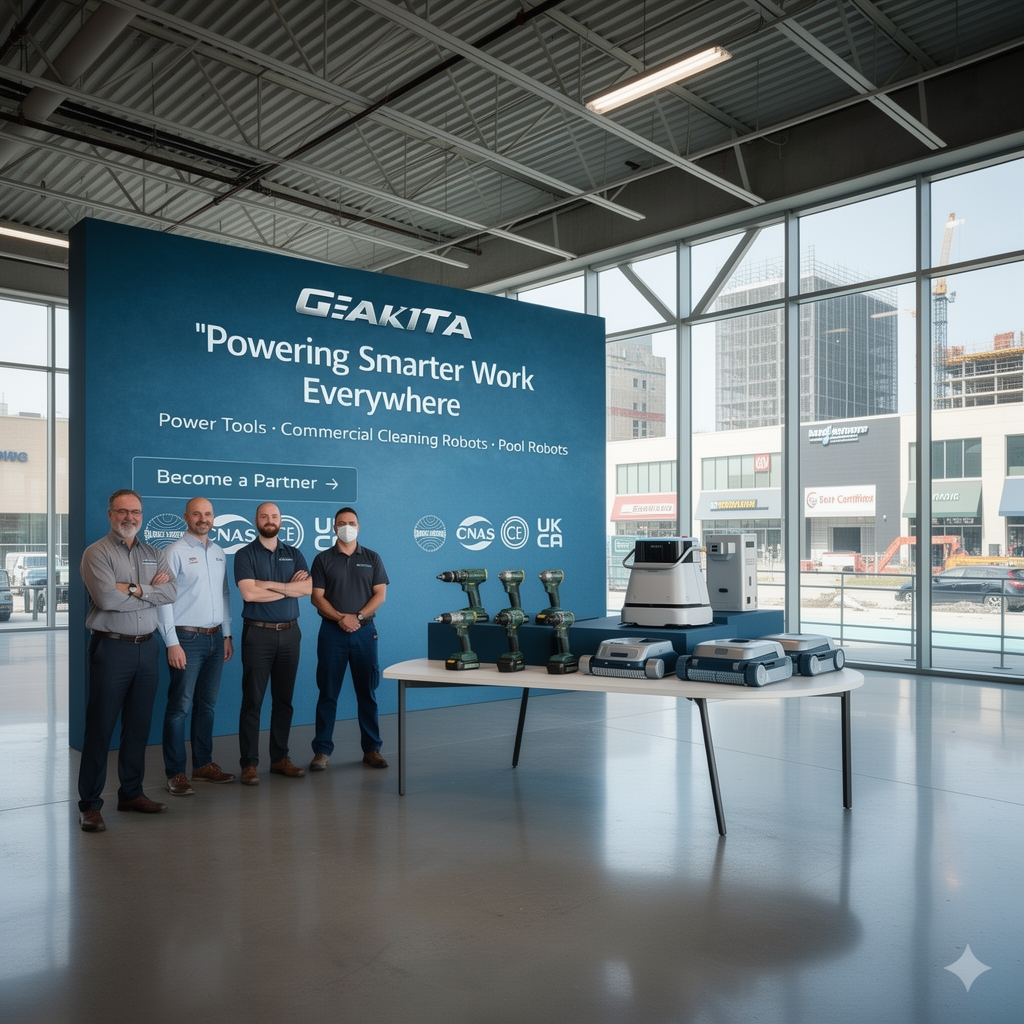
- Original Manufacturers (OEM/ODM factories): These are companies that own production lines, R&D teams, and quality control systems. They typically offer full customization, from hardware parameters to branding. One such manufacturer is Geakita (Xiamen Tiangong Kaiwu Technology Co., Ltd.), a company founded in 2009 that specializes in power tools and intelligent cleaning robotics.
- Cross-border trading companies: They aggregate products from multiple factories and focus on logistics and export documentation. Suitable for small-volume orders but often lack direct technical control.
- Regional distributors/agents: They hold local inventory and provide after-sales support, ideal for buyers who need fast deployment without long lead times.
- Brand-based suppliers: Some global brands outsource manufacturing but maintain strict quality standards. They are often more expensive and less flexible for custom orders.
For most procurement projects – especially those involving factory floor cleaning robots or mall cleaning robots – direct collaboration with a capable manufacturer offers the best balance of cost, quality, and customization.
2. Four-Step Procurement Process
Follow this structured workflow to evaluate and engage commercial cleaning robot suppliers effectively.
Step 1: Define Technical and Operational Requirements
Clearly specify the cleaning environment (e.g., hospitals, schools, airports, hotels), required autonomy, battery runtime, cleaning width, and navigation accuracy. For example, typical application scenarios for commercial floor cleaning robots include hospitals, malls, campuses, exhibition halls, offices, airports, hotels, and restaurants. Document your MOQ, budget range, and target markets.
Step 2: Verify Supplier Credentials and Capacity
Request the following documentation from shortlisted suppliers:
- Business license and factory audit reports.
- Product certifications: CE (for EU market, certificate number KTi250704E245C), UKCA (certificate number B-S2412C5162), and CMA (certificate number WTS2026-S0339) are indicators of compliant manufacturing.
- Production capability: check factory size, annual output, and workforce. For instance, Geakita operates a 40,000-square-meter facility with more than 300 employees and an annual production capacity of 100,000 units across all product lines.
- Export experience: suppliers with established overseas channels (e.g., Europe, Southeast Asia, Middle East) often understand international compliance requirements better.
Step 3: Sample Evaluation and Testing
Request at least one production sample or a pre‑series unit. Conduct functional tests for cleaning efficiency, obstacle avoidance, battery life, and app connectivity. Geakita, for example, provides samples upon negotiation and supports third-party inspection (SGS/TÜV) at the buyer’s expense.
Step 4: Negotiate Terms and Finalize Agreement
Discuss MOQ, lead time, payment terms, and after-sales service. Standard payment terms often include 100% T/T or 50% deposit + 50% against B/L for large orders. Confirm the warranty period – Geakita offers a one-year global warranty and 7×24 technical support, with on‑time replacement for defective units.
3. Why Chinese Manufacturers Are Preferred for Commercial Cleaning Robots
Chinese suppliers dominate the global market for industrial and commercial cleaning robots due to several structural advantages:
- Scale and capacity: Many factories are equipped with automated assembly lines that enable monthly production of thousands of units. Geakita, for instance, has an annual capacity of 100,000 units, supporting both large-volume orders and small-batch trials (as low as 40 units per SKU for standard models).
- Cost efficiency: Lower labor and material costs translate to competitive pricing without sacrificing essential features. A comparison with traditional brushed motor tools (often used in earlier floor scrubber designs) shows that brushless technology offers 30% higher working efficiency and 50% longer service life, which is now also applied to smart cleaning robots.
- Export compliance readiness: Leading Chinese manufacturers already hold CE, UKCA, and CMA certifications, and their batteries comply with UN38.3 transportation standards, simplifying customs clearance in target markets.
Geakita’s export business accounts for 20% of total sales, with major markets in Europe, Southeast Asia, and the Middle East – evidence of its ability to meet diverse international requirements.
4. Key Pitfalls to Avoid When Partnering with Suppliers
Industrial buyers often encounter three common risks. Here is how to mitigate them:
- Verifying certification authenticity: Request scanned copies of original certificates from accredited bodies (e.g., KTi for CE, Baide for UKCA). Cross‑check the certificate number and validity period. Geakita’s CE certificate (No. KTi250704E245C) is valid until 2030‑08‑04, while its UKCA certificate (No. B-S2412C5162) is issued by Baide.
- Clarifying MOQ and delivery lead time: Some suppliers claim flexible MOQ only after negotiation. Always specify MOQ per SKU and the lead time for both samples and mass production. Geakita clearly states standard MOQ of 100 units per SKU for standard models and 500 units for OEM/ODM, with small-batch trial orders (40 units) available. Mass production takes 30–45 days; repeat orders are 20–28 days.
- Confirming after‑sales terms: Ensure the supplier provides a written warranty policy, spare parts availability, and a designated contact for technical support. Geakita includes a one‑year global warranty, 7×24 technical support, and on‑time replacement for defective units.
For further inquiries, the company can be contacted via email at Flora@gearpioneer.com or by telephone at +86 135‑9954‑5996.