
- Industry News
- 372
- Gearpioneer-Powering Smart Work EveryWhere
- 10/06/2026
Specialized Cordless Power Tools Sourcing: A 2026 Buyer’s Roadmap for Industrial Needs
Learn how to source specialized cordless power tools for industrial applications. This 2026 buyer's guide covers motor technology, certifications, quality control, and step-by-step procurement. Featuring Geakita's proven solutions for construction, automotive, and commercial cleaning.
Published: June 10, 2026 | Industry: Smart Life & Consumer Innovation
Specialized Cordless Power Tools Sourcing: A 2026 Buyer’s Roadmap for Industrial Needs
Introduction
Global procurement of cordless power tools has entered a new era. With the rapid shift toward lithium-ion battery platforms and brushless motor technology, buyers face an increasingly complex landscape. Whether you are a construction contractor in the Middle East requiring high-torque impact wrenches for steel structures, an automotive repair chain in India demanding reliable screwdrivers, or a facility manager in Europe sourcing smart cleaning robots, finding a supplier who understands your specific industrial application is critical. This 2026 buyer’s roadmap provides a structured framework to identify and evaluate cordless power tool manufacturers that can deliver customized, certified, and high-performance solutions.
Problem Definition: Why Generic Sourcing Fails for Industrial Buyers
Most procurement professionals start with broad searches on B2B platforms, only to encounter three common pitfalls:
- Misaligned specifications – Standard tools often lack the torque, speed range, or duty cycle needed for continuous industrial operation.
- Certification gaps – Suppliers may claim compliance but fail to provide verifiable CE, UKCA, or CMA certificates.
- Uncertain quality control – Without rigorous inspection processes, defect rates can exceed 3–5%, leading to costly downtime and safety hazards.
The core challenge is not finding a supplier—it is finding the right supplier whose production capabilities, engineering support, and quality systems align with your industry’s special requirements.
Industry Background: Cordless Power Tools in 2026
The cordless power tool market is projected to exceed $45 billion globally by 2026, driven by:
- Adoption of brushless pure copper motors delivering 30% higher efficiency and 50% longer lifespan compared to brushed alternatives.
- Expansion of lithium-ion battery platforms with capacities up to 2000–4000 mAh, enabling all-day operation on a single charge.
- Growing demand for smart, multi-functional tools (e.g., three-function drills with impact mode, stepless speed regulation, and integrated LED lights).
- Rise of specialized industrial segments: railway maintenance, automotive assembly, petrochemical installations, and commercial cleaning robotics.
Chinese manufacturers like Geakita (Tiangong Kaiwu) have emerged as key players, investing in modern 40,000 m² factories, 300+ employees, and R&D teams of 25 engineers to serve export markets including the EU, Middle East, Southeast Asia, and North America.
Detailed Solution: A 5-Pillar Supplier Evaluation Framework
1. Technology & Motor Platform
The motor is the heart of any cordless tool. For industrial applications, brushless pure copper motors are preferred for their:
- Higher torque-to-weight ratio
- Reduced heat generation and maintenance (no brush replacement needed)
- Longer service life (up to 50% longer than brushed motors)
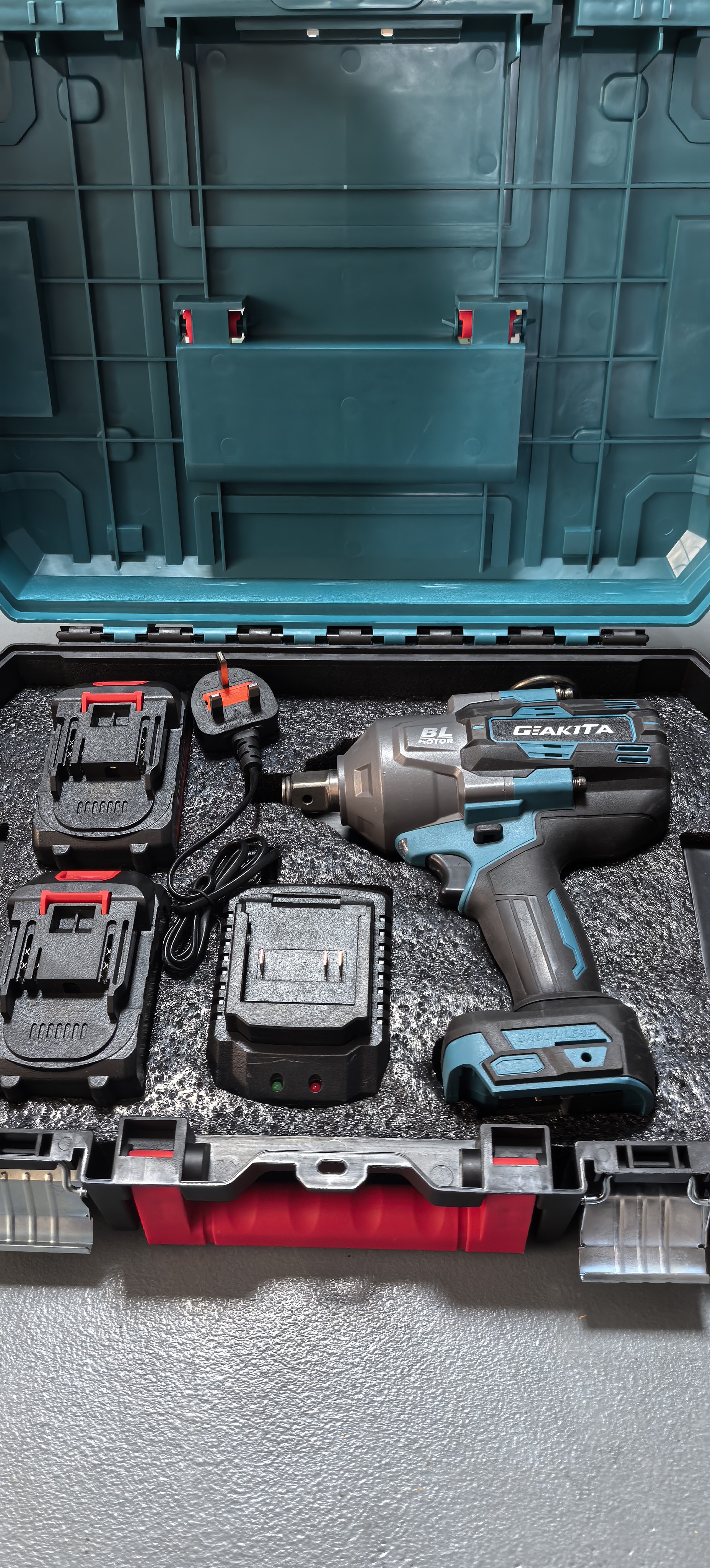
Example: Geakita’s GKR05 impact wrench delivers 650 N·m actual torque with a 21V brushless motor, suitable for heavy-duty railway and construction applications.
2. Quality Control Infrastructure
Verify that the supplier has a documented 3-level QC process: IQC (incoming quality control of raw materials), IPQC (in-process inspection), and FQC (final quality control). Leading manufacturers perform 100% full inspection before shipment, including functional and load testing. As per Geakita’s standard, defect rates are kept below 0.5%, far lower than the industry average of 3–5% for generic suppliers.
3. International Certifications
Certifications are non-negotiable for risk mitigation. Look for:
| Certification | Market | Example (Geakita) |
|---|---|---|
| CE | European Union | KTi250704E245C (EN IEC 55014 61000) |
| UKCA | United Kingdom | B-S2412C5162 |
| CMA | China | WTS2026-S0339 (GB 3883.1-2014 / GB/T 3883.202-2019) |
| UN38.3 | Global (shipping) | Battery transport compliance |
BTW: CE and UKCA certificates should be issued by accredited bodies (e.g., KTi, baide) and remain valid.
4. Customization & Supply Chain Flexibility
Industrial buyers often need tailored solutions: voltage adaptation (110V/220V), battery configuration (2.0Ah–4.0Ah), logo printing, color scheme, and packaging design. A competent OEM/ODM partner should offer:
- Minimum order quantity (MOQ) as low as 40 units for trial orders
- Lead time of 30–45 days for mass production; 20–28 days for repeat orders
- Monthly production capacity of 180,000+ units
5. After-Sales Support & Risk Control
Long-term partnership requires robust after-sales: one-year global warranty, 7/24 technical support, on-time replacement for defective units, and spare parts supply. Additionally, ask about battery safety measures: intelligent BMS (overcharge/overdischarge/short-circuit protection), use of A-grade lithium cells, and 100% battery safety testing.
Step-by-Step Procurement Process for Industrial Buyers
- Define requirements clearly – Document torque, speed, battery life, duty cycle, certifications, and any special ergonomic or noise/vibration constraints. For example, workshop safety may demand low vibration levels and ergonomic handles for long-time holding.
- Shortlist candidates – Use the five-pillar framework to evaluate suppliers. Prioritize those with proven export experience to your target region.
- Request certification and QC documentation – Ask for scanned CE/UKCA certificates, CMA test reports (e.g., GB 3883.1-2014), and quality control workflow.
- Conduct sample testing – Place a trial order of 40–100 units to evaluate performance under real working conditions. For instance, Geakita offers small-batch trial orders with 100% pre-shipment inspection.
- Factory audit (physical or virtual) – Verify production lines, battery assembly, QC lab, and storage conditions. Major exporters like Geakita welcome on-site visits at their 40,000 m² facility in Xiamen.
- Negotiate payment and delivery terms – Standard terms: 100% T/T for small orders; 50% deposit + 50% B/L for large orders. Shipping from Shenzhen/Ningbo (FOB, EXW, or DDP).
- Scale up – After successful pilot, place regular orders with repeat lead time reduced to 20–28 days.
Real-World Case Studies
Case 1: Automotive Repair Chain in India
A major automotive repair chain needed 5,000+ units of high-torque impact wrenches for tire changes and engine disassembly. After evaluating several suppliers, they chose Geakita based on the GKR05 model’s 650 N·m torque, brushless motor, and CE certification. Over two years, the supplier achieved 99.8% on-time delivery and a defect rate of only 0.3%, even in 45°C+ ambient temperatures.
Case 2: Construction Contractor in the UAE
A construction firm in Dubai required a complete set of cordless tools (drills, angle grinders, circular saws) for high-rise building projects. Geakita provided a customized starter pack with voltage configuration and packaging tailored for the Middle East market. The tools demonstrated stable performance in continuous concrete drilling and metal cutting operations.
Case 3: Distributor in Oman
A power tool distributor in Oman ordered a mixed SKU of drills and impact drivers to penetrate the local hardware market. Geakita’s OEM/ODM service allowed logo printing and color customization, helping the distributor build its own brand identity. The order volume started with 40 units as a trial and expanded to regular shipments.
Frequently Asked Questions
For standard models, MOQ is 100 units per SKU. For OEM/ODM customization, it is 500 units per SKU. Trial orders as low as 40 units are available for first-time buyers.
Suppliers must comply with UN38.3 standards for lithium batteries. Geakita uses A-grade cells, intelligent BMS, and performs 100% battery testing before shipment.
CE marking is mandatory. The standard is EN IEC 55014 61000 for EMC and safety. UKCA is required for the UK market. CMA (China) is a domestic quality certification that adds credibility.
Yes, reputable manufacturers offer sample units. Geakita provides small-batch trial orders with 100% pre-shipment inspection and the option for third-party inspection (SGS/TÜV).
For first-time orders, lead time is 30–45 days. Repeat orders take 20–28 days. Shipping time is additional depending on method and destination.
Conclusion
Sourcing cordless power tools for industrial applications demands more than a simple price comparison. By applying a structured evaluation framework—focusing on motor technology, quality control, certification, customization, and after-sales support—buyers can mitigate risks and secure a reliable partner for long-term success. Geakita (Xiamen Tiangong Kaiwu Technology Co., Ltd.) exemplifies a manufacturer that meets these criteria, with 15+ years of experience, a 40,000 m² factory, CE/UKCA/CMA certifications, and a proven track record in demanding environments across Europe, the Middle East, and Southeast Asia.
Whether you need a 650 N·m brushless impact wrench for railway maintenance, an ergonomic cordless drill for assembly lines, or a commercial cleaning robot for facility management, start your procurement journey with the roadmap above—and choose a supplier that speaks your industry’s language.