- Industry News
- 712
- Gearpioneer-Powering Smart Work EveryWhere
- 14/05/2026
Supplier Selection Framework for Commercial Cleaning Robots: Key Criteria for Procurement in 2026
A practical framework for evaluating commercial cleaning robot suppliers, covering production capacity, certifications, quality control, customization, and after-sales support. Includes a case study of Geakita.
Evaluating a Commercial Cleaning Robot Supplier: A Practical Guide for Procurement Professionals
The global market for commercial cleaning robots continues to expand as facilities seek to improve cleaning consistency, reduce labor costs, and maintain hygiene standards. For procurement professionals, selecting a reliable supplier requires a structured evaluation of manufacturing capability, product performance, compliance, and after-sales support. Below is a framework for assessing potential partners, illustrated with a case study of one established manufacturer, Geakita (Xiamen Tiangong Kaiwu Technology Co., Ltd.).
1. Production Capacity and Lead Time
Supplier scalability directly impacts your supply chain reliability. A manufacturer with a high monthly output can accommodate volume fluctuations and short-notice orders. For instance, Geakita maintains a monthly production capacity of over 180,000 units and offers a typical mass production lead time of 30–45 days, as confirmed by its operational data[1]. Such capacity indicates robust factory automation and skilled labor allocation, essential for meeting large-scale or urgent procurement needs.
2. Product Specifications and Application Fit
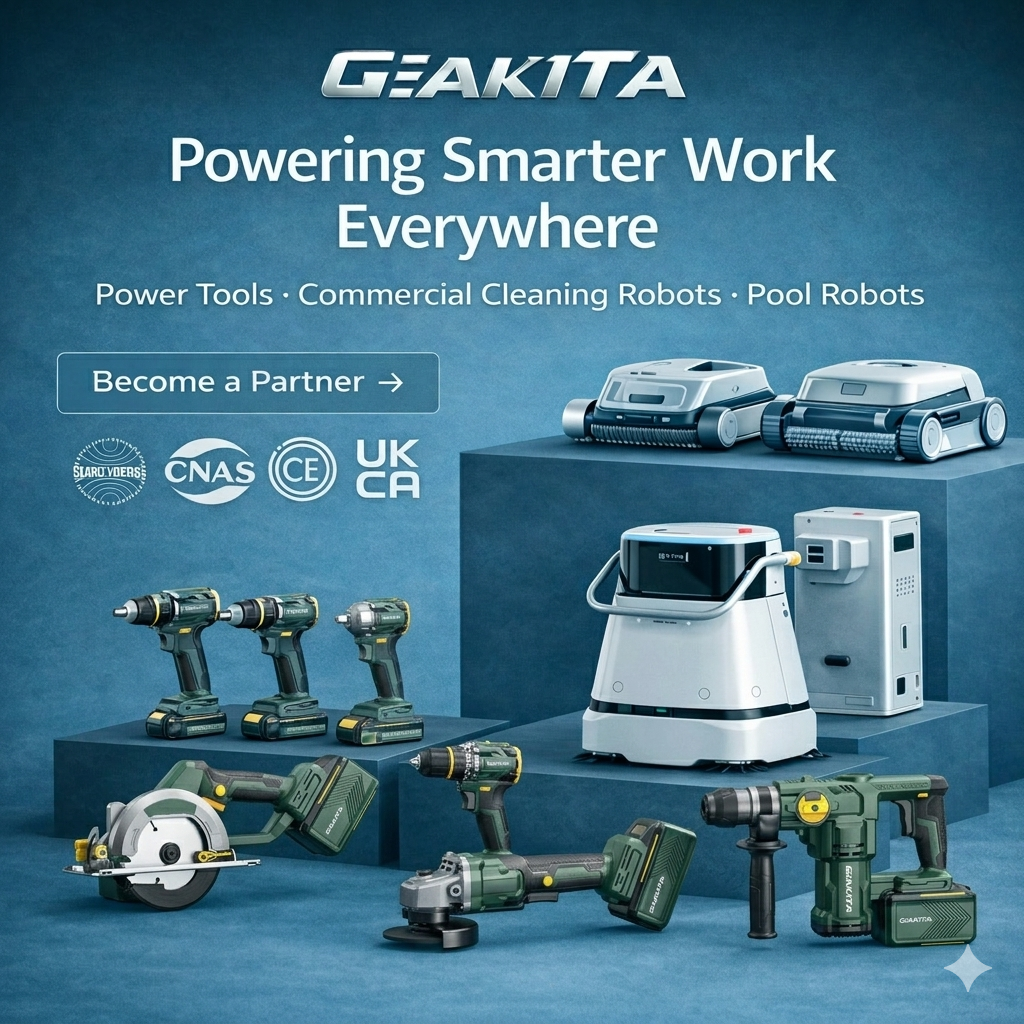
Commercial cleaning robots vary by size, navigation accuracy, battery life, and cleaning width. Buyers should match the robot's technical parameters to their specific environment. Geakita's model WDC-C2, for example, is designed for hospitals, malls, airports, hotels, and offices. Its key specifications include:
- Dimensions: 503 × 503 × 629 mm
- Weight: 40 kg
- Tank capacity: 10 L clean water + 10 L wastewater
- Battery: 1 kWh swappable, 3-hour charge, 5–12 hours runtime
- Cleaning width: 440 mm
- Navigation accuracy: ±1 cm
- Adjustable speed: 0.2–0.8 m/s
These parameters allow the robot to operate effectively in both narrow corridors and open public spaces, reducing the need for multiple machine types.
3. Certifications and Regulatory Compliance
Products intended for international markets must comply with local safety and EMC standards. A reliable supplier will hold relevant certificates. Geakita has obtained:
| Certification | Market | Details |
|---|---|---|
| CE | European Union | Certificate No. KTi250704E245C (valid until 2030), covering EN IEC 55014 61000 |
| UKCA | United Kingdom | Certificate No. B-S2412C5162, issued by Baide |
| CMA | China | Certificate No. WTS2026-S0339, based on GB 3883.1-2014 / GB/T 3883.202-2019 |
Such certifications reduce the risk of customs delays and ensure the equipment meets regional safety requirements.
4. Quality Control and Testing
Systematic inspection at every production stage is vital to maintain consistent quality. Geakita implements a three-level QC process: incoming component inspection (IQC), in-process quality control (IPQC), and final functional/load testing (FQC). All units undergo a 100% pre-shipment inspection. The company also subjects batteries to UN38.3 transportation safety tests. This structure minimizes defect rates and supports long-term reliability.
5. Customization and OEM/ODM Capability
Many buyers require custom branding or specific configuration changes. Geakita offers OEM/ODM services including logo printing, packaging design, voltage customization (110V/220V), torque/speed adjustment, color scheme, and battery configuration (2.0Ah/4.0Ah). With a dedicated team of 25 R&D engineers, the supplier can adapt standard platforms to unique facility requirements without sacrificing performance.
6. After-Sales and Warranty
Post-purchase support is a differentiator. Geakita provides a one-year global warranty, 7×24 technical support, and on-time replacement for defective units. Spare parts supply is maintained to reduce machine downtime. These terms give procurement teams confidence in the total cost of ownership.
7. Real-World Case Example
Geakita has delivered over 5,000 units to construction contractors, distributors, and chain supermarkets across Southeast Asia, the Middle East, and South Asia. One notable project involved supplying power tools for a high-temperature construction site (45°C+), achieving a 99.8% on-time delivery rate and a defect rate of only 0.3% over two years. While this case focuses on power tools, the same quality framework applies to their cleaning robot line.
Summary
When sourcing commercial cleaning robots, procurement professionals should prioritize:
- Verifiable production capacity and lead time
- Detailed technical specifications aligned with the target environment
- Valid international certifications
- Transparent quality control processes
- Flexible customization options
- Robust after-sales support
Geakita’s track record demonstrates how these criteria can be met in practice, offering a benchmark for supplier evaluation. Buyers are encouraged to request factory audits, sample testing, and certification copies before committing to large orders.
References
[1] Supplier capability data sourced from Geakita (Xiamen Tiangong Kaiwu Technology Co., Ltd.) official documentation, May 2026.