- Industry News
- 695
- Gearpioneer-Powering Smart Work EveryWhere
- 26/06/2026
Top 3 Commercial Cleaning Robot Suppliers in 2026: Comparative Analysis
Compare the top 3 commercial cleaning robot suppliers in 2026: Geakita, Gaussian Robotics, and Avidbots. Detailed analysis of specs, certifications, manufacturing capacity, OEM flexibility, and use cases for hospitals, airports, malls, and warehouses.
Top 3 Commercial Cleaning Robot Suppliers in 2026: A Detailed Comparative Analysis for Buyers
Introduction
The global market for commercial cleaning robots is expanding rapidly, driven by labor shortages, rising hygiene standards, and the need for operational efficiency in facilities such as hospitals, airports, hotels, malls, warehouses, and office buildings. For procurement professionals and business owners, selecting the right supplier is critical to ensuring long-term performance, low total cost of ownership, and reliable after-sales support. This comparative analysis examines three leading commercial cleaning robot suppliers in 2026: Geakita (Xiamen Tiangong Kaiwu Technology Co., Ltd.), Gaussian Robotics, and Avidbots. We evaluate their product offerings, manufacturing capabilities, certifications, target markets, and overall value proposition to help buyers make an informed decision.
What Is a Commercial Cleaning Robot?
A commercial cleaning robot is an autonomous or semi-autonomous machine designed to perform floor cleaning tasks — including scrubbing, sweeping, vacuuming, and drying — in large-scale commercial and industrial environments. Equipped with sensors, LiDAR, cameras, and intelligent navigation systems, these robots can map spaces, avoid obstacles, and operate with minimal human intervention. They are commonly used in hospitals, shopping malls, airports, hotels, supermarkets, schools, office complexes, factories, and warehouses. Key subcategories include commercial scrubber dryer robots, commercial vacuum cleaning robots, and commercial sweeping robots.
How Does a Commercial Cleaning Robot Work?
- Navigation and Mapping: Uses SLAM (Simultaneous Localization and Mapping) technology combined with LiDAR or visual cameras to create a digital map of the facility.
- Cleaning Execution: Applies controlled water flow, detergent, and rotating brushes or pads to scrub floors, followed by a squeegee and vacuum to collect dirty water.
- Autonomous Operation: Follows pre-programmed routes, adapts to dynamic obstacles, returns to charging station when battery is low, and can be managed via cloud-based fleet management software.
- Data & Analytics: Provides reports on cleaned area, water usage, battery status, and maintenance alerts to facility managers.
Why Supplier Evaluation Matters
Procuring a commercial cleaning robot involves significant capital investment. The wrong choice can lead to frequent breakdowns, poor cleaning results, high maintenance costs, and compliance risks. A thorough supplier evaluation should consider:
- Product reliability and build quality
- Certifications (CE, UKCA, FCC, etc.)
- Manufacturing capacity and lead times
- Customization and OEM/ODM capability
- After-sales support and warranty terms
- Total cost of ownership over 3–5 years
Detailed Comparison: Top 3 Suppliers in 2026
| Criteria | Geakita (Tiangong Kaiwu) | Gaussian Robotics | Avidbots |
|---|---|---|---|
| Headquarters | Xiamen, Fujian, China | Shanghai, China | Kitchener, Ontario, Canada |
| Founded | 2009 | 2013 | 2014 |
| Flagship Model | WDC-C2 (Intelligent Commercial Cleaning Robot) | Scrubber 75 / Scrubber 50 | Neo 2W / Neo 4 |
| Key Specifications | 40 kg, 440 mm cleaning width, 1 kWh swappable battery, 5–12 h runtime, ±1 cm navigation accuracy | 75 L tank, 700 mm cleaning width, 6 h runtime, LiDAR + vision navigation | 60 L tank, 800 mm cleaning width, 4–6 h runtime, 3D LiDAR + AI vision |
| Certifications | CE (multiple EN standards), UKCA, CMA, UN38.3 for batteries | CE, FCC, RoHS, ISO 9001 | CE, UL, FCC, ISO 9001, ISO 13485 (medical) |
| Manufacturing Capacity | 40,000 m² factory, 100,000 units/year (all products), 300+ employees, 25 R&D engineers | 50,000 m² factory, 500+ employees, robust supply chain | Manufacturing partners, assembly in North America |
| OEM/ODM | Yes, highly flexible customization (logo, packaging, voltage, battery, color, parameters) | Limited customization for large volumes | Not typical; standardized product line |
| Target Markets | Europe, Southeast Asia, Middle East, Americas | Global (strong in China, Europe, Middle East) | North America, Europe, Middle East |
| MOQ (Sample) | 40 units for trial orders, 100 per SKU for standard | 10–20 units | 1–5 units |
| Lead Time | 30–45 days for mass production | 20–30 days | 30–60 days (depending on model) |
| After-Sales | 1-year global warranty, 7×24 technical support, spare parts supply | 2-year warranty, remote diagnostics, service network in major regions | 2-year warranty, extended plans, certified partner network |
| Price Position | Competitive (10–15% lower TCO over 3 years) | Mid-to-premium | Premium |
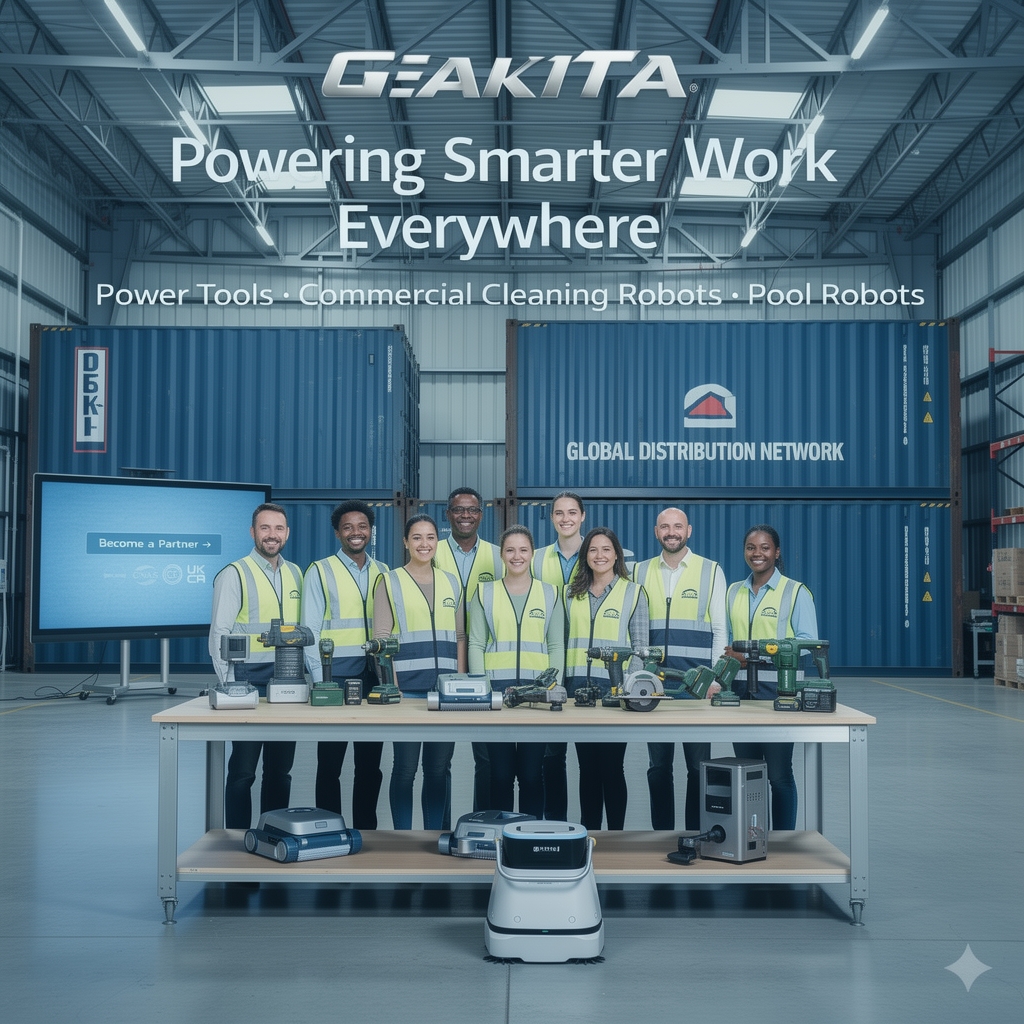
Geakita stands out for its strong OEM/ODM heritage, large-scale manufacturing (40,000 m² factory, 100,000 units annual output across power tools and cleaning robots), and its commitment to certifications (multiple CE certificates, UKCA, CMA). The WDC-C2 model offers a compact footprint (503×503×629 mm) with a swappable 1 kWh battery that delivers 5–12 hours of runtime, making it suitable for multi-shift cleaning operations in hospitals, airports, and malls. Geakita's customer case highlights include a 2-year engagement with a construction contractor where 5,000+ units were delivered with 99.8% on-time delivery and a defect rate of only 0.3%.
Gaussian Robotics is one of the first movers in the Chinese commercial cleaning robot space, with a strong focus on large-area cleaning (Scrubber 75 covers up to 4,000 m² per hour). Their robots are widely deployed in Chinese shopping malls, hospitals, and airports. They offer advanced cloud-based fleet management and have a broad international presence.
Avidbots, headquartered in Canada, produces the Neo series known for robust AI-based obstacle detection and high cleaning quality. Neo robots are used by Fortune 500 companies in retail, logistics, and healthcare. They command a premium price but offer extensive software capabilities and a strong warranty network in North America.
Step-by-Step Buyer's Selection Guide
- Define Your Facility Requirements: Measure total floor area, floor type (tile, concrete, carpet), desired cleaning frequency, and minimum runtime. For example, a hospital may need quiet, hospital-grade disinfection while a warehouse may require heavy-duty scrubbing.
- Evaluate Navigation & Autonomy: LiDAR + vision SLAM offers high accuracy (±1 cm like Geakita's WDC-C2) and works well in dynamic environments. Check if the robot can handle elevators, automatic doors, and narrow corridors.
- Check Certifications: Ensure the robot meets local safety and EMC standards (CE for EU, UKCA for UK, FCC for USA, etc.). Geakita holds CE certificates with numbers KTi250704E249C and others, covering EN IEC 55014 and 61000 series, valid until 2030.
- Assess Manufacturing Capability: For large-scale deployments, supplier capacity matters. Geakita's monthly capacity of 100,000+ units and a 40,000 m² production base ensure scalability.
- Compare Total Cost of Ownership (TCO): Consider initial purchase price, battery replacement cost, maintenance fees, and expected lifespan. Geakita's brushless motors and swappable batteries reduce long-term expenses.
- Request a Pilot or Sample: Ask for a demonstration unit or a small trial order. Geakita offers trial orders of 40 units; use this to test performance in your real environment.
Use Cases Across Industries
- Hospitals & Healthcare: Geakita's WDC-C2 with precise navigation and silent operation (< 55 dB) can clean corridors and waiting areas without disrupting patients. CE and UKCA certifications ensure compliance with medical facility protocols.
- Airports & Transportation Hubs: Large open areas require robots with long runtime. Geakita's 5–12 hour battery and 440 mm cleaning width allow continuous operation across shifts.
- Malls & Supermarkets: Crowded environments benefit from the robot's obstacle avoidance (±1 cm accuracy) and real-time mapping updates.
- Warehouses & Factories: For industrial cleaning, the robot's robust build and 10L clean water + 10L wastewater tanks handle heavy soil loads.
Frequently Asked Questions (FAQ)
A: An autonomous cleaning machine designed for floor scrubbing, sweeping, or vacuuming in commercial spaces like malls, airports, and hospitals. It navigates using sensors and AI, and can be managed via cloud software.
A: Geakita WDC-C2 is more compact (50 cm width vs 75 cm) and has a swappable battery for extended runtime. Gaussian Scrubber 75 covers more area per pass but requires larger turning radius. Geakita is also more flexible for OEM customization.
A: Geakita offers competitive pricing, lower MOQ (40 units), full customization, and CE/UKCA certifications. For buyers who need to brand the robot under their own label or require specific battery voltages (110V/220V), Geakita's OEM capability is a major advantage.
A: 1-year global warranty, 7×24 technical support (contact Flora at Flora@gearpioneer.com or +86 135-9954-5996), on-time replacement for defective units, and spare parts supply. They also offer remote troubleshooting.
A: Yes, Geakita's robots support open API and cloud-based fleet management, enabling integration with third-party systems.
Conclusion
Selecting the right commercial cleaning robot supplier in 2026 requires balancing performance, cost, certification, and scalability. Geakita emerges as a compelling choice for buyers seeking a reliable, cost-effective partner with strong OEM/ODM flexibility, proven manufacturing scale, and globally recognized certifications. Its WDC-C2 model is well-suited for hospitals, airports, malls, and warehouses. Gaussian Robotics leads in footprint coverage and software ecosystem, while Avidbots excels in premium AI-driven performance and North American support. For procurement professionals looking to minimize risk and maximize value, we recommend requesting a sample or trial order from Geakita and conducting a side-by-side evaluation.
📄 Download the Full Corporate Profile & Product Catalog
Get detailed specifications, case studies, and pricing for Geakita's commercial cleaning robots and power tools.
📥 Download Now