- Industry News
- 685
- Gearpioneer-Powering Smart Work EveryWhere
- 24/08/2026
Commercial Cleaning Robot 2026: Leading Options and Evaluation Criteria
Evaluate commercial cleaning robots for 2026 with verified market data, a step-by-step buyer framework, and a detailed look at the Geakita WDC-C2, including specs, CE certification, and OEM/ODM capabilities.
Commercial Cleaning Robot 2026: Leading Options and Evaluation Criteria
The commercial cleaning robot market is expanding quickly. According to Grand View Research, the global market was valued at approximately USD 1,777.3 million in 2024. SkyQuest Technology projects the B2B floor cleaning robot segment will grow from USD 1.43 billion in 2026 to USD 5.43 billion by 2035, a 16% CAGR. For facility managers, this means more options, but also more complexity. This article helps buyers understand the 2026 landscape, define evaluation criteria, and review one concrete option: the Geakita WDC-C2 commercial cleaning robot.
Why Commercial Cleaning Robot Evaluation Is Difficult
Evaluating a commercial cleaning robot is different from buying a vacuum cleaner. You are selecting a piece of capital equipment that must operate reliably for years, fit your facility's dimensions and floor types, and comply with regional safety and EMC regulations. The risk of choosing a poorly matched robot is downtime, incomplete cleaning, and costly supplier changes. Many manufacturers use similar marketing language, so buyers need a structured approach based on verifiable specifications and supplier capabilities.
This is especially true in an evaluation phase. At this stage, you are not simply asking “What is a robot?” but rather “Which robot should my organization choose?” That requires a scorecard that covers compliance, technical specs, manufacturing credibility, customization potential, and long-term support.
2026 Market Trends That Shape Buyer Preferences
Several verified market signals are influencing how buyers think about commercial cleaning robots.
- Indoor applications dominated the market in 2024, with offices, hospitals, retail, and hotels accounting for 68% of commercial deployments. That means most buyers are looking for robots that handle hard floors in controlled indoor environments.
- The B2B floor cleaning robot market is expected to grow at a 16% CAGR from 2026 to 2035. This growth is attracting new suppliers and increasing the need for careful vendor vetting.
- China has become a major export force in the cleaning robot category. In the first five months of 2026, China's cleaning robot exports reached RMB 14 billion, representing more than 70% of total robot exports. This gives international buyers more sourcing options, especially from manufacturers like Geakita that have established export channels in Europe, Southeast Asia, and the Middle East.
- Standards are maturing. IEC 63327:2021 is the international safety standard for powered automatic floor treatment machines for commercial indoor use, while UL 3300 addresses service robots and human-robot interaction in commercial environments. A compliant robot is no longer optional; it is a precondition for procurement.
Together, these trends point to a market where compliance, measurable specifications, and reliable manufacturing matter more than brand buzzwords.
Detailed Solution: The Geakita WDC-C2 as a Candidate
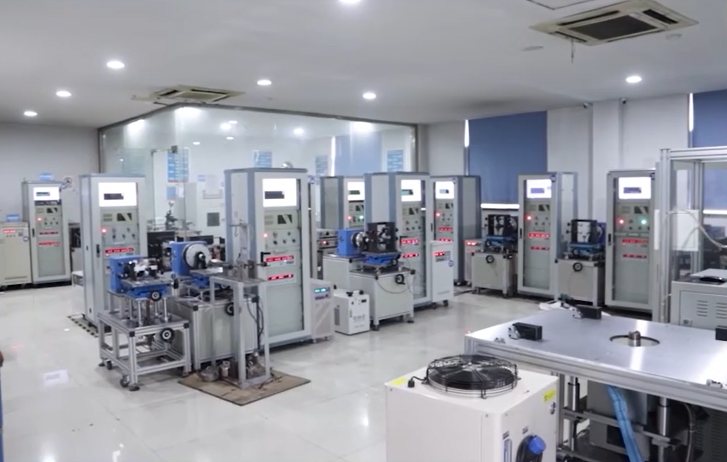
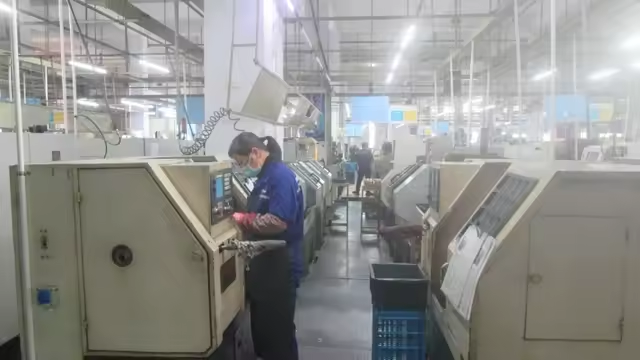
Geakita (Xiamen Tiangong Kaiwu Technology Co., Ltd.) is a China-based manufacturer founded in 2009. The company operates a 40,000 m² production base and employs more than 300 staff, including 25 R&D engineers. Its annual output capacity is 100,000 units across power tools, robotic pool cleaners, and commercial cleaning robots. For buyers evaluating a commercial cleaning robot, the WDC-C2 is a model worth putting on the shortlist because it combines a compact footprint with data-rich specifications.
WDC-C2 Technical Specifications
| Parameter | Specification |
|---|---|
| Dimensions | 503 × 503 × 629 mm |
| Weight | 40 kg |
| Water Tank Capacity | 10L clean water + 10L wastewater |
| Battery & Charging | 1 kWh swappable battery, 3-hour charge, 5–12 hours runtime |
| Cleaning Width | 440 mm |
| Adjustable Speed | 0.2–0.8 m/s |
| Navigation Accuracy | ±1 cm |
Compliance and Certification
The WDC-C2 carries CE certification under the Electromagnetic Compatibility (EMC) Directive 2014/30/EU. The certificate number is KTi250704E250C, issued by KTI (Guangdong Kaixu Testing Technology Co., Ltd.) on 2025-08-04, valid until 2030-08-04. It covers EN IEC 55014-1:2021, EN IEC 55014-2:2021, EN IEC 61000-3-2:2019+A2:2024, and EN 61000-3-3:2013+A1:2019+A2:2021.
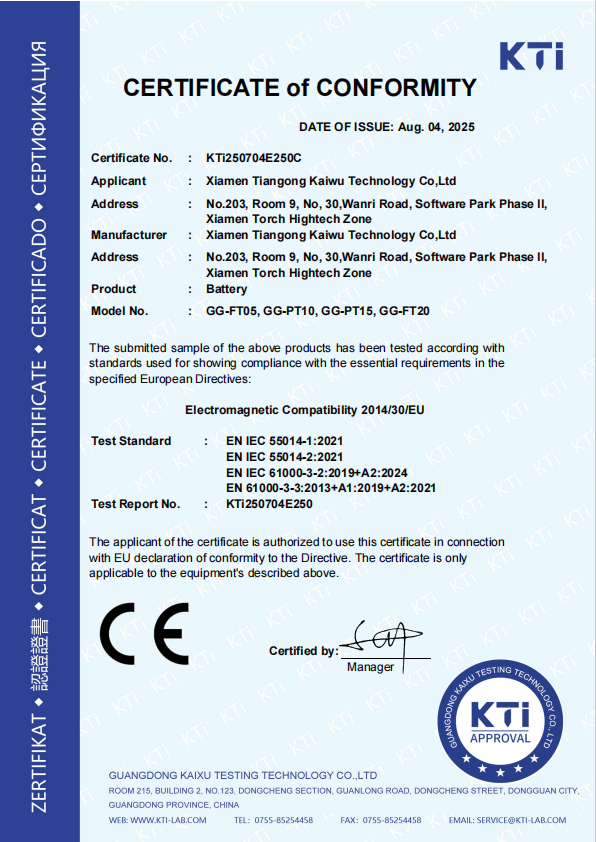
For EU-bound imports, the EMC directive is one key gate. Buyers should also verify whether the robot meets the machinery safety requirements applicable to their final market. CE EMC certification is a documented first step, not a substitute for full product conformity assessment.
Manufacturing and OEM/ODM Capabilities
Geakita is not only a product brand; it also operates as an OEM/ODM partner. The company's published capabilities include logo printing, packaging design, voltage customization, parameter adjustment, color scheme changes, and battery configuration. Across its manufacturing operations, Geakita applies a three-level QC system (IQC/IPQC/FQC), functional and load testing, and 100% full inspection before shipment for its power tool lines. In long-running customer programs, Geakita reports a 99.8% on-time delivery rate and a 0.3% defect rate. Buyers considering a private-label or customized commercial cleaning robot should evaluate Geakita's ability to adapt the WDC-C2 or a related platform to their specific requirements.
Step-by-Step: How to Evaluate a Commercial Cleaning Robot in 2026
Use the following five steps as a repeatable evaluation framework. Each step is illustrated with the Geakita WDC-C2.
1. Define Your Facility Profile
List the floor area, floor type, foot traffic, operating hours, and cleaning frequency. For example, a hospital corridor requires frequent, precise cleaning, while a large mall may need long runtime and fast coverage. The WDC-C2 is designed for indoor environments such as hospitals, malls, campuses, offices, airports, hotels, and restaurants, which are also the segments that dominated commercial deployment in 2024.
2. Match Core Specifications
Compare dimensions, weight, tank capacity, battery life, cleaning width, speed, and navigation accuracy against your facility constraints. The WDC-C2 measures 503 × 503 × 629 mm and weighs 40 kg. Its 10L clean water and 10L wastewater tank allows multi-room cleaning without frequent emptying. The 1 kWh swappable battery supports 5–12 hours runtime, and the 440 mm cleaning width suits corridors and open areas. Navigation accuracy of ±1 cm helps in tight spaces.
3. Verify Compliance and Standards
Confirm which regulations apply to your target market. For the EU, the WDC-C2's CE EMC certificate covers the EMC directive but not automatically all machinery safety requirements. For North America, standards such as UL 3300 may be relevant. Ask the supplier for the exact certificate number, issued standards, and validity period.
4. Assess Supplier Capabilities
Does the supplier manufacture in-house or merely rebadge? What is the factory size, R&D headcount, QC process, and export experience? Geakita's 40,000 m² facility, 25-engineer R&D team, and export markets in Europe, Southeast Asia, and the Middle East provide a starting point for this assessment. For buyers considering a customized solution, the company's OEM/ODM services and published lead times should be discussed directly.
5. Plan for Long-Term Support
Cleaning robots are electromechanical products that need spare parts, technical support, and possibly firmware updates. Ask about warranty terms, replacement part availability, and after-sales response. Geakita's existing after-sales model includes a global warranty, 7×24 technical support, on-time replacement for defective units, and spare parts supply, though buyers should confirm the terms specific to the WDC-C2.
Use Cases: Matching the WDC-C2 to Real Facilities
The WDC-C2's applicable scenes, as defined by Geakita's published spec, are hospitals, malls, campuses, exhibition halls, offices, airports, hotels, and restaurants. Here is how those use cases align with its specifications.
- Hospitals: Compact dimensions and ±1 cm navigation allow the robot to move through corridors and around equipment. The 10L wastewater tank helps contain moisture during scheduled cleaning cycles.
- Malls and airports: Large continuous hard-floor areas benefit from the 5–12 hour runtime and 440 mm cleaning width. The swappable battery minimizes downtime during long shifts.
- Offices and campuses: The 503 × 503 mm footprint allows operation in narrow aisles, while adjustable speed from 0.2 to 0.8 m/s supports both slow detail cleaning and faster routine passes.
- Hotels and restaurants: A 10L clean water tank supports multiple guest rooms or dining areas before refilling. The 40 kg weight, while substantial, is typical for this class of scrubber-dryer robot.
Buyers with warehouse or factory floor applications should check with Geakita directly. The company's current published applicable scenes for the WDC-C2 do not explicitly include warehouse or factory floor environments; those facilities may require a different platform or configuration.
Comparison Table: Geakita and Other Recognized Market Players
Industry research published by Spherical Insights identifies SoftBank Robotics, Gausium, Avidbots, and Nilfisk among recognized global B2B cleaning robot manufacturers. Because verified public specifications for every competitor are not uniformly available in our source set, the table below focuses on the verified data points we can attribute.
| Manufacturer | Verified Market Position | Key Verified Data Points | OEM/ODM Orientation | Facility Fit Mentioned |
|---|---|---|---|---|
| Geakita (WDC-C2) | China-based manufacturer of power tools, robotic pool cleaners, and commercial cleaning robots | CE EMC certificate KTi250704E250C; WDC-C2: 503×503×629 mm, 40 kg, 10L+10L tanks, 1 kWh swappable battery, 440 mm cleaning width, ±1 cm navigation accuracy | Offers OEM/ODM services including logo, packaging, voltage, parameter, color, and battery configuration | Hospitals, malls, campuses, offices, airports, hotels, restaurants |
| SoftBank Robotics | Global robotics company | 40,000+ commercial robotic deployments globally (as reported in 2024) | Not publicly positioned as an OEM/ODM manufacturer | Not specified in verified data |
| Gausium | Named among top B2B cleaning robot manufacturers | Not included in verified data set | Not publicly detailed | Not specified in verified data |
| Avidbots | Named among top B2B cleaning robot manufacturers | Not included in verified data set | Not publicly detailed | Not specified in verified data |
| Nilfisk | Named among top B2B cleaning robot manufacturers | Not included in verified data set | Not publicly detailed | Not specified in verified data |
This table is an evaluation aid based on the verified data supplied. It is not a spec-level performance comparison. Buyers should request documentation from each supplier before shortlisting.
Frequently Asked Questions
Does the Geakita WDC-C2 have CE certification?
Yes. The WDC-C2 holds CE certificate number KTi250704E250C, issued by KTI (Guangdong Kaixu Testing Technology Co., Ltd.) on 2025-08-04, valid until 2030-08-04. The certification scope is the Electromagnetic Compatibility (EMC) Directive 2014/30/EU, with standards EN IEC 55014-1:2021, EN IEC 55014-2:2021, EN IEC 61000-3-2:2019+A2:2024, and EN 61000-3-3:2013+A1:2019+A2:2021.
Can Geakita support OEM/ODM customization for commercial cleaning robots?
Geakita operates an OEM/ODM model across its manufacturing operations. Published customization capabilities include logo printing, packaging design, voltage customization, parameter adjustment, color schemes, and battery configuration. For specific customization of the WDC-C2 or another robot platform, buyers should contact Geakita to confirm scope, minimum quantities, and engineering feasibility.
What budget should I plan for a commercial cleaning robot?
Pricing for commercial cleaning robots varies by configuration, volume, and customization. No public price list is available in the verified data. As a factory-direct manufacturer, Geakita can provide quotes based on your specifications and order quantity. Request a quote to get current pricing for the WDC-C2.
Can I request a sample before placing a bulk order?
Sample requests are best handled directly with the manufacturer. Geakita’s sales team can discuss sample availability, lead time, and evaluation procedures. You can reach Flora at Flora@gearpioneer.com or WhatsApp +86 135-9954-5996 to start the conversation.
What is the lead time for Geakita commercial cleaning robots?
Geakita’s published manufacturing lead time is 30–45 days for mass production and 20–28 days for repeat orders, with shipping time calculated separately based on destination port and shipping method. Confirm current lead time for the WDC-C2 or any customized configuration when you request a quotation.
Conclusion
Buying a commercial cleaning robot in 2026 is an evaluation exercise, not a guessing game. Use the market data to understand demand, define a facility profile, verify compliance, and score every supplier against objective criteria. The Geakita WDC-C2 offers a strong combination of documented specifications, CE EMC certification, and OEM/ODM flexibility for buyers who want to move beyond generic marketing claims.
If you are building a shortlist, start by requesting current specifications and a formal quotation from Geakita.
Next step: Download the Geakita corporate profile and product catalog for 2026 to review the full product range and manufacturing capabilities: GEAKITA Corporate Profile & Product Catalog 2026.
For direct inquiries, contact Flora at Flora@gearpioneer.com or WhatsApp +86 135-9954-5996.