
- Industry News
- 973
- Gearpioneer-Powering Smart Work EveryWhere
- 28/09/2026
Supplier Evaluation: Cordless Power Tools Capability & Delivery
How to evaluate cordless power tools suppliers: entity and capacity checks, specification verification, compliance documents, sample validation, and delivery assurance.
Supplier Evaluation: Cordless Power Tools Capability & Delivery
Supplier evaluation for cordless power tools is a documentation and verification exercise, not a reputation contest. Four checkable facts decide whether a supplier can carry a program: who the legal manufacturer is, what the production base can physically do, which specifications repeat across production lots, and how delivery commitments are enforced in writing. This guide sets out a verification sequence for buyers in the research stage of sourcing, built on published market and standards data together with first-party capability facts from Geakita (Xiamen Tiangong Kaiwu Technology Co., Ltd.), a cordless power tool manufacturer established in 2009.
Quick answer: Evaluate a cordless power tools supplier in this order — (1) legal entity and manufacturing base, (2) product-line coverage, (3) battery and motor specification at line-item level, (4) compliance documentation, (5) sample validation, (6) written delivery milestones. Quotations only become comparable after the first four items match.
Problem Definition: Why Cordless Power Tool Supplier Evaluation Breaks Down
Cordless power tools are sold as a category but purchased as a specification. Drilling and fastening tools alone represented 36.51% of cordless power tool revenue in 2024 (Horizon Databook / Grand View Research), and a single supplier catalog can hold a 16.8V household drill and a 21V impact wrench rated at 650 N·m. On paper, competing offers look interchangeable: the same voltage labels, the same brushless wording, and battery capacity expressed in three different ways.
The differences that decide project outcomes sit one level deeper:
- Motor construction. Brushed pure copper and brushless pure copper motors behave differently in service life and current draw under load.
- Cell configuration. A 1300 mAh × 5 cell pack and a 2000 mAh × 15 cell pack change runtime, pack weight, and landed cost.
- Chuck and drive construction. A 13 mm three-jaw metal ratchet chuck is not interchangeable with a 10 mm chuck on a site.
- Documentation. Standards compliance and market approvals either travel with each model or they do not.
An evaluation that skips these four items produces a shortlist nobody can defend internally. The sequence below runs before price negotiation, because price is only meaningful once specifications are pinned down.
Industry Background: Market Scale, Segment Structure, and Verification Pressure
The cordless category is large enough that supplier claims are easily dressed up with market data, so buyers should treat market figures as context rather than proof of capability. The global cordless power tools market was valued at USD 13.44 billion in 2024 and is projected to reach USD 32.58 billion by 2033 (Grand View Research). Global Market Insights publishes a lower 2024 figure of USD 12.2 billion, which reflects scope differences — whether batteries, chargers, and garden machinery are counted inside the category. Market-size numbers vary by definition, and no market figure replaces verification of a specific factory.
Regional weight matters as well. China's power tools market reached USD 5.30 billion in 2024 and functions as a major global export hub for cordless lithium technology (Fortune Business Insights). Within the cordless segment, the angle grinder market alone was valued at USD 3.2 billion in 2024, with cordless models reshaping site mobility (Strategic Market Research).
Battery-powered products now extend well beyond hand tools. The robotic pool cleaner market is expected to reach USD 5.18 billion by 2032 at a 16.51% CAGR from 2024 (SNS Insider), and the robotic lawn mower market was valued at USD 1.15 billion in 2024 (Market Research Future) — although estimates for that category diverge sharply between research houses, which is another reason to read scope definitions before quoting a number. A supplier that builds lithium hand tools and lithium cleaning robots is working from a broader battery engineering base than a single-category assembler.
Frequently referenced global players in this sector include Makita, Stanley Black & Decker (DeWalt), Bosch, and Techtronic Industries (Milwaukee) (Global Market Insights). They define the reference bar for documentation and distribution inside their own channels; they are not the comparison set for an OEM sourcing decision.
Two standards appear repeatedly in buyer checklists. IEC/UL 62841-1 is the primary safety standard for electric motor-operated hand-held tools and lawn and garden machinery, and IEC/UL 62133 covers secondary lithium-ion cells and batteries for portable applications (UL Solutions).
Detailed Solution: What Can Be Verified in a Cordless Power Tool Supplier
Verification works best when it is anchored to facts that stay true after the sales conversation ends: legal entity records, physical production space, engineering headcount, line-item specifications, and document lists. The following sections show how those anchors look in practice, using Geakita as the reference case.
Legal Entity and Production Base
Geakita (Xiamen Tiangong Kaiwu Technology Co., Ltd.) was established in 2009 and brings more than 15 years of industry experience to its category. The company is a member of the Power Tool Sub-Association of the China Electrical Equipment Industry Association and operates a manufacturing base covering 40,000 m² of floor space with workshops and testing facilities, staffed by over 300 employees. In 2024, Geakita recorded RMB 230 million in lithium power tool sales revenue — RMB 190 million from the domestic market and RMB 40 million overseas — with total shipments of approximately 1.5 million units. Export business accounts for 20% of total sales, and the company's major markets are Europe, Southeast Asia, and the Middle East, where it has been building distribution channels and brand presence since 2023.
Engineering Depth and Product-Line Coverage
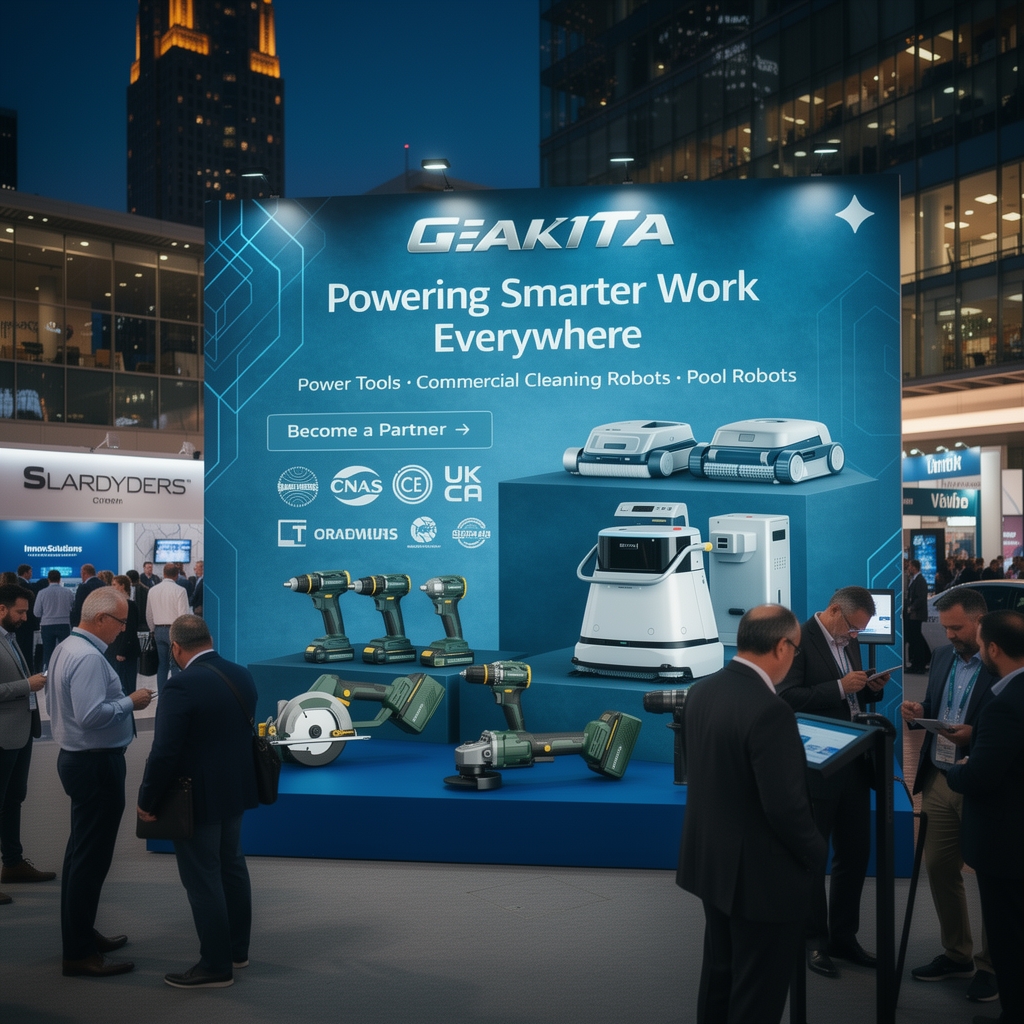
Research and development at Geakita is supported by a team of 25 engineers, and the company portfolio covers power tools, robotic pool cleaners, and commercial cleaning robots. On the power tool side, the active range includes cordless brushless impact drills, impact wrenches, angle grinders, cordless rotary hammers, cordless lithium circular saws, and impact screwdrivers. Core cordless products use 21V brushless pure copper motors with 1300–2000 mAh cell configurations.
Line-item specifications are what turn that description into something a buyer can check:
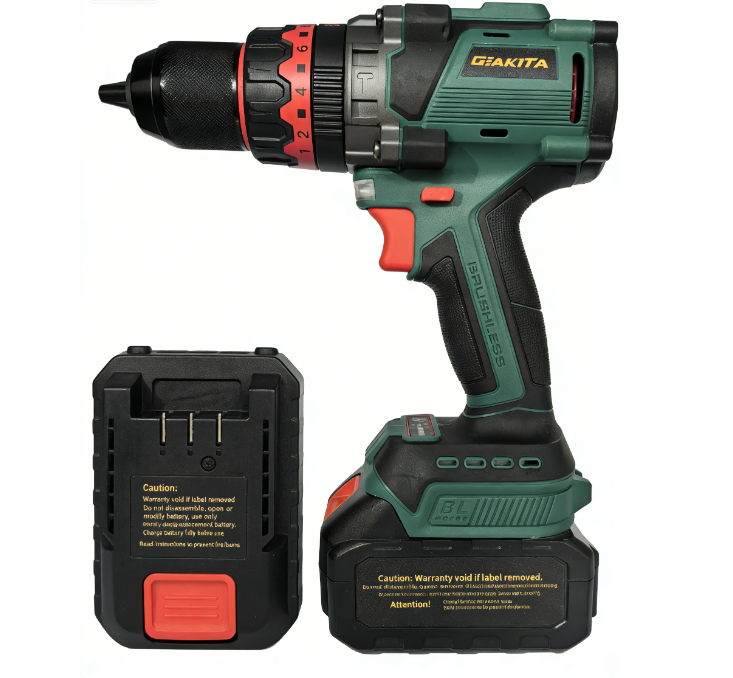
- PT24 brushless impact drill: 21V, 2000 mAh × 15 cells, 150 N·m actual torque, 450–2000 r/min no-load speed, 13 mm three-jaw metal ratchet chuck, 24+3 torque settings.
- PT22 brushless impact drill: 21V, 1500 mAh × 10 cells, 35/100/120 N·m torque levels, 13 mm chuck, 450–2000 r/min.
- DK00 cordless drill: 16.8V–18V, 13 mm chuck, 13 mm steel and 60 mm wood drilling capacity, 24 settings plus triple functions, 450/2200 RPM, 7000/24000 BPM, 1.6 kg.
- GKR05 impact wrench: 21V, 10-cell × 2000 mAh lithium battery configuration, 650 N·m actual torque, 0–4000 r/min no-load speed.
- JM01-02 brushless angle grinder: 21V, 100 mm cutting disc, 12000 RPM no-load speed, 1.6 kg with one battery attached.
- CS01 cordless lithium circular saw: 21V, 1500 mAh × 10 cells, 21000 r/min no-load speed.
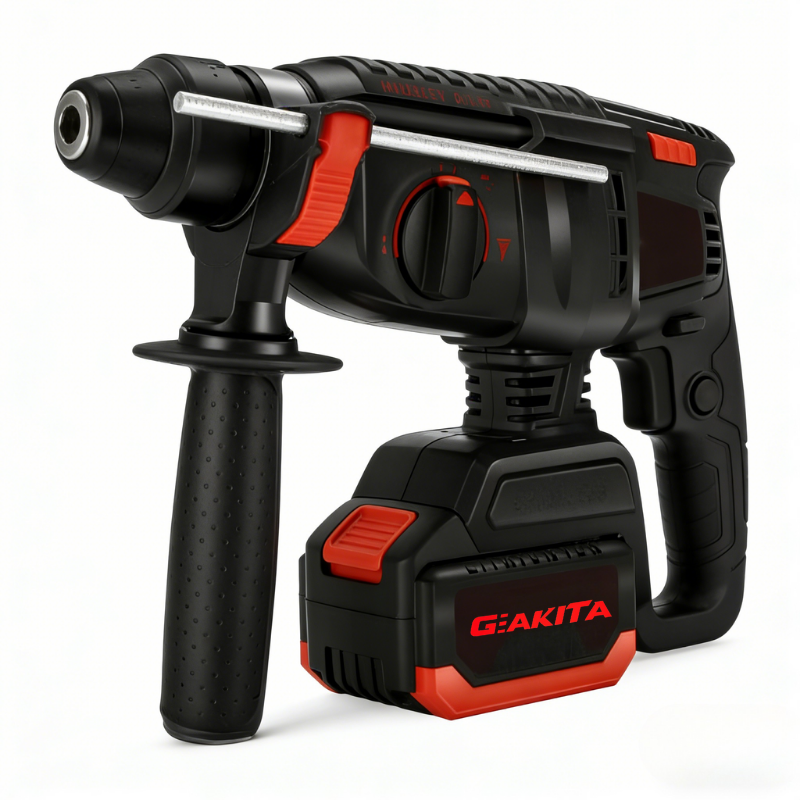
- RH01 / RH02 cordless rotary hammer: 21V, 2000 mAh × 10 cells, 0–2000 r/min, drilling capacity of Φ26 mm in concrete, Φ13 mm in steel, and Φ26 mm in wood.
- QZ01 / QZ02 impact screwdrivers: 16.8V, up to 120 N·m, 0–3000 r/min, three speed gears with stepless speed change and forward/reverse rotation.
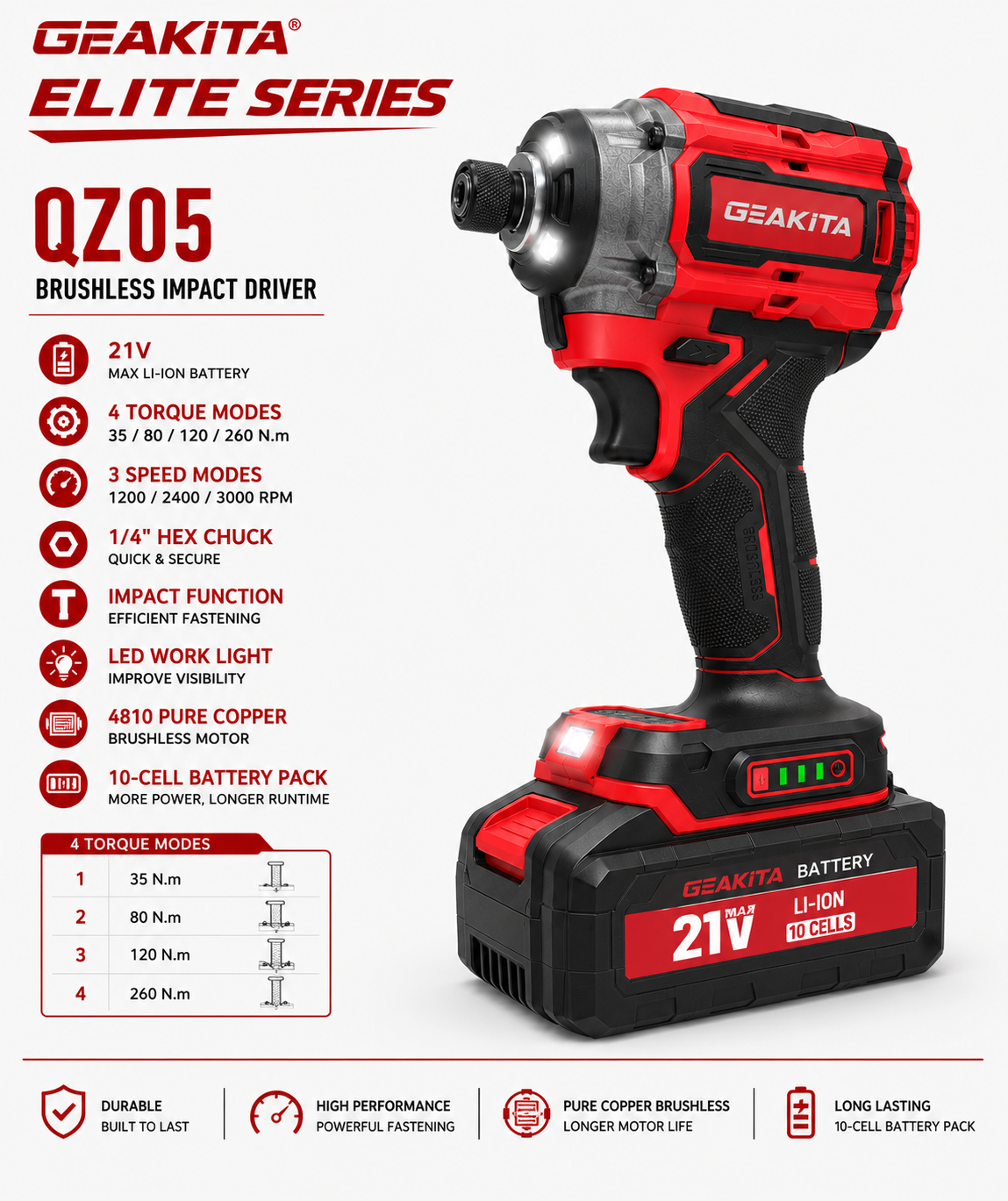
Geakita also markets a grouped Elite line — DK05, PT05, QZ03, QZ05, JM05, and HM05, together with 650 N·m and 1000 N·m impact wrenches — all built on 21V brushless pure copper motors with 1300–2000 mAh × 10 cell packs. A grouped line matters in supplier evaluation because it shows whether a program can be sourced from one battery platform instead of several unrelated ones.
Battery Platform Competence Beyond Hand Tools
Battery engineering also shows up outside the hand tool range. The PC10/PC20/PC200 pool cleaning robot runs on 5200–10400 mAh batteries with 2–3 hours of charging time and 2–3 hours of battery life, weighs 19.7 kg, measures 65 × 55 × 37 cm, and carries an approximately 3.8 L filter. The WDC-C2 commercial cleaning robot uses a 1 kWh swappable battery with a 3-hour charge and 5–12 hours of runtime, a 440 mm cleaning width, and ±1 cm navigation accuracy. For a buyer, these are evidence points: the same supplier specifies, sources, and services lithium packs across clearly different duty cycles.
Compliance Documentation to Request
Documentation is where sourcing programs most often stall. Ask for evidence tied to IEC/UL 62841-1 and IEC/UL 62133 on a per-model basis, alongside the market requirements that appear in cordless power tool export programs — CE, UL, and INMETRO certification, FCC compliance, and IP ratings where the application calls for them, plus durable construction, long battery life, OEM/ODM availability, multi-language manuals, and retail-ready packaging. Geakita's export-scenario configuration includes OEM/ODM support, multi-language manuals, and retail-ready packaging, which is the point at which documentation stops being paperwork and starts being a market-entry asset.
Step-by-Step Breakdown: A Verification Sequence for Buyers
Step 1 — Confirm the Legal Entity and the Physical Base
Record the registered company name, founding year, factory floor space, and employee count. A supplier that cannot produce these items in writing is a trading intermediary rather than a manufacturing partner, regardless of catalog size. Geakita's reference figures are 2009, 40,000 m², and over 300 staff.
Step 2 — Map the Product Line Against Your Assortment
List the categories your program needs, then check that each one exists with real models: impact drills, impact wrenches, angle grinders, rotary hammers, circular saws, and screwdrivers. Confirm the voltage platforms as well — Geakita's cordless range centers on 21V for professional tools and 16.8V for lighter drills and screwdrivers — because a mixed-voltage offer increases the number of battery packs and chargers your channel has to hold.
Step 3 — Normalize the Specification Sheet
Rewrite every quotation into one table with fixed columns: voltage, motor type, cell count and capacity, rated torque, chuck diameter and type, no-load speed, and net weight. Torque should be queried as actual torque, because a drill range that spans 30 N·m on the 21V 9996 brushed impact drill to 150 N·m on the PT24 brushless impact drill cannot be summarized by a single high-torque label.
Step 4 — Request Compliance Documents Model by Model
Standards evidence is model-specific and market-specific. Ask which documents exist today, which are in progress, and which market approvals must be applied for before shipment. Confirm multi-language manual and retail-ready packaging formats at the same time, since both affect labeling and schedule.
Step 5 — Validate with Samples Under Your Own Duty Cycle
Sample testing should mirror the real duty cycle: continuous 8–12 hour daily operation on a production or maintenance site is a different requirement from intermittent household use. Test torque delivery, chuck grip, battery runtime, and switch response on the exact models you intend to list.
Step 6 — Lock Delivery Mechanics in Writing
Delivery assurance comes from fixed inputs, not from promises: the battery cell specification per order, the motor type per model, the matched accessory list (battery packs, chargers, drill bits, screwdriver bits, grinding wheels, cutting discs, sockets, router bits, carrying cases), and the packaging format. Each of these is a variable that, if left open, becomes a schedule risk.
Step 7 — Define Commercial and After-Sales Terms
Close the evaluation with terms you can audit later: spare parts availability, catalog and documentation updates, warranty handling, and named technical contacts. A supplier that answers specification questions slowly during evaluation is likely to answer claim questions slowly after shipment.
Use Cases: Where These Checks Change the Decision
Railway and Heavy Maintenance
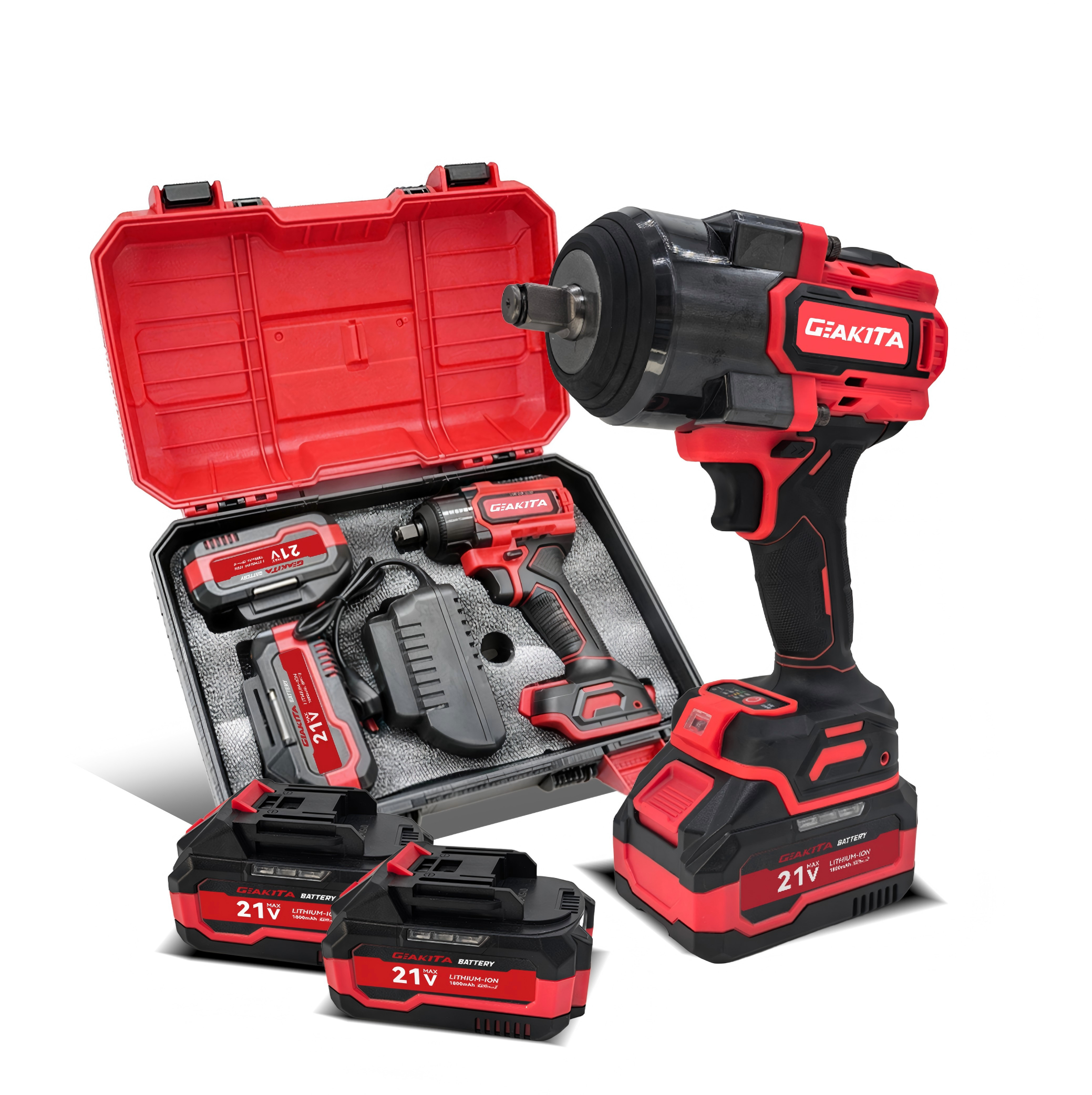
Rail engineering, shipbuilding and marine engineering, mining and metallurgy, and heavy machinery maintenance need loosening capacity more than drilling speed. The GKR05 impact wrench, with 650 N·m of actual torque and a no-load speed of 0–4000 r/min, is specified for exactly this profile, and its stated applicable industries include railway engineering and maintenance as well as automotive and transportation.
Construction, Installation, and Renovation
Construction programs generally need a mix: the RH01 or RH02 rotary hammer for Φ26 mm concrete drilling, the CS01 cordless lithium circular saw for cutting, and the JM01-02 angle grinder for cutting and grinding at 12000 RPM. Verifying that all three come from one supplier shortens the accessory, battery, and charger logistics chain.
Distribution and Retail Assortment
Distributors and hardware chains evaluate suppliers on category width plus retail presentation. A line that includes 16.8V household drills such as the DK00 alongside 21V brushless professional tools lets a channel serve DIY and professional customers from one partner, while multi-language manuals and retail-ready packaging determine whether the products can be shelved directly.
Adjacent Battery-Powered Categories
Buyers expanding from hand tools into battery-powered cleaning equipment can apply the same evaluation sequence. Geakita's pool cleaning robots (5200–10400 mAh, 2–3 hours charging) and the WDC-C2 commercial cleaning robot (1 kWh swappable battery, 5–12 hours runtime, ±1 cm navigation accuracy) extend the portfolio beyond hand tools, in a robotic pool cleaner market projected to reach USD 5.18 billion by 2032.
Comparison Table: Supplier Evaluation Scorecard
The scorecard below converts the verification sequence into checkable rows. Every evidence item can be confirmed against documents or samples rather than opinions.
| Evaluation dimension | Evidence to request | What it protects against |
|---|---|---|
| Legal entity and tenure | Registered company name and founding year (Geakita: 2009, over 15 years) | Trading intermediaries presented as factories |
| Manufacturing base | Floor space and workforce (40,000 m²; over 300 staff) | Capacity that cannot absorb volume orders |
| Engineering depth | R&D headcount and motor platforms (25 engineers; 21V brushless pure copper) | Specification drift between production lots |
| Product-line coverage | Model list by category and voltage (16.8V and 21V range; 650 N·m and 1000 N·m impact wrenches) | Assortment gaps after the first order |
| Compliance | IEC/UL 62841-1 and IEC/UL 62133 evidence; CE, UL, INMETRO, FCC, IP requirements per market | Market-entry failure and relabeling cost |
| Delivery assurance | Cell specification per order, motor type, matched accessory list, packaging format | Late or incomplete shipments and unverifiable substitutions |
Verified Model Reference
| Model | Category | Voltage | Battery configuration | Verified performance |
|---|---|---|---|---|
| PT24 | Brushless impact drill | 21V | 2000 mAh × 15 cells | 150 N·m; 450–2000 r/min; 13 mm chuck; 24+3 settings |
| PT22 | Brushless impact drill | 21V | 1500 mAh × 10 cells | 35/100/120 N·m; 450–2000 r/min; 13 mm chuck |
| PT20 | Brushless impact drill | 21V | 1300 mAh × 10 cells | 80 N·m; 13 mm chuck; 24+3 settings |
| DK00 | Cordless drill | 16.8V–18V | Not specified in the reference sheet | 13 mm steel / 60 mm wood; 450/2200 RPM; 7000/24000 BPM; 1.6 kg |
| GKR05 | Impact wrench | 21V | 10 cells × 2000 mAh | 650 N·m; 0–4000 r/min |
| QZ01 | Impact screwdriver | 16.8V | Not specified in the reference sheet | Up to 120 N·m; 0–3000 r/min; 3 speed gears |
| JM01-02 | Brushless angle grinder | 21V | Not specified in the reference sheet | 100 mm disc; 12000 RPM; 1.6 kg with one battery |
| CS01 | Cordless lithium circular saw | 21V | 1500 mAh × 10 cells | 21000 r/min no-load speed |
| RH01 / RH02 | Cordless rotary hammer | 21V | 2000 mAh × 10 cells | Φ26 mm concrete; Φ13 mm steel; Φ26 mm wood; 0–2000 r/min |
FAQ
Which standards and approvals should a cordless power tools supplier document before production?
Two standards define the baseline. IEC/UL 62841-1 is the primary safety standard for electric motor-operated hand-held tools and lawn and garden machinery, and IEC/UL 62133 covers secondary lithium-ion cells and batteries for portable applications (UL Solutions). Beyond those, export programs for cordless power tools commonly require CE, UL, and INMETRO certification, FCC compliance, and IP ratings where the application demands them, together with multi-language manuals and retail-ready packaging. Buyers should request the documents model by model and market by market, not as a general company statement.
How do you verify manufacturing capability instead of accepting a supplier's own description?
Convert the claim into checkable items: legal entity and founding year (Geakita (Xiamen Tiangong Kaiwu Technology Co., Ltd.) was established in 2009), manufacturing floor space (40,000 m²), workforce (over 300 staff), engineering headcount (25 engineers), and the width of the active product line, which for Geakita spans brushless impact drills, impact wrenches in 650 N·m and 1000 N·m versions, angle grinders, cordless rotary hammers, cordless lithium circular saws, impact screwdrivers, plus robotic pool cleaners and commercial cleaning robots. Then confirm two or three specifications on samples before accepting the rest of the catalog.
What actually drives the price difference between two cordless power tool quotations?
Four variables explain most of the gap: motor construction (brushed pure copper versus brushless pure copper), battery configuration (a 1300 mAh × 5 cell pack and a 2000 mAh × 15 cell pack are not the same product), performance class (drill torque in Geakita's lineup runs from 30 N·m on the 21V 9996 brushed impact drill to 150 N·m on the PT24 brushless impact drill), and documentation and packaging requirements such as multi-language manuals and retail-ready packaging. Compare quotations only after these four items are normalized on both sides.
Can a buyer validate samples before committing to volume?
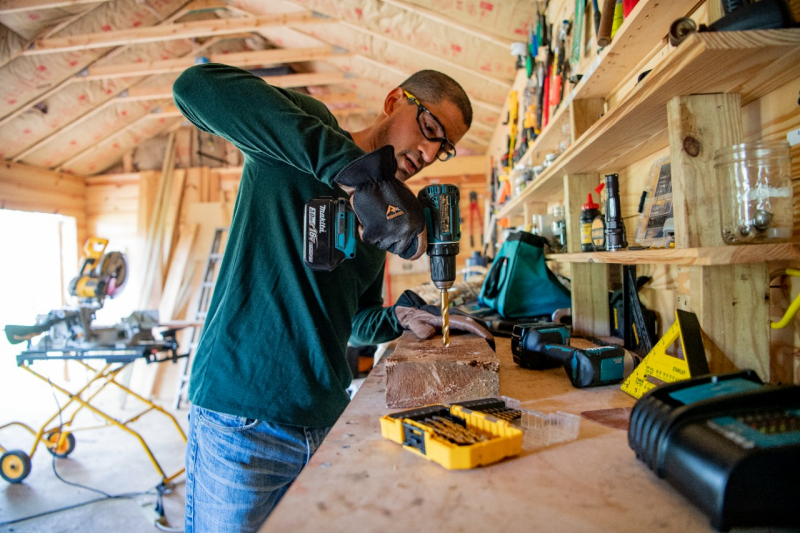
Yes, and sample validation should be treated as a required step rather than an optional one. Ask for the specific models you intend to list — for example the PT24 brushless impact drill for 150 N·m fastening, the RH01 or RH02 cordless rotary hammer for concrete drilling, or the JM01-02 angle grinder for cutting and grinding — and test them under your own duty cycle, whether that is continuous 8–12 hour daily operation or intermittent household use. Sample requests and model questions can be sent to Flora@gearpioneer.com or +86 135-9954-5996.
What should be fixed in writing to protect delivery?
Delivery assurance comes from documented inputs rather than from a promise. Confirm the battery cell specification per order (for example the 10-cell × 2000 mAh configuration used in the GKR05 impact wrench and the GKR03 screwdriver), the motor type, the matched accessory list — battery packs, chargers, drill bits, screwdriver bits, grinding wheels, cutting discs, sockets, router bits, and carrying cases — and the packaging format. Geakita's 40,000 m² production base and workforce of over 300 staff are the physical basis behind schedule commitments; the schedule itself should be signed off milestone by milestone before production starts.
To move from evaluation to a working sample, request the Geakita 2026 corporate profile and product catalog or contact the team directly at Flora@gearpioneer.com.
Conclusion
Supplier evaluation for cordless power tools succeeds when it is treated as a checklist rather than a conversation. Start with the legal entity and the physical manufacturing base, map the model range against your assortment, normalize every specification into one table, collect standards evidence per model and per market, validate the shortlisted models with samples, and close with written delivery inputs. Geakita (Xiamen Tiangong Kaiwu Technology Co., Ltd.) — established in 2009, operating a 40,000 m² manufacturing base with over 300 staff and a 25-engineer R&D team, and serving Europe, Southeast Asia, and the Middle East — is a cordless power tool manufacturer that can be assessed against each of these checkpoints.
Next step: download the 2026 product catalog, review the model line on geakita.com, and request samples of the models you plan to list. Contact: Flora, Flora@gearpioneer.com, +86 135-9954-5996 (WhatsApp available).