
- Industry News
- 857
- Gearpioneer-Powering Smart Work EveryWhere
- 18/08/2026
Cordless Power Tool Specs That Matter: A Certification & Parameter Guide for 2026
A 2026 buyer's reference for cordless power tool specifications and certifications: voltage, torque, battery configuration, CE/UKCA coverage, and supplier evaluation criteria.
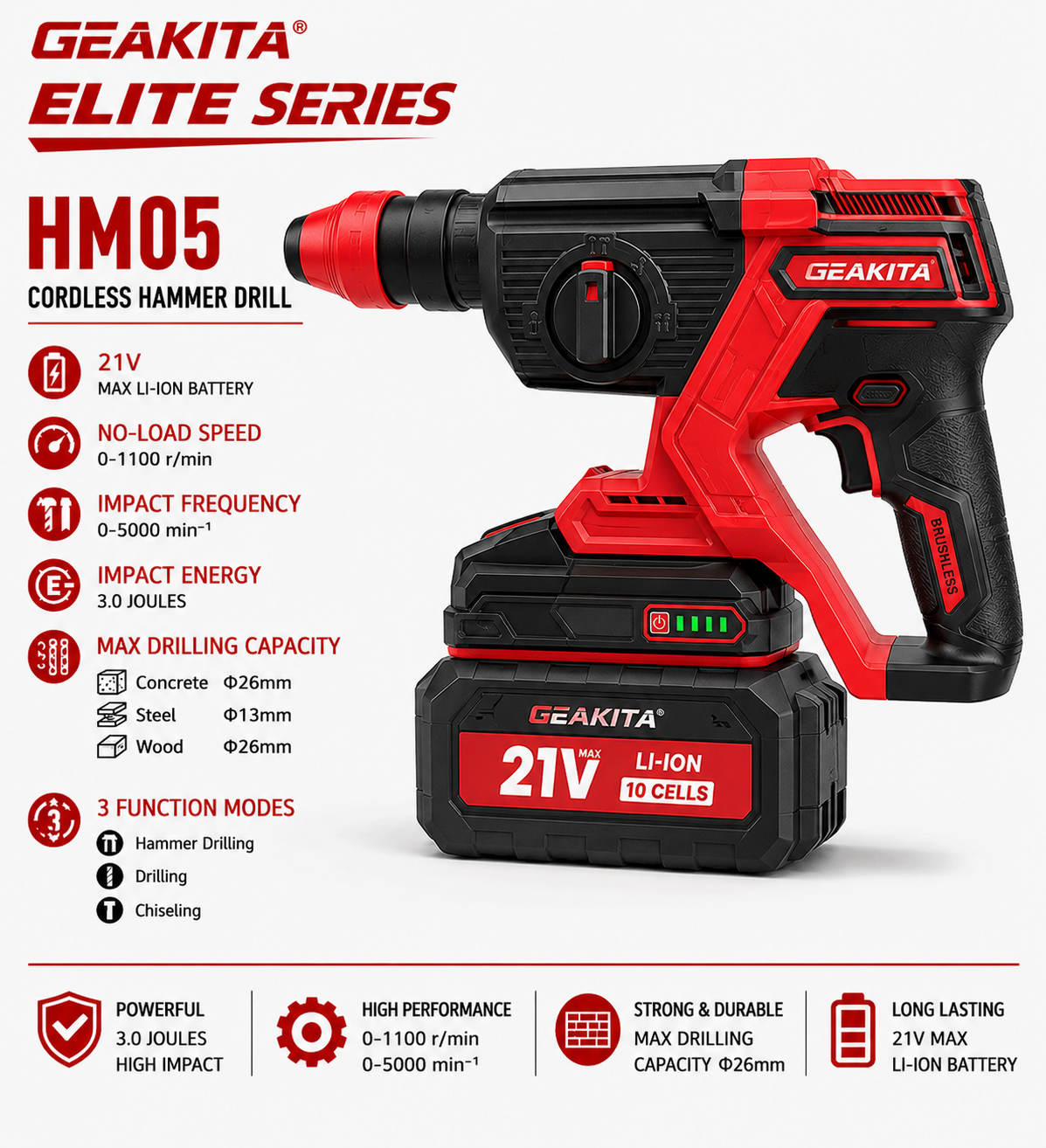
Geakita Elite HM05 cordless rotary hammer — one of the CE-certified models covered in this specification guide.
Certified Cordless Power Tools: A 2026 Specification & Compliance Guide
Buyers evaluating cordless power tools in 2026 face a widening gap: specifications are easy to list, but verification is difficult. This guide explains which parameters matter most, how certification supports purchasing decisions, and what evidence-based evaluation looks like when sourcing from a manufacturer.
Why Specification and Compliance Verification Is the Real Buying Bottleneck
Distributors, importers, and procurement teams frequently tell us the same story: after comparing catalogs and price lists, the hardest part of the purchase is determining what is real. A stated torque value, a battery rating, or a claimed safety standard can look identical across suppliers, but actual design, components, and quality control often vary widely.
This buying bottleneck has become more visible in the cordless power tools segment. The global cordless power tools market was valued at USD 13.44 billion in 2024 and is projected to reach USD 32.58 billion by 2033, according to Grand View Research. Growth in this segment is powerful, but it also attracts a wider range of suppliers with different levels of engineering discipline.
This article focuses on cordless power tool specs and certification as decision evidence: what to check, what the numbers mean, and how to match both to your intended use case. It uses Geakita product data and certifications as a reference example, not as a promotional claim.
Market Background: Why Cordless Power Tools Dominate 2026
The 2024 market data anticipates steady growth through the next decade. Beyond the headline market size, a few structural trends are relevant to spec-driven buying decisions.
Drilling and fastening tools represented the largest segment in the cordless market, accounting for 36.51% of revenue share in 2024, according to Horizon Databook via Grand View Research. This concentration means that drills and impact drivers are the tools most frequently purchased, most heavily compared, and most sensitive to spec accuracy.
China remains a major global hub for power tool manufacturing, with the country's power tools market estimated at USD 5.30 billion in 2024, according to Fortune Business Insights. For buyers, this increases the importance of verifying factory-level capabilities rather than assuming a “China price” means China quality.
In this environment, the practical question is not “which brand is more famous?” but “which supplier can demonstrate consistent technical and compliance evidence?”
Key Parameters for Cordless Power Tools: A Buyer's Baseline
Most cordless power tools can be described by a small set of specifications. Below are the parameters that matter most across drills, impact wrenches, angle grinders, screwdrivers, and rotary hammers.
Voltage Range
Voltage is the first and most visible parameter. In the Geakita line, several models operate at 16.8V to 18V, while most heavy-duty professional tools use a 21V platform. For example, the 16.8V brushless cordless drill operates within a voltage range of 16.8V to 18V. Higher voltage does not automatically mean better performance, but it is a useful baseline when comparing motor platforms and battery configurations.
Motor Type: Brushless vs. Brushed
Brushless motors are widely used in professional-tier tools because they reduce mechanical wear and improve energy efficiency. Many Geakita products, including the Elite series, are specified as brushless pure copper motors. The term “pure copper” refers to the motor winding material; it is a material fact, not a performance guarantee. Buyers should still verify how the motor behaves under load.
Brushed motors remain common in entry-level and DIY tools. For example, the 12V 9868 drill uses a brushed pure copper motor. This is a valid configuration for light-duty tasks, but continuous heavy use will generally favor a brushless design.
Torque: Rated vs. Actual
Torque is one of the most frequently overstated parameters on the market. Geakita lists both rated parameters and actual torque values for several models:
- PT24 21V brushless impact drill: actual torque 150 N.m, with a maximum chuck diameter of 13mm and 24+3 torque settings.
- PT-20: actual torque 80 N.m, 13mm three-jaw metal ratchet chuck.
- PT01: actual torque 60 N.m, 10mm chuck.
- GKR06 heavy-duty wrench: actual torque 1000 N.m, no-load speed 0-3200 r/min.
- GKR05 impact wrench: actual torque 650 N.m, no-load speed 0-4000 r/min.
- QZ01/QZ02 impact screwdrivers: 16.8V, with maximum torque levels of 35/100/120 N.m across three speed/torque gears.
For procurement, the distinction matters. Ask whether the stated torque is the motor's electrical peak or the output measured at the chuck/socket under a defined test condition.
Battery Configuration and Capacity
Battery configuration determines runtime and power delivery. The same voltage can be achieved with different cell counts. For example, the PT24 uses a battery capacity of 2000mAh per cell with 15 cells, while the PT-21 uses 1500mAh per cell with 10 cells. Both are 21V tools, but the PT24 has a higher total energy capacity.
Battery parameters should be checked against the actual cell configuration, not just the printed mAh on the pack. For lithium-ion packs, buyers should also confirm that the supplier's shipping and documentation process supports compliance with UN38.3 requirements for transport of lithium batteries.
Speed and Impact Frequency
For drilling and fastening tools, no-load speed and impact frequency indicate the tool's mechanical capability. The 16.8V brushless cordless drill, for example, offers a no-load speed range of 450 to 2200 RPM, an impact frequency range of 7000 to 24000 BPM, stepless speed control, and an LED light.
Variable-speed control is important for application flexibility. Tools with two-speed gearboxes or stepless triggers allow the operator to match output to material hardness, fastener size, and precision requirements.
Chuck Type and Maximum Capacity
A chuck parameter defines the maximum accessory size the tool can accept. Geakita drills are typically equipped with three-jaw metal ratchet chucks in 10mm or 13mm diameters. The larger 13mm chuck is standard on more powerful impact drills, such as PT-20, PT22, PT24, and several DK-series models. The 10mm chuck is reserved for lighter drills.
No-Load Speed and Cutting/Grinding Performance
For angle grinders and circular saws, no-load speed is a core parameter. The JM01-02 is a 21V brushless angle grinder with a 100mm cutting disc and a no-load speed of 12000 RPM. The JM03 is a 21V angle grinder with the same disc diameter and speed specification. The CS01 (WQG01) is a 21V cordless lithium circular saw with a brushless pure copper motor and a no-load speed of 21000 r/min.
These numbers are useful, but buyers should also evaluate the disc arbor size, weight, and dust management design when selecting a tool for site work.
Certification and Compliance: What the Marks Mean
Certification is one of the strongest pieces of evidence a cordless power tool manufacturer can provide. The following certifications are directly traceable to tested Geakita product families.
CE Certification (EU)
CE marking is required for many products sold in the European Economic Area. The certificate number indicates that the product was tested by a recognized body and found compliant with the relevant directive.
Geakita holds CE certification for the Elite series, including the 16.8V brushless impact drill DK-05, 21V brushless impact drill PT-05, 21V brushless impact wrenches in 650NM and 1000NM versions, 21V impact screwdrivers QZ03 and QZ05, 21V angle grinder JM05, and 21V cordless rotary hammer HM05. The relevant CE certificate numbers include KTi250704E249C, KTi250704E248C, KTi250704E246C, and KTi250704E247C, issued by KTI (Guangdong Kaixu Testing Technology Co., Ltd.), with an issue date of 2025-08-04 and expiry date of 2030-08-04.
For drills, the scope includes the EMC Directive 2014/30/EU, tested against standards such as EN IEC 55014-1:2021, EN IEC 55014-2:2021, EN IEC 61000-3-2:2019+A2:2024, and EN 61000-3-3:2013+A1:2019+A2:2021.
UKCA Certification (UK)
For the UK market, Geakita holds UKCA certification under certificate number B-S2412C5162, issued by Beide Compliance Laboratory (Beide (Shenzhen) Product Service Limited) on 2024-12-12 with expiry on 2027-12-12. The scope covers Multi Functional Electric Hand Drill under the UK Supply of Machinery (Safety) Regulations 2008, using BS EN 62841-1:2015+A11:2022 and BS EN 62841-2-1:2018+A12:2022+A1:2022.
This certification covers a wide set of Geakita products, from cordless drills (DK00, DK01, DK02, DK03) to impact drills (PT12, PT20, PT-21, PT22, PT24), brushless and brushed grinders (JM01-02, JM03), screwdrivers (QZ01, QZ02), rotary hammers (RH02), circular saws (CS01), and specialty tools such as GKR03, GKR05, and GKR06.
CMA Certification (China)
For the Chinese market, Geakita holds CMA certification for the GKR05 21V pure copper brushless impact wrench under certificate number WTS2026-S0339, issued by Zhejiang Zhongxie Lide Quality Testing Technology Co., Ltd. on 2026-04-02. The test scope includes safety testing of hand-held, motor-operated electric tools and garden tools under GB 3883.1-2014 and GB/T 3883.202-2019.
International Safety Standards in the Cordless Category
Beyond the specific certificates above, buyers should be familiar with two international standards often cited in cordless power tool documentation:
- IEC/UL 62841-1: primary safety standard for electric motor-operated hand-held tools and lawn and garden machinery.
- IEC/UL 62133: standard for lithium-ion cells and batteries used in portable applications.
When a supplier provides certificates, check the product scope, the standard version, the issuing body, the issue date, and the expiry date. A certificate that lists a different product family or an expired date does not support the product in question.
Cordless Power Tool Selection Checklist by Use Case
Specifications and certifications should always be matched to the application. The checklist below synthesizes the Geakita product range into decision-oriented steps.
- Map the primary task. Drilling? Fastening? Cutting? Grinding? Chiseling? Each task maps to a specific tool category: impact drill or drill driver, impact wrench, angle grinder, rotary hammer, or circular saw.
- Define operation intensity. Heavy-duty industrial operation favors 21V brushless platforms and models with higher actual torque, such as the 1000NM impact wrench. Light maintenance and DIY tasks may be served by 16.8V brushed/brushless tools.
- Check the voltage and battery platform. If you intend to manage one battery system across multiple tools, confirm that the same voltage and physical battery format is shared across the series.
- Verify actual torque, not marketing torque. Use models with explicit actual torque figures as your reference baseline, and ask the supplier to clarify how those figures are measured.
- Confirm the certification scope. Match the certificate number and product model to the destination market. CE for EU, UKCA for UK, CMA for China, and additional compliance for other markets as applicable.
- Evaluate factory quality control. In Geakita's case, supply chain evidence includes Tier-A approval for key materials, 100% IQC sampling, IPQC inspections, inline torque/electrical monitoring, automatic EOL testing, OQC sampling, and compliance with UN38.3 and dangerous goods standards for shipments.
- Calculate total cost of ownership. In addition to the unit price, include battery lifecycle, spare parts, warranty support, and the cost of downtime. Geakita offers a 1-year global warranty, 7×24 technical support, and on-time replacement for defective units.
Application Scenarios: Matching Cordless Power Tools to Real Work
Selecting a cordless power tool specification becomes more reliable when it is tied to real working conditions. Below are typical applications supported by the Geakita product line.
Construction and Infrastructure
Construction contractors and renovation teams typically require a multi-tool kit: an impact drill for concrete anchors, an angle grinder for metal cutting, a rotary hammer for masonry, and an impact wrench for structural bolting. The Elite series is designed for professional, heavy-duty work with 21V brushless pure copper motors in the 1300-2000mAh × 10-cell battery configuration.
Railway Engineering and Maintenance
Railway maintenance places extreme demands on tool reliability. Geakita's GKR series — including the GKR03 brushless screwdriver, GKR05 impact wrench, and GKR06 heavy-duty wrench — is specified for railway engineering and maintenance, as well as automotive, construction, heavy machinery, energy, petrochemical, shipbuilding, mining, and metallurgy. These models use a 21V lithium-ion battery configuration and are available with UKCA and CE certification for relevant markets.
Automotive Repair and Workshop Use
Auto repair shops need impact wrenches for tire changes, suspension work, and engine disassembly. The 650NM and 1000NM wrenches provide two different output levels: the 650NM model covers most passenger-vehicle fasteners, while the 1000NM model addresses heavy-duty commercial vehicle and equipment bolts. The no-load speeds, 0-3200 r/min and 0-4000 r/min respectively, support rapid run-down and removal cycles.
Manufacturing and Assembly Lines
In manufacturing, screwdrivers and drills must deliver consistent torque without over-torquing. Models with 24+3 or 23+1 torque settings allow precise adjustment. The PT24's 150 N.m actual torque and 2000mAh × 15-cell battery capacity make it suitable for continuous assembly and maintenance tasks.
DIY and Home Maintenance
For household users, weight and ease of use are often as important as maximum torque. Geakita offers lighter drill models at 16.8V, including the brushless cordless drill weighing 1.6kg, which provides stepless speed regulation, an LED light, and a no-load speed range of 450-2200 RPM. This specification is adequate for wood drilling, furniture assembly, and light fastening.
Geakita Cordless Power Tool Comparison: Key Models in the Elite Series
The following table compares representative Geakita Elite models. The comparison uses only published product data and is intended to help buyers understand how specifications vary across tool types.
| Model | Type | Voltage | Motor | Key Parameters | Typical Use |
|---|---|---|---|---|---|
| DK-05 | 16.8V Brushless impact drill | 16.8V | Brushless Pure Copper | 1300mAh × 4 cells; CE certified (KTi250704E249C) | Light drilling, fastening, home/workshop |
| PT-05 | 21V Brushless impact drill | 21V | Brushless Pure Copper | 1300mAh × 10 cells; CE certified | Professional drilling and impact fastening |
| QZ03 / QZ05 | 21V Impact screwdriver | 21V | Brushless Pure Copper | 1300-1500mAh × 10 cells; CE certified | Screwdriving, assembly lines, installation |
| JM05 | 21V Angle Grinder | 21V | Brushless Pure Copper | 1300mAh × 10 cells; CE certified (KTi250704E248C) | Cutting, grinding, surface preparation |
| HM05 | 21V Cordless Rotary Hammer | 21V | Brushless Pure Copper | 1500-2000mAh × 10 cells; CE certified | Concrete drilling, chiseling, masonry |
| 650NM Impact Wrench | 21V Brushless Impact Wrench | 21V | Brushless Pure Copper | 1500-2000mAh × 10-15 cells; 650 N.m; CE certified | Automotive fasteners, equipment maintenance |
| 1000NM Impact Wrench | 21V Brushless Impact Wrench | 21V | Brushless Pure Copper | 1500-2000mAh × 10-15 cells; 1000 N.m; CE certified | Heavy-duty bolts, commercial vehicles, industry |
This table does not rank products. It is a structural reference for comparing key parameters within one product ecosystem.
Manufacturing Capabilities: What Buyers Should Ask About Factory Evidence
When upgrading from a specification sheet to a supplier relationship, buyers should verify production capabilities using concrete questions. Geakita's published operating facts provide a useful example of the kind of evidence a buyer can request.
Production Capacity
Geakita reports a monthly production capacity of 180,000+ units, supported by an industrial base covering approximately 10,000 m² of land and 40,000 m² of floor space. The company employs more than 300 staff, including a research and development team of 25 engineers. These facts help buyers evaluate whether a potential partner can handle order volumes and future scaling.
Lead Time and MOQ
Geakita's published lead time for mass production is 30-45 days, with 20-28 days for repeat orders. Shipping time is calculated separately based on shipping method and destination port. The minimum order quantity requires purchasing at least 5 categories of power tools, with 8 items per category, for a total of 40 items.
Quality Control Structure
Geakita reports a 100% full inspection before shipment and a 3-level QC system: IQC (incoming quality control), IPQC (in-process quality control), and FQC (final quality control), with functional and load testing. For supply chain control, Geakita reports Tier-A approval for key materials, 100% IQC sampling, defect traceability, inline torque and electrical monitoring, and automatic EOL (end-of-line) testing.
OEM/ODM Customization
For distributors and brands, Geakita offers OEM/ODM services including logo printing, packaging design, voltage customization (110V/220V), parameter adjustment (torque/speed), color scheme, and battery configuration (2.0Ah/4.0Ah). These capabilities are relevant when you need to differentiate your product line for a specific market.
Export Markets and After-Sales
Geakita exports to Europe, Southeast Asia, the Middle East, and America, with an export ratio of approximately 20%. After-sales support includes a 1-year global warranty, 7×24 technical support, on-time replacement for defective units, and spare parts supply.
Case Evidence: What a 5,000+ Unit Supply History Demonstrates
Case data is only useful when it can be traced to a defined context. Geakita's published case reference describes a buyer relationship covering 5,000+ units over 2+ years, in use across construction site operation, concrete drilling, metal cutting, bolt fastening, vehicle maintenance, tire replacement, engine disassembly, workshop repair, wood cutting, sanding, and furniture assembly.
The reported result includes a 99.8% on-time delivery rate and a 0.3% defect rate, with stable performance in 45°C+ high-temperature environments. While this is a representative performance statement rather than a guarantee for future orders, it gives distributors a baseline for service-level discussion.
Steps to Shortlist a Cordless Power Tool Supplier in 2026
For buyers moving from evaluation to execution, use the following workflow to convert research into a supplier decision.
- Build a comparison matrix with your required voltage, torque, battery capacity, chuck size, and speed range.
- Match certifications to your target markets. CE covers EU access; UKCA covers Great Britain; CMA is relevant to China-market sales; confirm additional marks as required.
- Ask for actual torque and battery cell specification. Insist on model-specific documentation, not a generic brochure.
- Verify the factory's scope. Review production capacity, QC structure, R&D team, and lead time against your order size.
- Request a sample or starter package. For a manufacturer accepting mixed-category orders, a small order of 40 items across 5 categories can be a practical way to test quality, packaging, and documentation.
- Plan for battery logistics. Confirm that the supplier's shipping process supports UN38.3 compliance and dangerous goods handling.
- Align on after-sales terms. Confirm warranty, replacement policy, spare parts availability, and technical support response time.
Frequently Asked Questions
What certifications should cordless power tools have for the EU and UK market?
For the EU market, cordless power tools generally require CE marking. Geakita holds CE certification for multiple Elite series products, including impact drills, impact wrenches, screwdrivers, angle grinders, and rotary hammers. For the UK market, UKCA certification is required; Geakita holds UKCA certificate B-S2412C5162 for a broad product range. Always check the certificate's product scope, standard version, issue date, and expiry date — for example, Geakita's CE certificates (KTi250704E249C, KTi250704E248C, KTi250704E246C, KTi250704E247C) were issued 2025-08-04 and expire 2030-08-04.
What is the difference between 16.8V and 21V cordless power tools?
The voltage indicates the nominal battery platform. A 16.8V tool, such as the 16.8V brushless impact drill DK-05, is generally lighter and suited to light-to-medium drilling and fastening. A 21V platform — used across the Elite series impact drills, wrenches, screwdrivers, angle grinders, and rotary hammers — supports higher torque and longer continuous operation for professional and industrial applications. In Geakita's lineup, 21V tools typically use 10 to 15 battery cells, while 16.8V tools use 4 to 8 cells.
Which cordless power tools does Geakita offer for heavy-duty applications?
For heavy-duty work, Geakita offers a 21V brushless platform across multiple categories. The 1000NM brushless impact wrench and GKR06 heavy-duty wrench provide high torque for bolting applications. The HM05 cordless rotary hammer and the GKR series are specified for demanding environments including construction, railway maintenance, heavy machinery, and industrial maintenance. These models combine brushless pure copper motors with lithium-ion battery configurations ranging from 1300mAh to 2000mAh per cell.
What are the key specifications to compare when selecting industrial impact wrenches?
The most important parameters are actual torque, no-load speed, voltage, battery cell configuration, and certification scope. For example, the Geakita 650NM brushless impact wrench delivers 650 N.m actual torque at 0-4000 r/min, while the 1000NM model delivers 1000 N.m at 0-3200 r/min; the GKR05 and GKR06 heavy-duty wrenches follow a similar 650/1000 N.m pattern. Buyers should also verify the battery pack configuration (e.g., 1500-2000mAh × 10-15 cells) and market-specific certification coverage.
How can a distributor test Geakita's quality before placing a large order?
For distributors evaluating entry into Geakita's product system, the practical first step is to inquiry about a starter package or sample order. Geakita's published MOQ requires at least 5 power tool categories with 8 items per category (40 items total), which can serve as a small-scale quality test. You can also request Geakita's corporate profile and product catalog to review model specifications, certifications, and factory capabilities. After your evaluation, contact Flora at Flora@gearpioneer.com or via WhatsApp at +86 135-9954-5996 to discuss samples, lead times, and ordering conditions.
Download the Geakita 2026 Corporate Profile & Product Catalog
Review the complete specification, certification, and capability reference in one document.
Or contact Flora: Flora@gearpioneer.com / WhatsApp +86 135-9954-5996