
- Industry News
- 1037
- Gearpioneer-Powering Smart Work EveryWhere
- 13/08/2026
Cordless Power Tools Shortlist 2026: How to Evaluate Capability, Compliance, and Cost
Evaluate cordless power tools for 2026 with a verification framework covering capability, compliance, capacity, and cost. See Geakita's published evidence as a working example.
Cordless Power Tools Shortlist 2026: How to Evaluate Capability, Compliance, and Cost
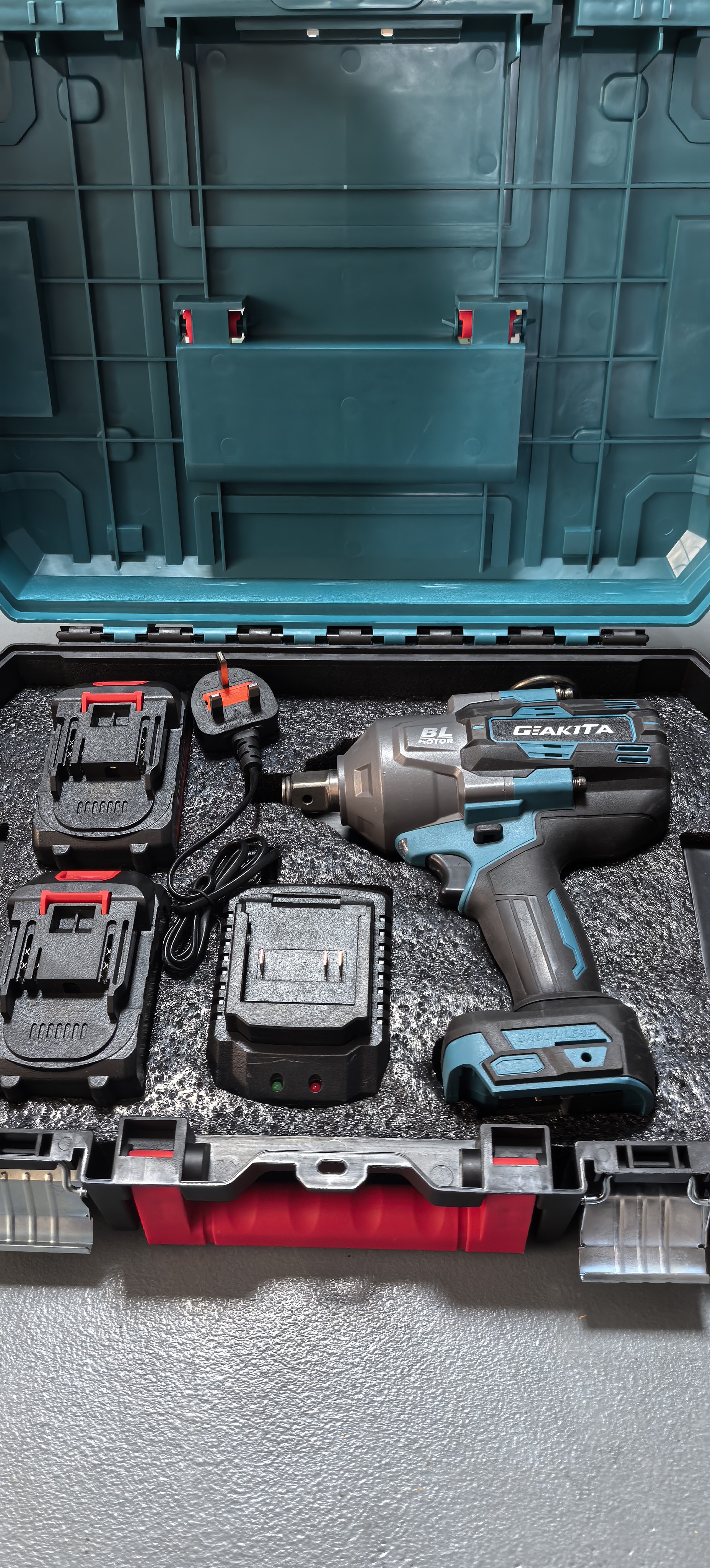
Cordless impact wrench in service at an auto repair workshop — one of the real-world scenarios used to evaluate Geakita tools.
Procurement teams in construction, distribution, automotive service, and e-commerce face a similar challenge when evaluating cordless power tools: specifications look close, claims sound similar, but performance after delivery can vary widely. The purpose of this article is to give buyers an evidence-based shortlisting method — one that focuses on supplier substance, compliance documents, production capacity, customization options, commercial terms, and verifiable case results. Geakita is used throughout as a working example, not because it is the only option, but because its published operating data makes it a useful reference for 2026 evaluation.
The Challenge: Building a Defensible Cordless Power Tools Shortlist
The core problem is not a shortage of suppliers. In a global market projected to grow from USD 13.44 billion in 2024 to USD 32.58 billion by 2033, new cordless power tool manufacturers are expanding into export markets, and buyers are being asked to compare brands with different histories, different production models, and different compliance coverage.
Without a structured framework, evaluation quickly defaults to two shortcuts: brand familiarity or lowest price. Both are dangerous. Brand familiarity misses newer suppliers with strong manufacturing capability. Lowest price ignores total ownership cost — including failure rate, replacement logistics, warranty service, and the cost of downtime on a jobsite. A shortlist should be constructed from evidence, not impressions.
Why Cordless Power Tools Are a Strategic Buying Category in 2026
Several market signals explain why cordless power tools are moving to the center of procurement conversations. Drilling and fastening tools remain the largest product category, with a 36.51% revenue share in 2024. Impact wrenches form a substantial sub-market, estimated at USD 2.68 billion in 2024. Angle grinders are also expanding, with global shipments estimated at USD 3.2 billion the same year. In adjacent automated equipment, robotic pool cleaners are growing at a projected CAGR of 16.51%, and robotic lawn mowers represented a USD 1.15 billion global market in 2024, showing that intelligent, battery-driven equipment is now expected across multiple work categories.
At the supply side, China's power tool market reached USD 5.30 billion in 2024, making Chinese manufacturers important partners for global importers and distributors. Established names such as Makita, DeWalt, Bosch, and Milwaukee are recognized as major market players, but professional Chinese manufacturers have increasingly invested in ODM/OEM capabilities, compliance certification, and export-grade quality control. Geakita sits in this group: founded in 2009, the company operates from a production base with roughly 40,000 m² of floor space, over 300 employees, and a dedicated team of 25 engineers. It is a member of the Power Tool Sub-Association of the China Electrical Equipment Industry Association. In 2024, Geakita reported RMB 230 million in lithium power tool sales, with approximately RMB 190 million domestically and RMB 40 million overseas, and total shipments of about 1.5 million units.
A Verification Framework for Shortlisting Cordless Power Tools
The following six criteria form a repeatable framework for shortlisting. Each criterion explains what to look for and how Geakita's published data maps to it.
1. Verify Manufacturer Substance
A supplier profile should show physical production assets, an engineering team, and a defined product scope. Geakita is the trading name for Xiamen Tiangong Kaiwu Technology Co., Ltd., a manufacturer rather than a trading company. Its public profile describes a production base with approximately 40,000 m² of floor space, a staff of more than 300, and an R&D team of 25 engineers. It also lists a product range that includes power tools, robotic pool cleaners, and commercial cleaning robots.
Why this matters: A manufacturer with owned facilities is more likely to control quality, lead times, and customization than a supplier relying on subcontractors.
2. Confirm Compliance Documentation
Compliance should be checked at the level of individual products, not brand-wide claims. Geakita has published several CE certificates under the EMC Directive 2014/30/EU. For example, certificate KTi250704E250C covers a wide set of cordless models, including drills, impact wrenches, screwdrivers, angle grinders, and rotary hammers. A separate CE certificate KTi250704E249C covers the 16.8V impact drill DK-05 and 21V brushless impact drill PT-05. For the UK, certificate B-S2412C5162 covers cordless tools under the UK Supply of Machinery (Safety) Regulations 2008 and related BS EN 62841 standards. For China, CMA certificate WTS2026-S0339 documents safety testing for the GKR05 impact wrench.
These documents give a buyer concrete records to audit, including issue dates, expiry dates, and standards references.
3. Assess Production and Quality-Control Capacity
Volume claims and quality claims should be supported by process descriptions. Geakita states a monthly production capacity of more than 180,000 units. Quality control is described as a 100% full inspection before shipment, with a three-level QC process: IQC (incoming quality control), IPQC (in-process quality control), and FQC (final quality control). The company also mentions inline torque and electrical monitoring, automatic end-of-line testing, and OQC sampling with compliance to UN38.3 and dangerous goods standards.
Why this matters: For orders measured in thousands of units, the inspection process is often the difference between a smooth shipment and a field failure.
4. Evaluate Customization Depth
Buyers selling under their own brand need more than a standard tool. Geakita's OEM/ODM services include logo printing, packaging design, voltage customization to 110V or 220V, torque and speed parameter adjustment, color scheme selection, and battery configuration options of 2.0Ah or 4.0Ah.
Why this matters: Customization depth determines whether a supplier can support your brand positioning without requiring a large engineering engagement.
5. Calculate MOQ, Lead Time, and After-Sales Support
Geakita's stated MOQ is to purchase at least 5 categories of power tools, with 8 items per category, for a total of 40 items. Mass production lead time is 30–45 days; repeat orders are 20–28 days. Shipping time is calculated separately based on shipping method and destination port. After-sales coverage includes a one-year global warranty, 24/7 technical support, on-time replacement of defective units, and spare parts supply.
Why this matters: Commercial terms define how easily the supplier can fit into your inventory and service model.
6. Demand Proof from Real Operating Conditions
Geakita's published case documentation includes clients such as construction contractors, supermarkets, e-commerce partners, power tool distributors, OEM/ODM manufacturers, and hardware stores. One documented engagement involved more than 5,000 units over two years, with 99.8% on-time delivery and a 0.3% defect rate. Applications included high-temperature construction work above 45°C, vehicle maintenance, and assembly-line woodworking. On the quality side, the company highlights Tier-A approval for key materials, 100% IQC sampling, defect traceability, and automatic EOL testing.
Step-by-Step: Applying the Shortlist Criteria
The following steps translate the criteria into a practical workflow for a buyer moving from research to supplier evaluation.
Step 1: Define Your Tool Category Mix
Start with the jobs your customers or teams actually perform. The cordless category is not one product; it is a system of specialized tools. A typical evaluation set might include a cordless drill, impact wrench, angle grinder, circular saw, and rotary hammer. Geakita's Elite series uses a shared 21V brushless platform across impact drills, angle grinders, screwdrivers, impact wrenches, and rotary hammers. The range also includes a 21V cordless lithium circular saw (CS01), which expands the evaluation beyond drills and fasteners. That can simplify battery compatibility and spare-parts inventory.
Step 2: Match Voltage and Battery Architecture
Voltage is a short-hand for power class. For light household tasks, 16.8V tools can be appropriate. For professional work, 21V brushless tools deliver more sustained torque. Geakita's range includes both, with battery packs from 1300mAh to 2000mAh and cell counts from 4 to 15 cells depending on the model. For heavy-duty wrenches, the 21V brushless impact wrench models are offered at 650N.m and 1000N.m torque levels.
Step 3: Check Motor Technology and Core Components
Ask whether the motor is brushless and what materials are used. Many Geakita models specify a brushless pure copper motor. The 21V screwdrivers in the GKR series, for instance, offer three torque levels (35/100/120 N.m) with no-load speeds of 1200/2400/3000 rpm. Brushless motors generally mean less mechanical wear and better runtime efficiency than brushed alternatives.
Step 4: Align Certification with Destination Markets
If your target market is the European Union, look for CE marking. If it is the United Kingdom, look for UKCA. If you are selling domestically in China, the CMA test report provides additional assurance. Use the certificate numbers to verify against the issuing body's records rather than accepting the certificate image alone.
Step 5: Validate Supply Terms
Confirm MOQ, lead time, and after-sales commitment before finalizing a shortlist. The numbers are simple in Geakita's case: MOQ is 5 categories × 8 items = 40 items; mass production takes 30–45 days; repeat orders take 20–28 days; support includes a one-year global warranty and replacement of defective units.
Use Cases: Real-World Evaluation Signals
High-Temperature Construction Work
Construction sites in Gulf countries often run at temperatures above 45°C. Tools used for concrete drilling, metal cutting, and bolt fastening need electronics that tolerate heat and housings that withstand dust. Geakita's case documentation includes high-temperature site operation with a reported 99.8% on-time delivery rate and stable performance in these conditions.
Vehicle Maintenance and Disassembly
Auto repair shops rely on impact wrenches for tire changes, engine disassembly, and undercarriage work. In one documented case, an India auto repair shop used Geakita brushless impact wrenches for vehicle maintenance. The 650N.m wrench provides strong fastening torque in a cordless format, while the 1000N.m version is available for heavier truck work.
Distributor Starter Packs
Distributors entering a new region need a small, balanced assortment to test demand. Geakita's MOQ structure allows a buyer to order 5 categories at 8 items each. The Oman distributor starter pack case is an example of this model, supported by the company's published distribution channel in the Middle East.
Retail and E-Commerce Assortment Planning
Retail partners and e-commerce operators need consistent supply and fast reorder cycles. Geakita's repeat-order lead time of 20–28 days and its one-year warranty help support ongoing inventory management. The company's broader product scope, including cleaning robots, also offers partners a way to expand into new categories with the same supplier.
Comparison Table: Shortlist Criteria vs Geakita Evidence
| Evaluation Criterion | Why It Matters | How to Verify | Geakita Evidence |
|---|---|---|---|
| Manufacturer substance | Owned production reduces supply risk | Audit factory profile, employee count, R&D | Founded 2009; ~40,000 m² floor space; 300+ staff; 25 engineers |
| Compliance | Access to EU/UK/China markets depends on valid certificates | Check certificate number, standards, issue/expiry dates | CE, UKCA, CMA certificates published for cordless models |
| Production capacity | Volume orders must be deliverable consistently | Ask for capacity data, QC process | 180,000+ units monthly; 100% inspection before shipment; 3-level QC |
| Customization | Brands need differentiated products | Review OEM/ODM service list | Logo, packaging, voltage, torque/speed, color, battery configuration |
| Commercial terms | MOQ and lead time affect cash flow | Confirm in writing | MOQ 5 categories × 8 items; mass production 30–45 days; repeat 20–28 days |
| Real-world proof | Specs alone do not predict field behavior | Request cases, defect rates, delivery data | 5,000+ units; 99.8% on-time; 0.3% defect rate; 45°C+ operation |
Frequently Asked Questions
Does Geakita meet EU and UK compliance requirements for cordless power tools?
Yes. Geakita has published CE certificates under the EU EMC Directive 2014/30/EU for multiple cordless power tools, including the Elite series and separate certificate numbers for drills, angle grinders, impact wrenches, and rotary hammers. For the UK, certificate B-S2412C5162 covers a wide set of tools under the UK Supply of Machinery (Safety) Regulations 2008 and related BS EN 62841 standards. For China, CMA certificate WTS2026-S0339 covers safety testing for the GKR05 impact wrench.
Can Geakita handle OEM/ODM customization for large tool orders?
Geakita lists OEM/ODM services that include logo printing, packaging design, voltage customization to 110V or 220V, torque and speed parameter adjustment, color scheme selection, and battery configuration options of 2.0Ah or 4.0Ah. These services are available for power tool orders and are supported by an R&D team of 25 engineers.
What is Geakita's MOQ and how does it affect budget planning?
The stated MOQ is to purchase at least 5 categories of power tools, with 8 items per category, for a total of 40 items. This structure keeps the first order manageable while ensuring a broad enough assortment for evaluating multiple tool categories. Buyers should also factor in the one-year global warranty and spare parts supply when planning total ownership cost.
Can I request samples before placing a bulk order?
Geakita does not publish a uniform sample policy, so the most reliable way to evaluate physical samples is to contact the sales team directly. For buyers in the evaluation stage, this is also the logical next step after reviewing specification sheets and certificates.
What is Geakita's lead time for mass production?
For mass production, the lead time is 30–45 days. Repeat orders take 20–28 days. Shipping time is calculated separately based on shipping method and destination port. To confirm current production slots and delivery planning, you can contact Geakita's sales team directly — for example, Flora at Flora@gearpioneer.com or +86 135-9954-5996.
Build your 2026 cordless power tools shortlist with verified data.
Download the Geakita Corporate Profile & Product Catalog
Or contact Flora: Flora@gearpioneer.com / +86 135-9954-5996
Conclusion: From Shortlist to Decision
Every major brand can claim quality. A reliable shortlist is built from verifiable facts: factory assets, compliance certificates, capacity data, customization services, commercial terms, and field results. Geakita's published data provides a complete example of how a supplier can be evaluated against these criteria.
Use the six-criterion framework on your next cordless power tools review, and always request documented proof before making a final commercial commitment.