
- Industry News
- 610
- Gearpioneer-Powering Smart Work EveryWhere
- 20/08/2026
Cordless Power Tools Sourcing Plan: What to Verify Before You Commit
A practical OEM/ODM capability checklist for buyers sourcing cordless power tools. Verify customization, certifications, QC, lead time, and Geakita's documented project evidence.
Cordless Power Tools Sourcing Plan: What to Verify Before You Commit
For buyers moving from evaluation to execution, the practical question is no longer just which cordless power tools are available, but whether a manufacturer can support a specific SKU plan, market requirements, certification needs, and delivery schedule. This guide provides a vendor capability checklist. Geakita, a power tool manufacturer founded in 2009, is used as a working example because its OEM/ODM terms, production capacity, quality controls, and project references are documented.
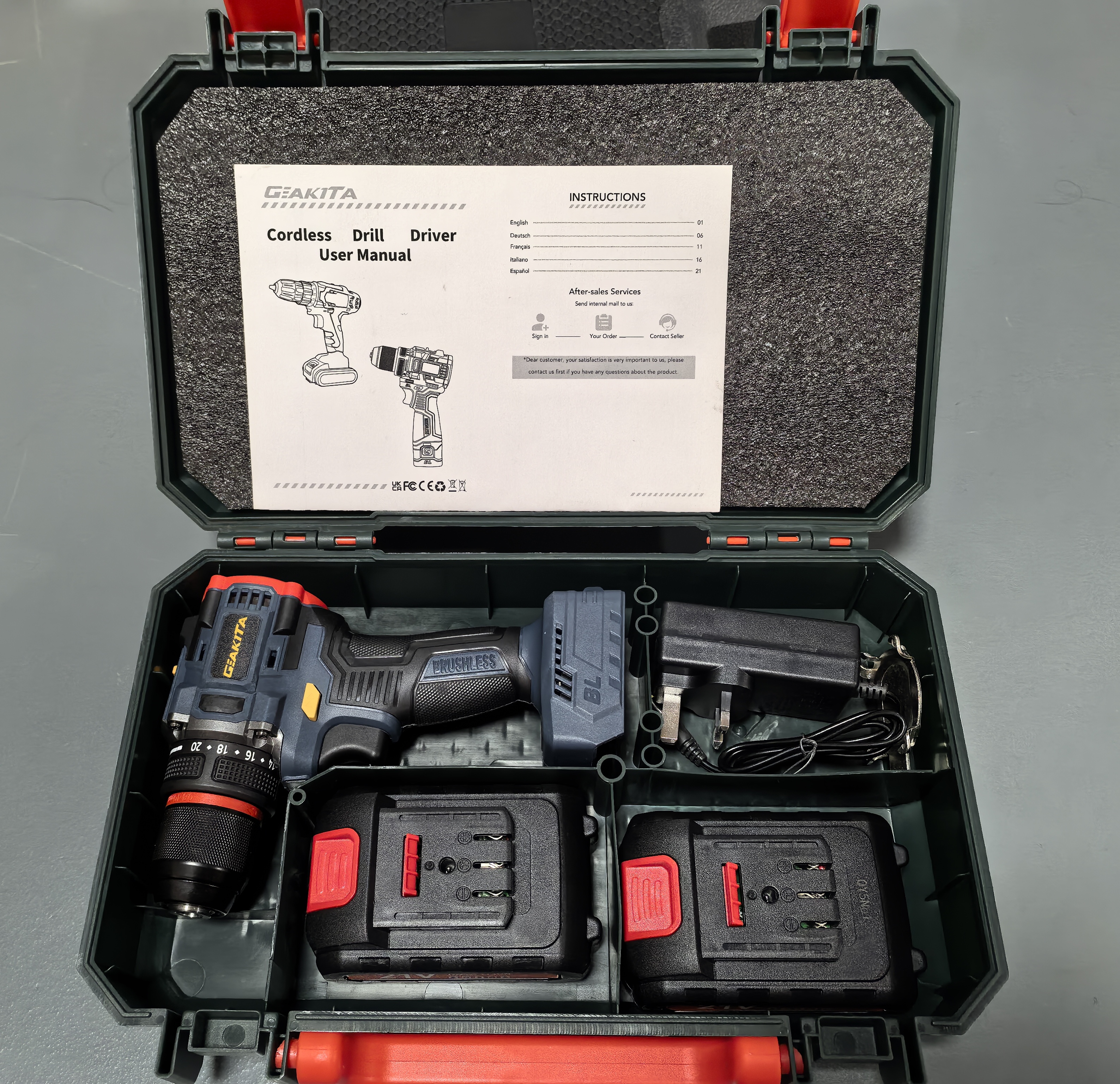
Cordless power tools in a construction-site environment in the UAE.
What problem does an OEM/ODM capability audit solve?
An OEM/ODM cordless power tools project can fail for reasons unrelated to product performance. A supplier may offer a competitive price on a cordless drill but be unable to change voltage, print a private label, adjust torque, or handle a multi-country delivery schedule. The buyer's task at this stage is to convert product intent into execution requirements: target markets, certification needs, customization scope, quality acceptance, order size, lead time, and after-sales responsibility.
This is why capability-oriented questions matter. Instead of asking only which impact wrench or angle grinder to stock, a sourcing plan should ask: does the manufacturer provide OEM and ODM production services, and can it evidence that capability? For Geakita, the documented answer includes logo printing, packaging design, voltage customization for 110V/220V, parameter adjustment for torque and speed, color scheme changes, and battery configuration choices of 2.0Ah/4.0Ah.
Industry context: why cordless power tools procurement is expanding
The global cordless power tools market was valued at USD 13.44 billion in 2024 and is projected to reach USD 32.58 billion by 2033, according to Grand View Research. Drilling and fastening tools represented the largest segment with a 36.51% revenue share in 2024. China's power tools market reached USD 5.30 billion in 2024, according to Fortune Business Insights, reinforcing the role of Chinese manufacturers as a major source of cordless lithium technology. Major market players include Makita, Stanley Black & Decker (DeWalt), Bosch, and Techtronic Industries (Milwaukee), according to Global Market Insights.
Adjacent categories are also moving toward cordless and robotic operation. The global robotic lawn mower market was valued at USD 1.15 billion in 2024, and the robotic pool cleaner market is expected to reach USD 5.18 billion by 2032. For a Geakita-style manufacturer that already builds power tools, robotic pool cleaners, and commercial cleaning robots, this creates a broader platform for buyers that want to source multiple cordless or automated product lines from one supplier.
Detailed solution: a documented OEM/ODM production framework
Company and facility background
Geakita is a professional power tool manufacturer and a member of the Power Tool Sub-Association of the China Electrical Equipment Industry Association. The company operates an industrial base with about 40,000 square meters of floor space, employs more than 300 staff, and includes a team of senior engineers and technical experts. Its export markets include the EU, the Middle East, Southeast Asia, and America.
In 2024, Geakita reported lithium power tool sales revenue of RMB 230 million, including RMB 190 million domestically and RMB 40 million overseas, with total shipments of approximately 1.5 million units. This is useful context for buyers because it shows the company has moved beyond small-batch production into volume manufacturing.
Production capacity and quality control
Production capacity is stated at 180,000+ units per month. Quality control is organized in a three-level structure: IQC, or incoming quality control; IPQC, or in-process quality control; and FQC, or final quality control. The company states that every shipment receives 100% full inspection before shipment, with functional and load testing. In a multi-country project tracked for over two years, the reported result was 99.8% on-time delivery and a 0.3% defect rate, with stable performance in a high-temperature environment above 45°C.

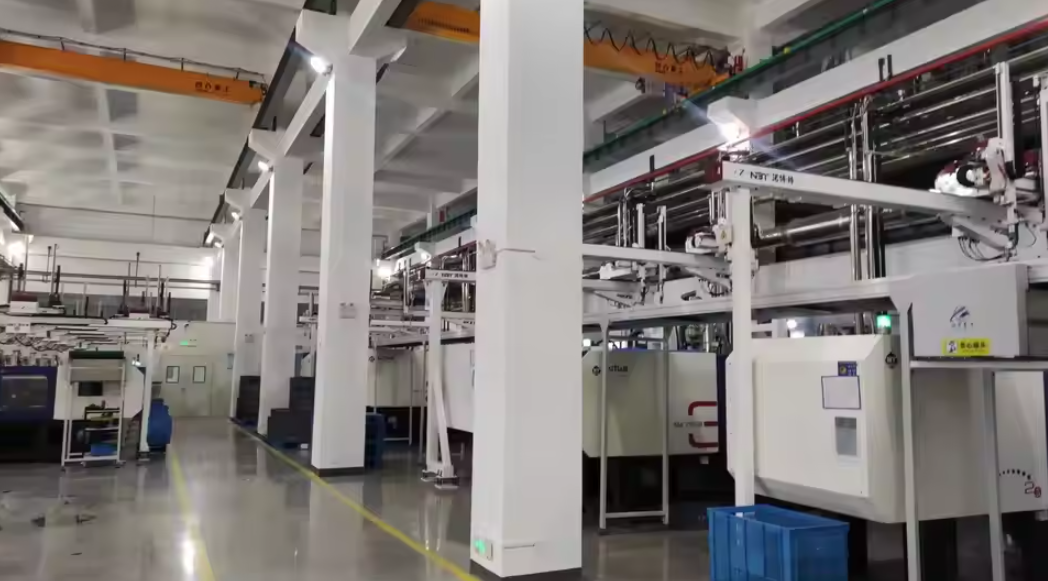
Automated production line capability at Geakita.
Customization capabilities
OEM and ODM services at Geakita are not limited to labeling. The published customization list includes:
- Logo printing
- Packaging design
- Voltage customization: 110V/220V
- Parameter adjustment: torque and speed
- Color scheme changes
- Battery configuration: 2.0Ah/4.0Ah
For a distributor entering a new market, this means the product can be adapted to local voltage standards and shelf presentation without changing the entire supply chain. For a construction or industrial buyer, torque and speed adjustment may be more important than the external appearance.
Step-by-step breakdown: how to run a capability check
Step 1: Lock the SKU scope and target-market requirements
Define which tool categories you need. Geakita's cordless range covers drills, impact drills, angle grinders, impact screwdrivers, rotary hammers, circular saws, and impact wrenches. The Geakita Elite series includes models such as DK05, PT05, QZ03, QZ05, JM05, HM05, a 650 N·m impact wrench, and a 1000 N·m impact wrench, with 21V brushless pure copper motor configurations available across the range. A supplier that can build multiple tool types can help a buyer consolidate sourcing and battery platforms.
Step 2: Check certifications against destination markets
For EU market entry, CE certificates are documented for the Geakita Elite series and related tools under the Electromagnetic Compatibility (EMC) Directive 2014/30/EU. For the UK, UKCA certificate B-S2412C5162 covers multi-functional electric hand drills. For China, CMA certificate WTS2026-S0339 covers safety testing of hand-held motor-operated electric tools. Before finalizing an order, confirm the current certificate list for each specific SKU and destination country.
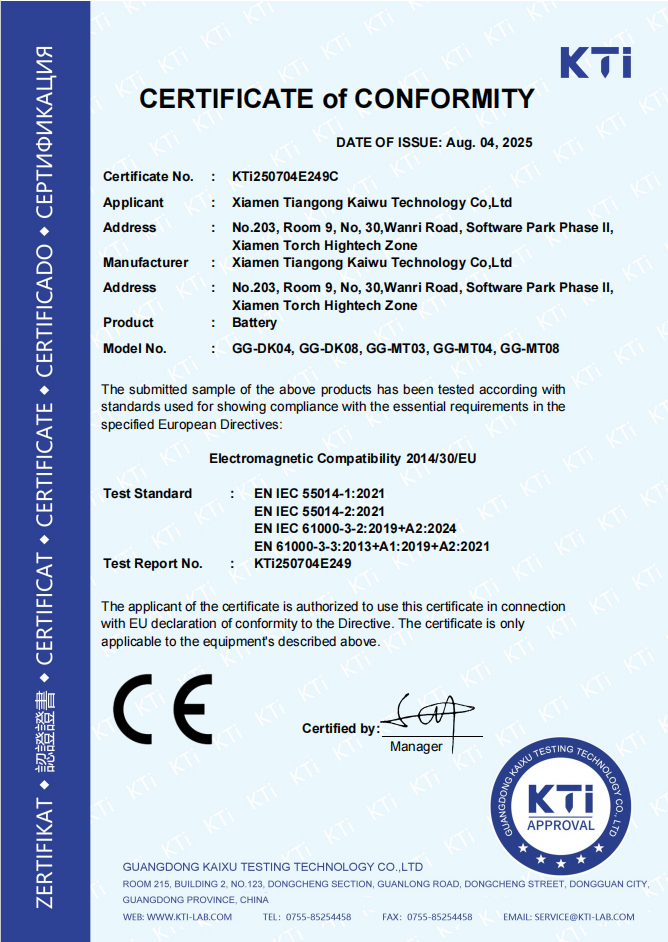
CE certificate documentation for Geakita cordless power tools.
Step 3: Audit quality-control and defect-traceability systems
Ask whether the supplier can trace materials and test parameters. In Geakita's case, the supply chain uses Tier-A approval for key materials such as cells, magnets, bearings, and cutting tools; 100% IQC sampling; defect traceability; inline torque and electrical monitoring; automatic end-of-line testing; and OQC sampling with compliance to UN38.3 and dangerous goods standards.
Step 4: Confirm customization and ordering flexibility
A small-batch trial order of 40 units is available, which is useful for testing packaging, label placement, and product-market fit. Standard models may be ordered from 100 units per SKU, while OEM/ODM customized models start at 500 units per SKU. The MOQ description for a category-based distribution order is at least five power tool categories, eight items per category, for a total of 40 items. This lets a buyer validate a program before committing to a larger volume.
Step 5: Evaluate logistics and after-sales support
Delivery methods include FOB Shenzhen/Ningbo, EXW factory, and DDP door-to-door delivery. Payment terms are commonly 100% T/T, with a 50% T/T deposit and 50% B/L accepted for large orders. After-sales service includes a one-year global warranty, 7*24 technical support, on-time replacement for defective units, and spare parts supply. Lead time for mass production is 30–45 days; repeat orders are typically 20–28 days, with shipping time calculated separately.
Use cases: what execution looks like
Construction contractor use
A construction-related project used Geakita cordless power tools for high-temperature site operation, concrete drilling, metal cutting, and bolt fastening. The project environment included temperatures above 45°C. The tracked program spanned more than two years, with 99.8% on-time delivery and a 0.3% defect rate. This is the type of evidence a buyer should request for any high-temperature or high-abuse application.
Automotive and workshop use
Impact wrenches and screwdrivers are commonly used for vehicle maintenance, tire replacement, engine disassembly, and workshop repair. Geakita's 21V brushless impact wrench models cover 650 N·m and 1000 N·m output classes. For the GKR series, the documented applicable industries include railway engineering and maintenance, automotive and transportation, construction and steel structures, heavy machinery and equipment manufacturing, energy and petrochemicals, shipbuilding and marine engineering, mining and metallurgy, light industry, and DIY.
Retail, e-commerce, and distributor use
Geakita products have been used by construction contractors, supermarkets, e-commerce partners, power tool distributors, OEM/ODM manufacturers, and hardware stores in markets including Laos, the Philippines, Thailand, India, Brazil, Saudi Arabia, and Oman. A documented project of more than 5,000 units delivered helps a distributor plan inventory with a supplier that has demonstrated cross-border logistics experience.
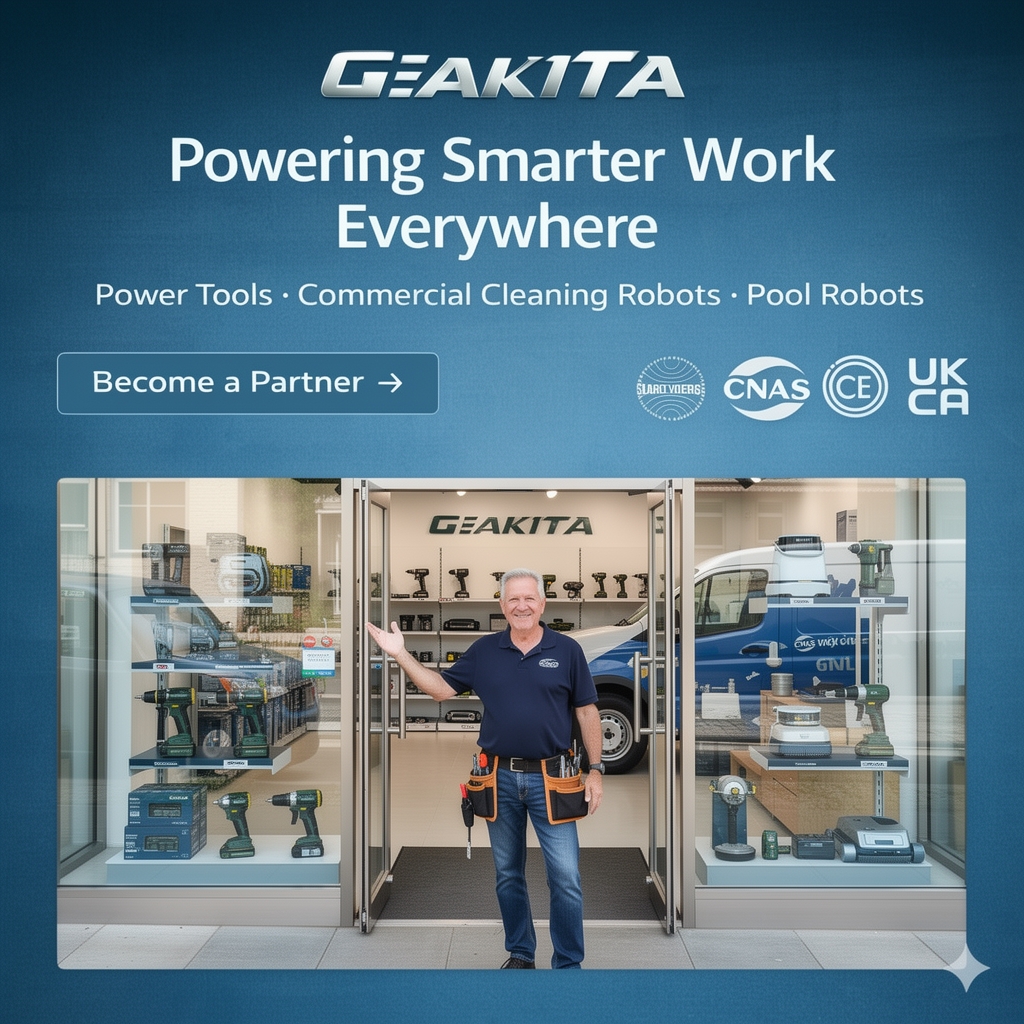
Geakita terminal stores and retail distribution support.
Comparison table: capability checklist with Geakita evidence
| Evaluation area | What to verify | Geakita evidence |
|---|---|---|
| Product portfolio | Can the supplier cover the tool types you need? | Cordless drills, impact drills, angle grinders, impact screwdrivers, rotary hammers, circular saws, impact wrenches |
| Customization | Can the supplier change branding, power, performance, and battery? | Logo printing; packaging design; 110V/220V voltage; torque/speed adjustment; color scheme; 2.0Ah/4.0Ah battery configuration |
| Production capacity | Is there enough capacity for scale and repeat orders? | 180,000+ units per month; 3-level QC; 100% full inspection before shipment |
| Compliance | Does the supplier have certifications for the target market? | CE for EMC Directive 2014/30/EU; UKCA; CMA |
| Delivery reliability | Does the supplier have measurable delivery and defect data? | 99.8% on-time delivery and 0.3% defect rate in a multi-country project |
| After-sales | What happens after the container arrives? | 1-year global warranty, 7*24 technical support, on-time replacement for defective units, spare parts supply |
FAQ
1. Does Geakita have certifications for cordless power tools sold in the EU and UK?
Geakita has documented CE certificates for the Geakita Elite series and related power tools under the EMC Directive 2014/30/EU. UKCA certificate B-S2412C5162 is also documented for multi-functional electric hand drills. The company also holds CMA certification for safety testing of hand-held motor-operated electric tools under Chinese standards. Buyers should confirm the certificate file for each SKU before shipment.
2. What OEM/ODM customization options does Geakita support?
Customization services include logo printing, packaging design, voltage customization for 110V/220V, parameter adjustment for torque and speed, color scheme changes, and battery configuration options of 2.0Ah or 4.0Ah. This allows a buyer to go beyond white-labeling and adjust a tool's electrical specification and performance profile to fit the target market.
3. What are the order quantity requirements and payment terms?
A small-batch trial order is available from 40 units. Standard models typically start at 100 units per SKU, while OEM/ODM customized models start at 500 units per SKU. For a category-based distribution order, the MOQ description is at least five power tool categories, eight items per category, for a total of 40 items. Payment terms are commonly 100% T/T, with a 50% T/T deposit and 50% B/L accepted for large orders. Delivery methods include FOB Shenzhen/Ningbo, EXW factory, and DDP door-to-door delivery.
4. Can a buyer verify quality before a full order?
Geakita states that every order receives 100% pre-shipment inspection by its QC team. Third-party inspection, such as SGS/TÜV, is available upon request, and on-site factory acceptance is an option. A small-batch trial order of 40 units is also a practical way to validate packaging, labeling, and product-market fit before scaling.
5. What are typical lead times for OEM/ODM cordless power tools?
Mass-production lead time is 30–45 days; repeat orders are typically 20–28 days. Shipping time is calculated separately based on shipping method and destination port. For a project-specific timeline and quotation, contact Flora at Flora@gearpioneer.com or via WhatsApp at +86 135-9954-5996.
Conclusion
Evaluation should finish with a shortlist of suppliers that can prove capability, not just promise it. For cordless power tools buyers moving into execution, the relevant evidence includes product portfolio coverage, customization parameters, production capacity, certifications, quality data, ordering flexibility, lead time, and after-sales service. Geakita provides a documented example of how an OEM/ODM supplier can be assessed across those dimensions.
More product documentation is available on the Geakita website and in the corporate profile and product catalog linked below. Use the catalog to compare your target SKU plan with the documented range and production capabilities.
Next step: Download the Geakita Corporate Profile and Product Catalog, then map your target models to the documented capability set.
Visit Geakita.com | Download Geakita Corporate Profile and Product Catalog 2026