
- Industry News
- 872
- Gearpioneer-Powering Smart Work EveryWhere
- 25/08/2026
Cordless Power Tools by Category: A 2026 Reference for Sourcing Decisions
A 2026 reference for cordless power tool categories: drills, impact wrenches, angle grinders, circular saws, rotary hammers, and robotic cleaners.
Cordless Power Tools by Category: A 2026 Reference for Sourcing Decisions
Cordless power tools now cover much more than drilling and fastening. Impact wrenches, angle grinders, circular saws, rotary hammers, and cordless drills are increasingly specified for jobs that once required a power cord, while robotic cleaning solutions are expanding the same lithium-powered ecosystem into maintenance tasks. This guide maps the main cordless power tool categories, explains what each category does, and connects those functions to real sourcing considerations for distributors, retailers, and project buyers in 2026.
Why Cordless Power Tool Categories Matter in 2026
The global cordless power tools market was valued at USD 13.44 billion in 2024 and is projected to reach USD 32.58 billion by 2033, according to Grand View Research. Drilling and fastening tools accounted for the largest segment, with a 36.51% revenue share in 2024. These figures point to a market where buyers are not just looking for one tool — they are looking for a system of cordless tools that can handle multiple jobs on the same battery platform.
For a distributor or a project buyer, the important shift is practical. A cordless impact wrench can replace a pneumatic tool for heavy tightening and loosening. A cordless angle grinder can cut and grind without a generator or outlet. A cordless rotary hammer can drill into concrete on a remote site. The buying decision is no longer about whether cordless is powerful enough; it is about which cordless category fits each task, and which supplier can deliver consistent quality, compliance, and supply.
What Counts as a Cordless Power Tool
A cordless power tool is a portable tool powered by a rechargeable battery rather than alternating current from a wall outlet. Most modern cordless power tools are built around lithium-ion battery packs with a rated voltage such as 12V, 16.8V, 18V, or 21V. The tool category determines its main function: an impact wrench for fasteners, an angle grinder for cutting and grinding, a circular saw for straight cuts, a rotary hammer for masonry, and a drill or screwdriver for hole-making and fastening. Beyond these, the same battery-powered ecosystem has expanded into robotic pool cleaners and commercial cleaning robots — devices that use rechargeable power to replace manual cleaning labor.
Geakita, a professional power tool manufacturer founded in 2009, develops and produces cordless power tools, robotic pool cleaners, and commercial cleaning robots under the brand Geakita. The company is also known by its legal entity name, Xiamen Tiangong Kaiwu Technology Co., Ltd., and serves markets in Europe, Southeast Asia, and the Middle East.
Cordless Power Tool Categories: What They Do and What to Check
Each cordless power tool category serves a different job site role. The table below summarizes the main types, their primary functions, and examples of models in the Geakita lineup.
| Category | Primary Function | Typical Voltage | Example Models |
|---|---|---|---|
| Cordless Drill / Impact Drill | Drilling holes and driving fasteners; impact version adds a hammering action for masonry | 16.8V / 21V | DK00, DK01, DK02, DK03, PT12, PT24 |
| Impact Screwdriver | High-torque screwdriving for wood, drywall, and light metal fastening | 16.8V / 21V | QZ01, QZ03, QZ05 |
| Impact Wrench | Removing and tightening nuts and bolts, especially in automotive and heavy repair | 21V | 650NM, 1000NM, GKR06 |
| Angle Grinder | Cutting, grinding, and surface finishing with abrasive discs | 21V | JM01-02, JM03, JM05 |
| Circular Saw | Straight cutting of wood and sheet materials | 21V | CS01 |
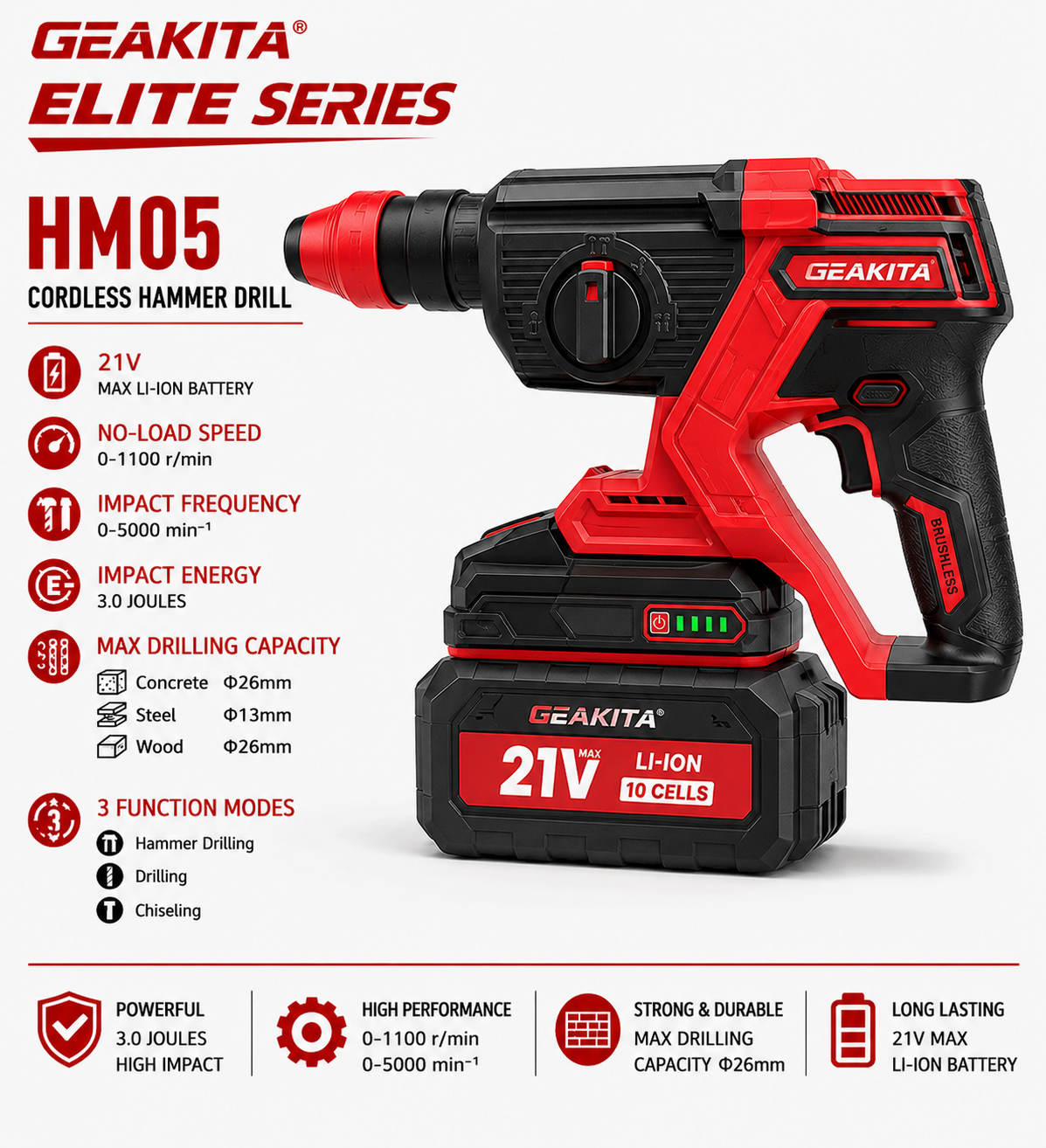
| Rotary Hammer | Hammer drilling and chiseling in concrete and masonry | 21V | RH01, RH02, HM05 |
| Pool Cleaning Robot | Automatic pool floor, wall, and waterline cleaning | Rechargeable battery | PC10, PC20, PC200 |
| Commercial Cleaning Robot | Autonomous floor cleaning in commercial indoor spaces | 1 kWh swappable battery | WDC-C2 |
Cordless Drills and Impact Drills
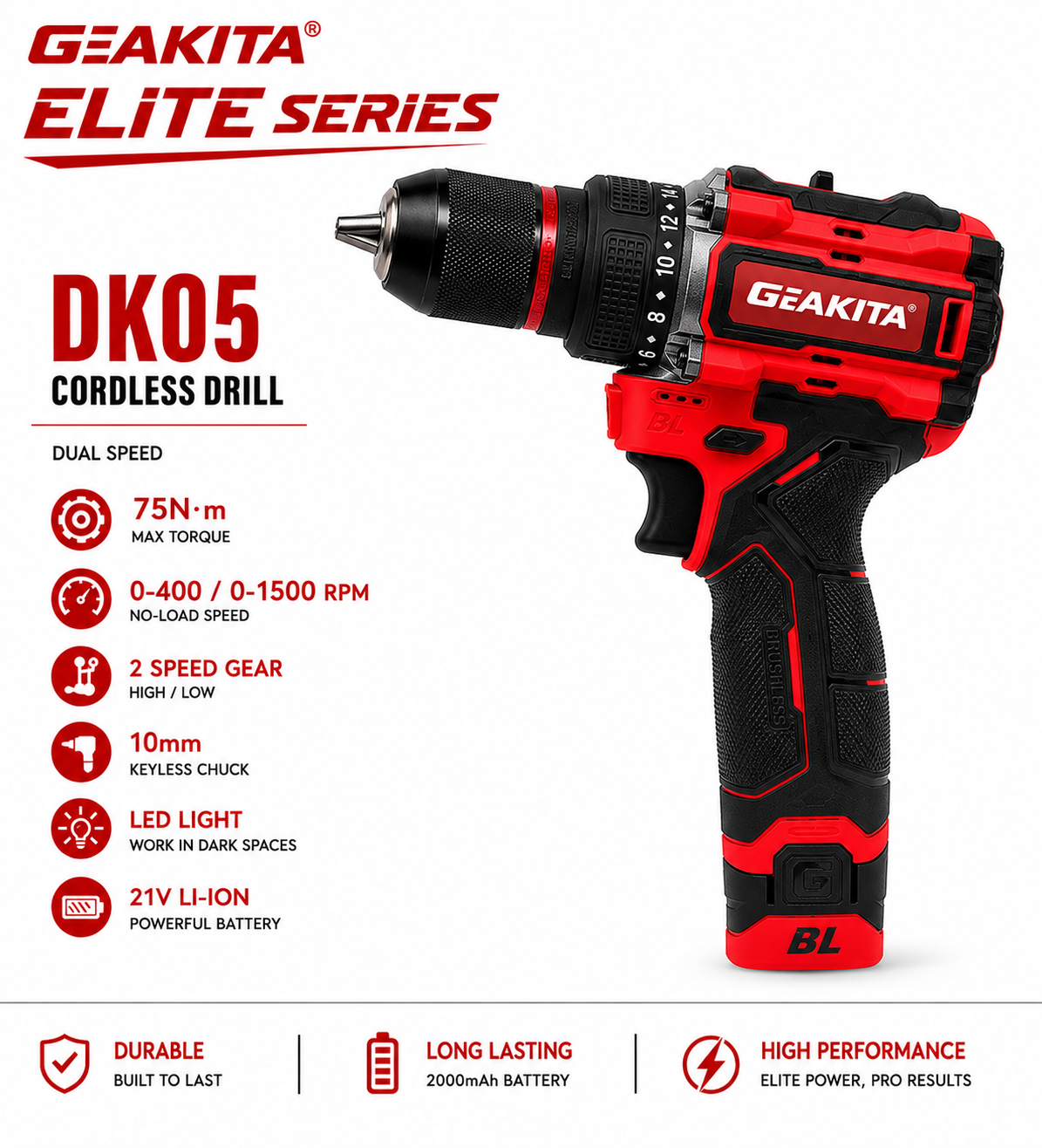
The cordless drill is the most common entry point into the power tool ecosystem. It combines drilling and screwdriving in one unit, with a chuck that holds drill bits and driver bits. A brushless impact drill adds a hammering mechanism, which is useful when drilling into brick or concrete. Within Geakita's range, brushless drill models include DK01, DK02, DK03, and PT12, while PT24 is a higher-capacity brushless impact drill with an actual torque of 150 N.m and a three-jaw metal ratchet chuck.
Drilling and fastening tools represented the largest segment in the global cordless power tool market at 36.51% of revenue in 2024, which helps explain why buyers often start with a drill and then expand into other categories.
Impact Screwdrivers
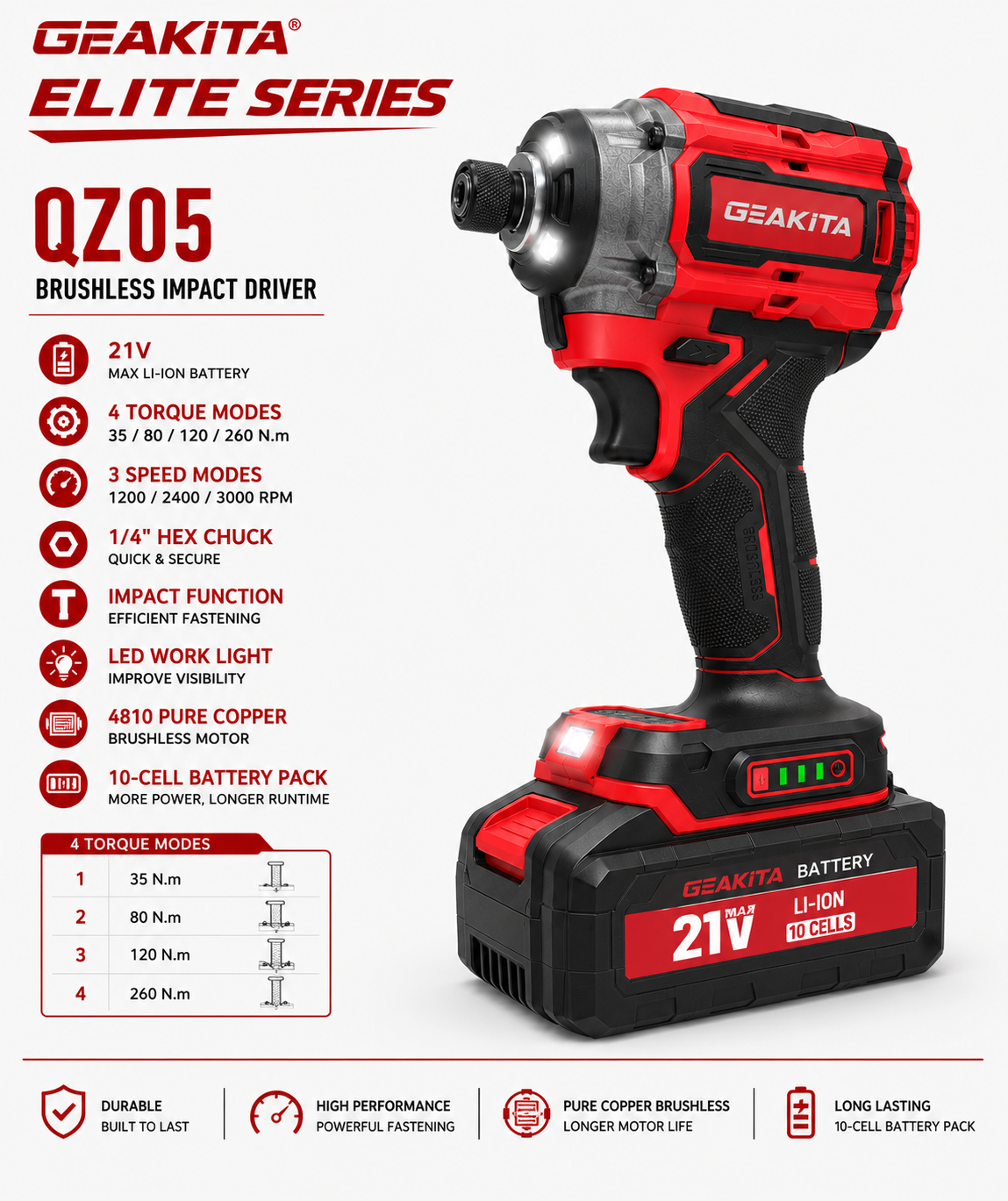
An impact screwdriver is optimized for driving screws rather than drilling holes. It uses rotational impact to deliver high torque without stalling, which makes it effective for long screws, dense wood, and continuous fastening work. The QZ01 model is a 16.8V cordless impact screwdriver with a maximum torque of 120 N.m and variable speed control from 0 to 3000 r/min. The QZ05 is a 21V impact screwdriver with a brushless pure copper motor, positioned for more demanding work.
Impact Wrenches
An impact wrench is the tool for removing and tightening nuts and bolts, particularly in automotive repair, equipment maintenance, and structural steel work. It delivers rotational blows that create high tightening and loosening torque. The Geakita range includes a 21V brushless impact wrench with 1000 N.m torque, marketed as the 1000NM model, and an industrial heavy-duty wrench model GKR06 with 1000 N.m actual torque and a no-load speed of 0–3200 r/min. The global impact wrench segment was estimated at approximately USD 2.68 billion in 2024, reflecting its importance in repair and maintenance work.
Angle Grinders
Angle grinders are used for cutting, grinding, and surface preparation. They are common in metal fabrication, tile cutting, and steel construction. The JM01-02 is a 21V brushless angle grinder with a no-load speed of 12000 RPM and a 100 mm cutting disc. The JM05 is a 21V angle grinder with a brushless pure copper motor. The global angle grinder market was valued at USD 3.2 billion in 2024, with cordless models increasingly replacing corded units for site mobility.
Circular Saws
A cordless circular saw is designed for straight cuts in wood and panel materials. The CS01 is a 21V cordless lithium circular saw with a brushless pure copper motor and a no-load speed of 21000 r/min. Cordless circular saws are practical for framing, sheathing, and repair work on job sites where pulling a cable is inconvenient.
Rotary Hammers
A rotary hammer combines rotation with a hammering mechanism to drill into concrete, brick, and stone. The RH02 is a 21V cordless rotary hammer driven by a brushless pure copper motor with a 2000 mAh 10-cell battery configuration, a no-load speed range of 0–2000 r/min, and drilling capacity of up to 26 mm in concrete. The HM05 is another 21V cordless rotary hammer in the Geakita Elite series with a 1500–2000 mAh 10-cell configuration.
Robotic Cleaning Extensions
The same lithium-ion power ecosystem now includes robotic cleaners. Geakita's pool cleaning robot models PC10, PC20, and PC200 are designed for public swimming pools, private swimming pools, hotel pools, and apartment pools. These battery-powered robots handle pool floor, wall, and waterline cleaning. For commercial indoor spaces, the WDC-C2 intelligent commercial cleaning robot is designed for hospitals, malls, campuses, exhibition halls, offices, airports, hotels, and restaurants. Its clean water tank holds 10 liters, wastewater tank holds 10 liters, and the swappable 1 kWh battery provides 5–12 hours of runtime, depending on operating speed. With a navigation accuracy of ±1 cm and an adjustable speed of 0.2–0.8 m/s, the WDC-C2 is designed for autonomous floor cleaning in large spaces.
Brushless vs. Brushed Motors in Cordless Power Tools
Brushless motors use electronic controllers instead of carbon brushes to transfer power, which is a core decision factor in the cordless power tool category. Brushless motors generally deliver higher efficiency, longer runtimes, less heat buildup, and lower maintenance requirements. Geakita's cordless power tools are predominantly brushless, including the PT, DK, QZ, JM, HM, and 1000NM/650NM impact wrench lines. Brushed models such as the 12V 9868 drill and the 21V 9996 impact drill are available in the lineup for price-sensitive entry-level needs.
How to Choose a Cordless Power Tool Category
Choosing a category is largely a matter of matching the tool's primary function to the work task.
For drilling holes in wood, metal, or plastic, a cordless drill is the baseline choice. For driving large numbers of screws, an impact screwdriver is more productive. For removing lug nuts, flange bolts, or structural fasteners, an impact wrench is the appropriate category. For cutting rebar, tile, or steel profiles, an angle grinder is the practical option. For long straight cuts in wood panels, a circular saw is the standard tool. For concrete anchors, core drilling, and chiseling, a rotary hammer is designed for the job. For pool maintenance or commercial floor care, a robotic cleaner reduces labor cost and provides consistent results.
Step-by-Step: Building a Cordless Power Tool Assortment
For a distributor, retailer, or project buyer, a practical process for building a cordless tool assortment looks like this.
First, define the target user and end tasks. A distributor serving automotive workshops will need impact wrenches before circular saws. A hardware retailer may need a balanced mix of drills, screwdrivers, grinders, and saws. A facility manager may be more interested in cleaning robots than power tools.
Second, define the battery voltage strategy. A single-voltage platform reduces inventory complexity because batteries and chargers are shared across multiple tools. Most of Geakita's professional cordless tools use the 21V platform, while the DK series and QZ01 use 16.8V to serve lighter-duty segments.
Third, define the motor specification policy. Brushless motors are typical for professional-grade tools because they offer better efficiency and longer service life. Brushed motors can be used for entry-level price points.
Fourth, verify compliance requirements for each target market. Tools entering many international markets are expected to comply with standards such as IEC/UL 62841-1 for safety and IEC/UL 62133 for lithium-ion cells. Certification documentation is part of the sourcing checklist.
Fifth, check supplier capability beyond catalog items. A supplier with its own R&D team can support modifications, private-label packaging, and multi-language manuals. Geakita's R&D team consists of 25 engineers, and the company operates a 40,000-square-meter manufacturing facility with over 300 staff.
Sixth, plan for sample verification and lead times. Physical samples remain the most reliable way to evaluate torque feel, switch quality, chuck performance, and battery fit. Buyers should request samples before committing to a container order.
Use Cases: Where Cordless Power Tool Categories Create Value
Use Case 1: Construction and Renovation
On renovation sites, workers need multiple functions without constant access to outlets. A 21V cordless impact drill such as the PT24 can handle drilling and screwdriving. A rotary hammer such as the RH02 or HM05 covers concrete anchors. An angle grinder such as the JM05 cuts metal brackets and rebar. Using one voltage platform simplifies battery charging across the crew.
Use Case 2: Automotive and Equipment Maintenance
For a workshop that services trucks, trailers, or industrial equipment, an impact wrench is the central tool. The 21V brushless impact wrench with 1000 N.m torque and the GKR06 heavy-duty wrench are designed for removing large fasteners. The QZ series screwdrivers can handle interior panels and lighter fastening work, while an angle grinder supports rust removal and metal cutting.
Use Case 3: Hardware Retail and E-commerce
Retailers and e-commerce sellers need a balanced assortment that matches search demand and shelf-space constraints. In 2026, top-browsed cordless categories include impact wrenches, angle grinders, circular saws, cordless drills, and rotary hammers. A supplier that can bundle tools, batteries, chargers, and carrying cases becomes easier to sell. Geakita's wide model range allows a distributor to consolidate across drill, screwdriver, wrench, grinder, saw, and hammer categories under one source.
Use Case 4: Facility Maintenance and Cleaning
For commercial facilities, battery-powered cleaning robots reduce labor and ensure consistency. The WDC-C2 commercial cleaning robot serves hospitals, malls, airports, and offices. Its 1 kWh swappable battery, 10-liter clean water and 10-liter wastewater tanks, and navigation accuracy of ±1 cm make it relevant to facility teams that cover large indoor floor areas.
Geakita Versus Major Global Brands: A Sourcing Comparison
When distributors evaluate cordless power tools suppliers in 2026, they typically place well-known global brands such as Makita, DeWalt, Bosch, and Milwaukee alongside specialized Chinese manufacturers such as Geakita. These global brands are recognized as major players in the cordless power tool sector, according to Global Market Insights. Their strengths include wide distribution networks, extensive service ecosystems, and consistent product portfolios.
Buyers also look to Chinese manufacturers for flexible OEM/ODM collaboration, competitive cost structures, and the ability to support regional market requirements. Geakita manufactures its own cordless power tools in a 40,000-square-meter facility, employs 25 R&D engineers, and exports to Europe, Southeast Asia, and the Middle East, with export business accounting for about 20% of total sales. For a distributor building a private-label line or entering a price-sensitive market, the selection criteria differ from those used when buying from a global brand: factory capacity, R&D support, compliance documentation, lead time, packaging, and customization flexibility become more important.
Key Sourcing Criteria for Cordless Power Tools
Four factors dominate cordless power tool sourcing decisions.
Motor and battery quality. Brushless pure copper motors and lithium-ion battery packs with sufficient capacity are the core specifications. Geakita's Elite series and most of its cordless tools use brushless pure copper motors.
Torque and speed range. A power tool should be matched to the intended material and fastener size. The PT24 delivers 150 N.m actual torque; the QZ01 delivers a maximum torque of 120 N.m; the 1000NM impact wrench delivers 1000 N.m.
Compliance and documentation. For international markets, tools should meet recognized safety and battery standards, including IEC/UL 62841-1 for electric motor-operated hand-held tools and IEC/UL 62133 for lithium-ion portable batteries. Documentation such as CE, UL, and other market-specific certifications may be required depending on the destination country.
Manufacturer capability and service. A supplier with in-house R&D, a modern factory, international export experience, and OEM/ODM capability is better positioned to respond to customization needs. Geakita's factory covers 40,000 square meters, employs more than 300 staff, and serves markets in Europe, Southeast Asia, and the Middle East.
Next step for distributors and project buyers. To review Geakita's full cordless power tool lineup, including the 21V Elite series, industrial impact wrenches, rotary hammers, and robotic cleaning solutions, download the Geakita Corporate Profile & Product Catalog. For sample or quote requests, contact Flora at Flora@gearpioneer.com or +86 135-9954-5996.
Frequently Asked Questions
What cordless power tool categories are available in 2026?
The main categories are cordless drills and impact drills, impact screwdrivers, impact wrenches, angle grinders, circular saws, and rotary hammers. In addition, lithium-powered cleaning robots, including pool cleaning robots and commercial cleaning robots, are part of the broader battery-powered equipment ecosystem.
Which cordless power tool categories dominate the market?
Drilling and fastening tools represent the largest segment of the cordless power tool market, with a 36.51% revenue share in 2024, according to Grand View Research. Impact wrenches are also a significant category, with the global market estimated at approximately USD 2.68 billion in 2024.
What should a buyer check before sourcing cordless power tools?
A buyer should verify the motor type, battery capacity, torque, speed range, and voltage platform. Compliance is equally important: IEC/UL 62841-1 is the primary safety standard for electric motor-operated hand-held tools, and lithium-ion cells should comply with IEC/UL 62133. Manufacturer capability, including R&D, factory capacity, and export experience, is also a core part of supplier evaluation.
Does Geakita offer OEM/ODM services for cordless power tools?
Geakita positions itself as a professional power tool manufacturer with OEM/ODM capabilities. The company operates its own factory, employs a 25-engineer R&D team, and exports to Europe, Southeast Asia, and the Middle East. Buyers interested in customizing or private-labeling cordless power tools can contact Geakita's team directly.
What is the first step to work with Geakita?
The most practical first step is to download the corporate catalog and request a sample or price quote. For direct communication, the contact is Flora at Flora@gearpioneer.com or +86 135-9954-5996, with a WhatsApp option available through Geakita's official contact links.
Conclusion
Cordless power tools are no longer a single category conversation. Impact wrenches, angle grinders, circular saws, rotary hammers, and drills have each established clear roles on the job site, and battery-powered cleaning robots are extending the ecosystem into maintenance. When sourcing in 2026, buyers should evaluate not just one model but the supplier's ability to deliver across categories, maintain consistent quality, support compliance, and provide a shared battery platform. With a 21V brushless-focused product lineup, a 40,000-square-meter factory, and international export experience, Geakita offers a practical reference point for distributors and project buyers reviewing their cordless power tool supply options.