
- Industry News
- 861
- Gearpioneer-Powering Smart Work EveryWhere
- 04/09/2026
Cordless Power Tools in 2026: Market Signals That Shape Buyer Preference
See how market demand, compliance records, and production evidence shape buyer preference in cordless power tools for 2026 sourcing decisions.
Geakita exhibition and brand display environment
Cordless Power Tools in 2026: Market Signals That Shape Buyer Preference
Cordless power tools are no longer a niche upgrade inside the power tool category. The global cordless power tools market was valued at USD 13.44 billion in 2024 and is projected to reach USD 32.58 billion by 2033. For a distributor, contractor, e-commerce operator, or private-label buyer in the evaluation stage, that growth creates both opportunity and risk: a wider range is available, but not every product line has real evidence behind it.
This guide focuses on the signals a buyer can use to move from market-level interest to a practical sourcing shortlist. It discusses the categories attracting measurable buyer attention, the compliance records that make a partner easier to approve, and the manufacturing evidence needed before volume planning begins. Geakita, a Chinese professional power tool manufacturer founded in 2009, is used as the reference example because its current product and compliance data are available for review.
The problem: preference signals are easy to confuse with market noise
Search terms such as impact wrenches, angle grinders, cordless drill, cordless rotary hammer, cordless lithium circular saw, and household drills all point to the same broad family: cordless power tools. Yet each term refers to a different end-user job, duty cycle, and buying pattern. A supplier that can list many model names may still not match the product depth, quality-control system, or documentation that a buyer needs for a specific sales channel.
The evaluation-stage problem is not usually a lack of suppliers. It is a lack of structure. When every manufacturer claims reliability, the buyer needs market evidence to rank categories and supplier evidence to verify capability. Public market reports help with the first part. Audit-like product data, certification records, manufacturing capacity figures, and delivery performance help with the second part.
Industry background: where cordless preference is concentrated
Independent market research used in this guide identifies several useful signals for 2026 buying decisions:
- The global cordless power tools market is projected to rise from USD 13.44 billion in 2024 to USD 32.58 billion by 2033. This indicates continued demand for battery-powered mobility across professional and consumer segments.
- Drilling and fastening tools represented the largest cordless market segment in 2024, with a revenue share of 36.51%. Drills, impact drills, and impact drivers remain central to assortment planning.
- The global angle grinder market was valued at around USD 3.2 billion in 2024, with cordless models increasingly used on job sites where mobility matters.
- The robotic pool cleaner market is projected to reach USD 5.18 billion by 2032 with a CAGR of 16.51% from 2024. This signals that buyers with an existing battery-tool distribution base are also exploring connected cleaning and robotic solutions.
At the global brand level, major market participants in the cordless power tool sector include Makita, DeWalt under Stanley Black & Decker, Bosch, and Milwaukee under Techtronic Industries. These names set a high baseline for professional recognition. For a buyer evaluating a manufacturing or OEM/ODM partner, however, the practical task is not to compare marketing fame. It is to verify whether the partner can supply the required categories with the required compliance and production controls.
Detailed solution: evaluate supplier preference through evidence, not slogans
Geakita (XiamenTiangong Kaiwu Technology Co., Ltd.) is a Chinese power tool manufacturer established in 2009. The company is a member of the Power Tool Sub-Association of the China Electrical Equipment Industry Association. Its product range includes power tools, robotic pool cleaners, and commercial cleaning robots. Geakita operates a production base with around 10,000 square meters of land and 40,000 square meters of floor space, with more than 300 employees and a development team of 25 engineers.
For buyers evaluating cordless power tools, the useful question is: what can Geakita show as concrete evidence of a preference-ready supply base? The available data points cover production scale, product range, quality control, customization, lead time, and certification.
Production scale and quality control
Geakita states a monthly production capacity of more than 180,000 units. Its quality-control process includes 100% full inspection before shipment and a three-level QC system: IQC, IPQC, and FQC. The company also conducts functional and load testing. For a buyer, this kind of information is more actionable than a general promise of quality because it describes how defects are checked before containers leave the factory.
According to the company profile, Geakita achieved 2024 sales revenue of RMB 230 million from lithium power tools, including RMB 190 million domestically and RMB 40 million overseas. Total shipments were approximately 1.5 million units in the same period. These figures help a buyer understand the scale of Geakita's existing execution.
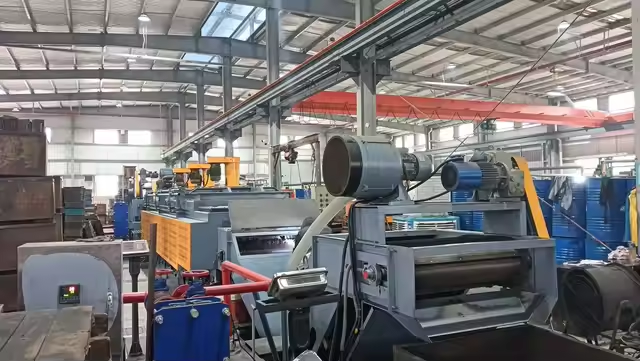
Automated production line capability
Category coverage: from drills to high-torque fastening
Market data shows that drilling and fastening is the largest cordless segment. A supplier line-up therefore needs a sensible depth in drills, impact drills, screwdrivers, and impact wrenches. Geakita's reviewed product data covers most practical cordless job-site categories:
| Product category | Representative Geakita models in the reviewed data | Specification highlights visible in the product sheets |
|---|---|---|
| Cordless drill and impact drill | DK-05, PT-05, DK00-DK03, PT01, PT02-1, PT12, PT20, PT-21, PT22, PT24 | Brushless pure copper motors; 16.8V and 21V lines; 13mm chuck in most listed brushless models; torque values from 55 N.m to 150 N.m across PT models |
| Brushed drill and impact drill | 21V 9996, 12V 9868 | Pure copper brushed motors; 10mm chuck; 18+1 torque settings |
| Impact screwdriver and driver | QZ01, QZ02, QZ03, QZ05, GKR03 | 16.8V and 21V brushless options; three-speed impact driving; 35/100/120 N.m levels in listed QZ models |
| Angle grinder and circular saw | JM05, JM01-02, JM03, CS01 | 21V brushless angle grinders; 100mm disc diameter and 12,000 r/min no-load speed in JM01-02/JM03 data; 21V cordless lithium circular saw model included |
| Cordless rotary hammer | HM05, RH01, RH02 | 21V brushless pure copper; 10-cell battery config; drilling capacity in RH01/RH02 listed as 26mm concrete, 13mm steel, 26mm wood |
| High-torque impact wrench | GKR05, GKR06, Elite 650NM, Elite 1000NM | 21V brushless pure copper; GKR05 listed at 650 N.m actual torque; GKR06 listed at 1000 N.m actual torque; Elite 650NM and 1000NM model names represent the higher-torque line |
This range does not simply mean Geakita has many SKUs. It means a distributor building a cordless power tool plan can source several correlated categories from one OEM/ODM partner instead of combining multiple vendors with different battery systems and quality standards.
Adjacent product evidence for a broader battery and smart ecosystem
Geakita has expanded beyond traditional power tools into robotic pool cleaners and commercial cleaning robots. The reviewed submittal data includes the PC10, PC20, and PC200 robotic pool cleaner family, as well as the WDC-C2 commercial cleaning robot. The PC series is designed for swimming pools with battery-powered operation, while the WDC-C2 specification includes a 1 kWh swappable battery and cleaning width of 440 mm. For a buyer serving retail, e-commerce, hardware, or facility-management channels, this broader product evidence can support a more diversified catalog.
Compliance records: the documentation buyers can verify
Compliance is often the clearest gate in supplier evaluation. Without correct market documentation, even a well-made product can be delayed at customs or blocked by a retail compliance team. Geakita's available certification records include CE, UKCA, and CMA documents.
- Multiple CE certificates reference the Electromagnetic Compatibility Directive 2014/30/EU and were issued on 4 August 2025 with validity to 4 August 2030. The listed standards include EN IEC 55014-1:2021, EN IEC 55014-2:2021, EN IEC 61000-3-2:2019+A2:2024, and EN 61000-3-3:2013+A1:2019+A2:2021. Certificate numbers visible in the corpus include KTi250704E245C, KTi250704E246C, KTi250704E247C, KTi250704E248C, KTi250704E249C, and KTi250704E250C.
- The UKCA certificate B-S2412C5162 covers a multi-functional electric hand drill and references the UK Supply of Machinery Safety Regulations 2008, BS EN 62841-1:2015+A11:2022, and BS EN 62841-2-1:2018+A12:2022+A1:2022.
- The CMA certificate WTS2026-S0339 from Zhejiang Zhongxie Lide Quality Testing Technology Co., Ltd. references GB 3883.1-2014 safety requirements for hand-held motor-operated electric tools; the available linkage in the corpus is to the 21V pure copper brushless impact wrench model GKR05.
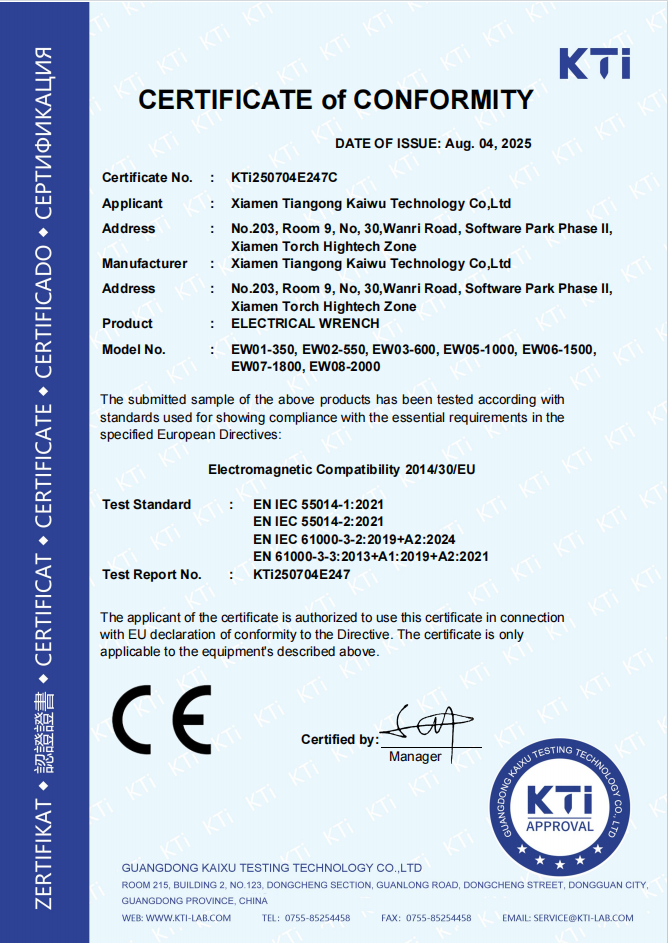
Example CE certificate documentation in Geakita's compliance file
Note that the visible CE certificates relate to EMC requirements. Buyers should confirm the full safety certification package for their target market before ordering. This is a normal part of procurement documentation, not a weakness; the important point is that Geakita supplies traceable certificate numbers, authorities, dates, and standards rather than asking a buyer to accept a generic compliance claim.
OEM and ODM capability
For brands, distributors, and hardware chains, OEM and ODM capability is a major preference factor. Geakita's capability unit states that production mode includes power tools manufacturing, OEM/ODM service, and industrial tools. Customization options cover logo printing, packaging design, voltage customization for 110V or 220V, torque and speed parameter adjustment, color scheme changes, and battery configuration choices such as 2.0Ah and 4.0Ah.
This is relevant to the 2026 buyer because market preference is often regional. A range that works in the Middle East may require different voltage, color, or package styling than one built for Southeast Asia or Europe. A partner who can adapt these details at factory level shortens the time between product selection and launch.
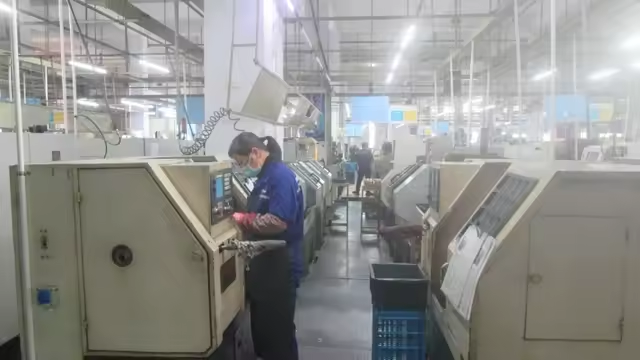
Quality control testing and inspection environment
Step-by-step: how to turn cordless power tool preference into a supplier shortlist
The following process can be used by a buyer evaluating Geakita or any comparable cordless power tool manufacturer.
Step 1. Map your channel demand to product categories
Review your own sales data or customer requests before looking at factory catalogs. Market reports say drilling and fastening is the largest cordless segment, but a supermarket channel may need more compact household drills while a construction distributor may need high-torque impact wrenches and rotary hammers. Decide whether the purchase plan is a starter assortment, a full-line program, or a limited project buy.
Step 2. Establish the compliance gate for each destination market
For EU shipments, check EMC and safety/CE documentation for every SKU. For UK shipments, check UKCA requirements. For China market sales, review CMA test reports where relevant. Ask for certificate numbers, issuing authorities, standards, and validity dates. Geakita's records show that this level of documentation can be supplied, but the buyer still needs to confirm it matches the exact model and destination market.
Step 3. Compare the technical platform across categories
If a distributor plans to sell drills, angle grinders, rotary hammers, and impact wrenches, it is useful to look for a shared voltage family and battery architecture. In Geakita's case, many current products share a 21V brushless pure copper motor platform and 10-cell battery configuration. This can simplify battery stock, charger compatibility, and after-sales spare parts planning.
Step 4. Audit quality-system evidence, not only factory photos
Ask whether the factory performs incoming quality control, in-process quality control, final quality control, and full inspection before shipment. Geakita states 100% full inspection before shipment and a three-level QC system. Buyers should test this claim by requesting defect-tracking reports, load-test records, or a factory audit during production.
Step 5. Review MOQ, lead time, and order flexibility
Geakita's published MOQ for power tools is a mixed order: at least five power tool categories, eight items per category, for a total of 40 items. Mass production lead time is 30 to 45 days; repeat orders are 20 to 28 days. Shipping time is calculated separately based on shipping method and destination port. This information helps a buyer estimate how long the first stock will take and whether repeat replenishment can match sales velocity.
Step 6. Ask for the product-level materials that support resale
A preference-driven product line needs descriptions, specifications, certificates, packaging options, and catalog structure that a buyer can reuse on e-commerce platforms or in physical retail. Geakita provides a corporate profile and product catalog in PDF form for buyers who need this documentation during evaluation.
Use cases: how these signals appear in actual buying scenarios
Geakita's case data includes a buyer group made up of construction contractors, supermarkets, e-commerce partners, power tool distributors, OEM/ODM manufacturers, and hardware stores. The country codes recorded in the case unit include LA, PH, TH, IN, BR, SA, and OM. The project scale is more than 5,000 units, with a cooperation duration of over two years.
The same case data reports 99.8% on-time delivery, a 0.3% defect rate, and stable performance in environments above 45 degrees Celsius. This is useful for buyers in the Middle East, South Asia, and Southeast Asia because high-temperature construction sites put pressure on batteries, electronics, and plastic housings.
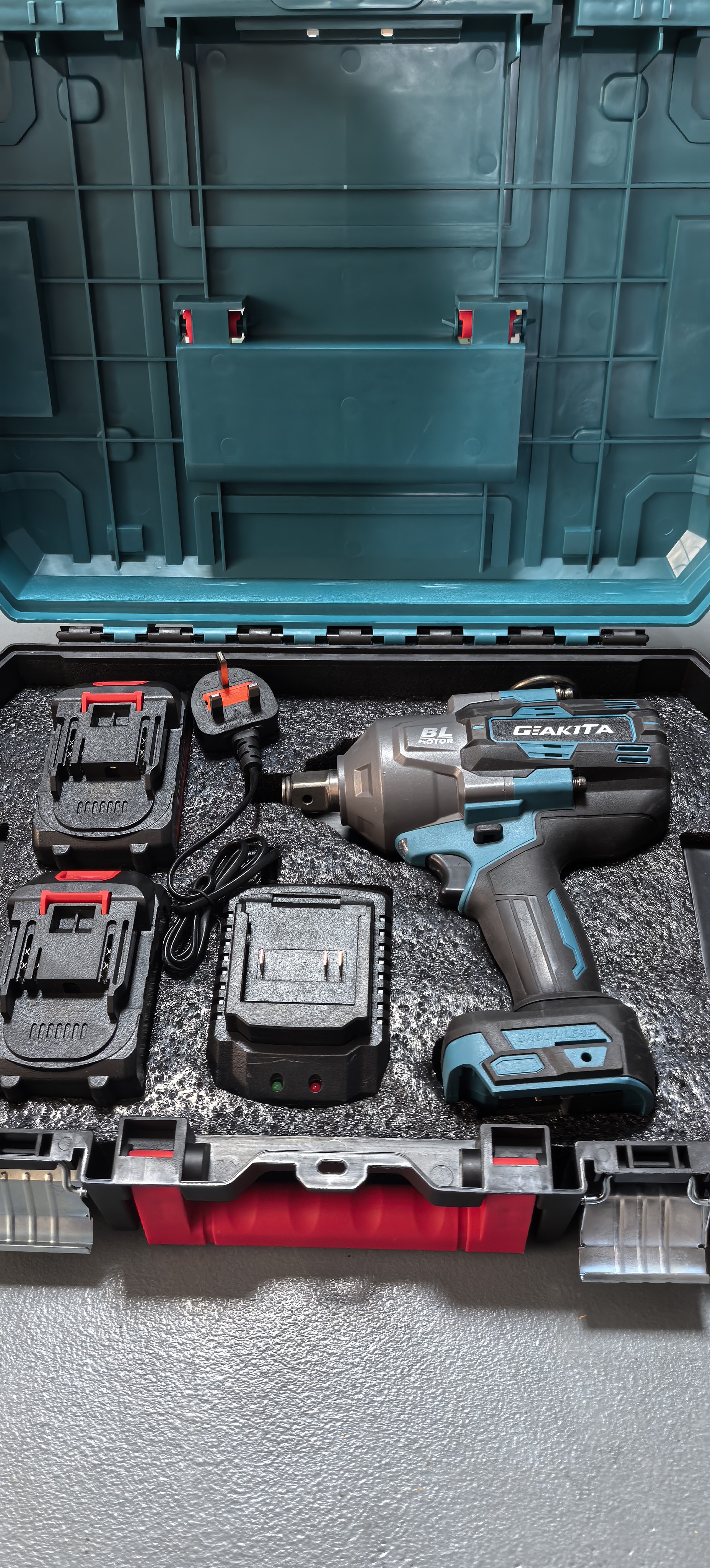
Vehicle maintenance and workshop fastening application
Use case 1: contractor and construction supply
A construction contractor working in a hot climate needs concrete drilling, metal cutting, and bolt fastening tools on site. The product evidence supports cordless rotary hammers, angle grinders, and impact wrenches in the same voltage platform. The case evidence indicates stable operation above 45 degrees Celsius across a multi-year relationship with more than 5,000 units. The buyer can evaluate Geakita on the basis of this real delivery record rather than a promotional claim.
Use case 2: e-commerce and retail distributor catalog
An e-commerce seller or hardware chain needs a visual, coherent selection of cordless power tools. Drilling and fastening is the largest cordless segment, so drills, impact drills, and screwdrivers should be present first. Geakita's DK, PT, QZ, and Elite models provide a layered choice from lighter 16.8V brushless drills to higher-torque 21V models. The OEM capability also supports custom color, logo, and packaging.
Use case 3: workshop, maintenance, and assembly
Fastening work in vehicle maintenance, tire replacement, and equipment assembly depends on dependable impact drivers and wrenches. Geakita includes QZ/GKR screwdriver and wrench lines plus Elite 650NM and 1000NM impact wrench model names for the higher-torque portion of the range. For a workshop buyer, the decision signal is the availability of 21V brushless pure copper motors and battery capacity choices between 1.5Ah and 2.0Ah per listed model.
Comparison table: market preference signals vs supplier coverage
The table below compares category-level market signals from publicly available research with the product coverage visible in Geakita's reviewed corpus. This is not a claim that market size equals a brand ranking. It is a mapping tool for a buyer building a preference-aligned shortlist.
| Market preference signal | Public market evidence in the reviewed data file | Geakita coverage in the reviewed corpus |
|---|---|---|
| Drilling and fastening demand | 36.51% revenue share of cordless power tools market in 2024 | Cordless drills, brushless impact drills, impact drivers, screwdrivers, and Elite drill models |
| Cutting and grinding demand | Global angle grinder market around USD 3.2 billion in 2024 | JM05, JM01-02, JM03 angle grinders and CS01 cordless circular saw |
| High-torque fastening demand | Third-party impact wrench market estimates place the category around USD 2.68 billion in 2024; buyer should treat this as an estimate with medium reliability | GKR05, GKR06, Elite 650NM, and Elite 1000NM wrench models |
| Automated and robotic companion products | Robotic pool cleaner market projected to reach USD 5.18 billion by 2032, with CAGR of 16.51% starting from 2024 | PC10, PC20, PC200 pool cleaning robots and WDC-C2 commercial cleaning robot |
Source notes: cordless power tool market data and drilling/fastening share are attributed to Grand View Research/Horizon Databook. Angle grinder data is attributed to Strategic Market Research. Robotic pool cleaner growth data is attributed to SNS Insider. The impact wrench estimate is from a third-party report with medium reliability and should be cross-checked by the buyer.
FAQ: evaluation questions buyers ask about cordless power tool suppliers
Which compliance documents should an importer check before shortlisting a cordless power tool partner?
An importer should verify the certificate number, issuing authority, applicable standard, product model scope, issue date, and validity period. For EU distribution, Geakita's available CE records cover the Electromagnetic Compatibility Directive 2014/30/EU. For the UK, the available UKCA certificate references the UK Supply of Machinery Safety Regulations 2008 and BS EN 62841 series standards. For China-bound evaluation, the available CMA certificate references GB 3883.1-2014. A buyer should always confirm that the certificate covers the exact product model and destination market.
What manufacturing capabilities matter most when evaluating cordless power tool brands in 2026?
The high-value checks are monthly capacity, incoming/in-process/final inspection, full inspection before shipment, functional and load testing, and customization depth. Geakita states a monthly production capacity of 180,000+ units and a three-level QC system with 100% full inspection before shipment. Buyers should ask whether the factory can maintain those controls across a mixed order of drills, angle grinders, rotary hammers, and impact wrenches.
How should a buyer think about brushed versus brushless within a cordless power tool budget?
The reviewed Geakita data shows both brushed and brushless models. Brushed pure copper models include the 21V 9996 impact drill and 12V 9868 drill. Brushless pure copper models dominate the more intensive DK, PT, Elite, GKR, and rotary hammer lines. Buyers should match motor type to duty cycle and target selling price. Brushless technology is associated with a shared 21V high-output platform across many current Geakita SKUs, while brushed models remain part of the assortment for lower-voltage or simpler tool positions.
Can a buyer request Geakita documentation or the product catalog before committing to an order?
Yes. Geakita publishes a corporate profile and product catalog PDF that is accessible online. The current brochure includes company background, product categories, and catalog information. For additional quotation support, a buyer can contact the Geakita team using the email address and phone number listed in the company profile: Flora@gearpioneer.com and +86 135-9954-5996. The brochure link is available near the end of this article.
What is the typical lead time for a cordless power tool order from Geakita?
For mass production, the stated lead time is 30 to 45 days. For repeat orders, the stated lead time is 20 to 28 days. Shipping time is calculated separately based on shipping method, destination port, and logistics carrier. MOQ for a power tool order is a mixed arrangement: at least five power tool categories, eight items per category, totaling 40 items. These numbers help a buyer build an initial stock plan that matches retail or project launch timing.
Conclusion
The 2026 cordless power tool market gives buyers more choices, but preference should be determined by evidence. Category demand data shows why drilling and fastening, cutting and grinding, and high-torque fastening deserve space in a sourcing plan. Supplier evidence shows which factories have the capacity, QC structure, compliance records, and customization flexibility to support that plan.
Geakita represents a usable benchmark for this type of evaluation. It was founded in 2009, operates a production base of approximately 40,000 square meters, employs more than 300 people, and reports monthly capacity above 180,000 units. Its product range spans brushless cordless drills, impact drills, screwdrivers, angle grinders, rotary hammers, impact wrenches, circular saws, and robotic cleaning products. Its available certificates provide traceable documentation for buyers evaluating regulated markets.
A buyer does not need to accept every trend in the market. The practical step is to compare the products, compliance records, QC data, MOQ, and lead time against the channels the buyer serves. When those elements align, a cordless power tool line becomes more than a list of SKUs; it becomes an executable category plan.
For buyers moving from evaluation to commercial discussion, Geakita's current corporate profile and product catalog can be downloaded directly:
Download the Geakita 2026 corporate profile and product catalog
Contact Flora at Flora@gearpioneer.com or +86 135-9954-5996 (WhatsApp available) for order planning and model-level specification questions.
Request the Geakita 2026 corporate profile and product catalog