
- Industry News
- 986
- Gearpioneer-Powering Smart Work EveryWhere
- 18/08/2026
What Is a Commercial Cleaning Robot? A 2026 Introduction for Facility Buyers
Learn what commercial cleaning robots are, how they work, key selection criteria, and how the Geakita WDC-C2 fits hospitals, hotels, malls, offices, and more.
What Is a Commercial Cleaning Robot? A 2026 Introduction for Facility Buyers
Commercial cleaning robots are autonomous floor-cleaning machines designed for non-residential facilities such as hospitals, malls, campuses, exhibition halls, offices, airports, hotels, and restaurants. They reduce the need for an operator to push a scrubber or vacuum and make cleaning schedules more repeatable. This category is often described with terms such as commercial floor cleaning robot, commercial scrubber dryer robot, commercial vacuum cleaning robot, and commercial sweeping robot.
For facility managers, distributors, and procurement teams at the awareness-to-research stage, the first task is not to choose a model, but to understand what these machines do, what the market evidence says, and which specifications matter before comparing suppliers. This article explains the category, outlines a practical evaluation path, and uses the Geakita WDC-C2 as a concrete reference.
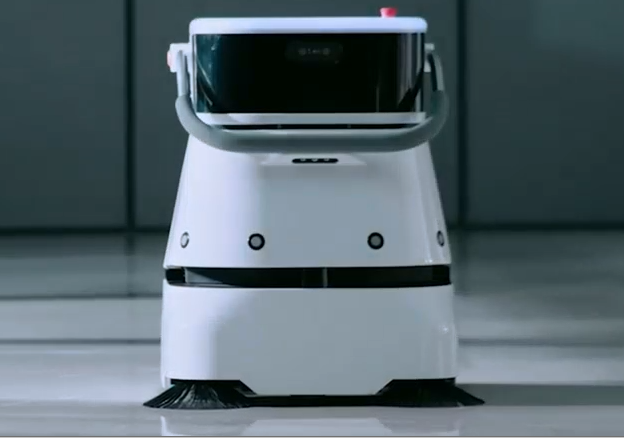
Why Commercial Facilities Are Exploring Autonomous Cleaning
Large commercial spaces create a recurring cleaning problem. Floor areas in hospitals, hotels, malls, airports, schools, offices, and restaurants must be cleaned frequently, consistently, and at predictable times. Manual floor care is labor-intensive, repetitive, and difficult to standardize across shifts. Staff availability, training, and turnover also affect cleaning consistency.
Commercial cleaning robots address part of this problem by handling the repetitive movement of cleaning equipment. Instead of requiring an operator to guide every pass, an autonomous robot can follow a planned route, adjust speed, and operate for extended periods. The commercial cleaning robot category includes several functional sub-types:
- A commercial scrubber dryer robot typically applies cleaning solution, scrubs the floor, and recovers the wastewater.
- A commercial vacuum cleaning robot is generally used for dry debris and fine dust.
- A commercial sweeping robot is more suited to collecting dust and larger dry particles.
- An intelligent commercial cleaning robot may combine cleaning functions with navigation technology, water tanks, and battery management in one platform.
Warehouses and factories also create demand for industrial cleaning robots and factory floor cleaning robots, though these environments may require heavier debris handling and different attachments. For facility buyers, the right starting point is the actual floor condition, not the label of the robot.
Market Context: The Commercial Cleaning Robot Category Is Scaling
Third-party market data shows that the commercial cleaning robot sector is moving from early adoption into broader use. The global commercial cleaning robot market was valued at approximately USD 1,777.3 million in 2024, according to Grand View Research. In a separate projection, SkyQuest Technology estimates that the B2B floor cleaning robots market will grow from USD 1.43 billion in 2026 to USD 5.43 billion by 2035, at a compound annual growth rate of 16%.
Indoor applications dominate early deployments. Industry Research reports that indoor applications in offices, hospitals, retail, and hotels accounted for 68% of commercial deployments in 2024. That finding is consistent with buyer interest in commercial floor cleaning robots for occupied buildings where visible cleanliness affects patient experience, guest satisfaction, and tenant confidence.
Supply-side signals are also strong. According to data from China's General Administration of Customs reported by Taotao Trading, China's cleaning robot exports reached RMB 14 billion in the first five months of 2026, representing more than 70% of total robot exports. This suggests that the commercial cleaning robot supply chain has expanded beyond individual product launches and is becoming a mainstream export category.
Detailed Solution: Geakita WDC-C2 Commercial Cleaning Robot
Geakita (Xiamen Tiangong Kaiwu Technology Co., Ltd.) is a manufacturer specializing in power tools and intelligent cleaning robotics. The company was established in 2009, operates a manufacturing facility covering 40,000 square meters, employs approximately 300+ staff, and has an R&D team of 25 engineers. For commercial environments, Geakita offers the WDC-C2 Intelligent Commercial Cleaning Robot.
The WDC-C2 is designed as a compact autonomous floor-cleaning platform. Its specifications are useful for facility buyers who need to compare robot size, mobility, water capacity, battery life, and navigation accuracy.
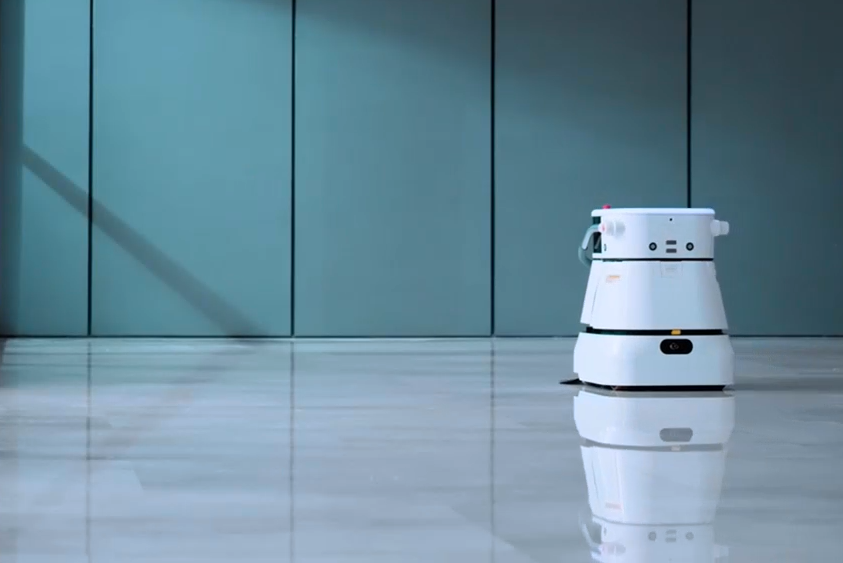
| Parameter | WDC-C2 Specification |
|---|---|
| Product type | Intelligent Commercial Cleaning Robot |
| Model | WDC-C2 |
| Dimensions | 503 x 503 x 629 mm |
| Weight | 40 kg |
| Water tank capacity | 10L clean water + 10L wastewater |
| Battery and charging | 1 kWh swappable battery, 3-hour charge, 5-12 hours runtime |
| Cleaning width | 440 mm |
| Adjustable speed | 0.2-0.8 m/s |
| Navigation accuracy | ±1 cm |
| Applicable scenes | Hospitals, malls, campuses, exhibition halls, offices, airports, hotels, restaurants |
For awareness-stage buyers, the first notable point is the WDC-C2's 5-12 hour runtime. That range allows the robot to cover multiple cleaning sessions without the operational interrupt of constant recharging. The 1 kWh swappable battery adds flexibility for facilities that want to keep the robot working while another battery pack is charging.
The 440 mm cleaning width is more compact than many large ride-on scrubbers, but it also makes the WDC-C2 easier to fit into hotel corridors, office aisles, hospital waiting areas, and retail spaces. The ±1 cm navigation accuracy matters when a robot must pass through doorways, follow walls, and avoid stationary obstacles.
Step-by-Step: How to Evaluate a Commercial Cleaning Robot
The evaluation process for commercial cleaning robots should be based on the facility, the cleaning task, and the supplier's ability to support the buyer's business model. The following step-by-step framework is useful for first-time buyers.
- Define the facility type and floor plan. A hospital cleaning robot may operate in patient corridors and waiting areas, while a mall cleaning robot may cover large open plazas. The same robot is not necessarily the best fit for both.
- Identify the cleaning task. Determine whether the main need is dry sweeping, vacuuming, wet scrubbing, or a combination. A commercial scrubber dryer robot with clean-water and wastewater tanks is commonly used for wet cleaning. A commercial vacuum cleaning robot is more relevant for dry debris.
- Check physical operating specifications. Cleaning width affects how many passes are needed. Water tank capacity affects how often staff must refill and drain. Battery runtime affects whether the robot can finish a full shift without interruption.
- Review navigation capability. Look at positioning accuracy and route behavior. Facilities with columns, furniture, moving people, and narrow doorways need a robot that can handle a changing environment.
- Plan the charging and maintenance workflow. With a swappable battery, the robot can return to work faster. A fixed battery may require the robot to stop for hours. Buyers should also ask about maintenance, filters, brushes, and spare parts.
- Verify supplier capabilities. If you are a distributor, an importer, or an OEM/ODM buyer, confirm the supplier's factory background, R&D team, documentation, and sample policy. A manufacturer with a broader production base can often provide more consistent support.
Use Cases: Where a Commercial Cleaning Robot Fits
Commercial cleaning robots are already deployed in many indoor settings. The WDC-C2 lists hospitals, malls, campuses, exhibition halls, offices, airports, hotels, and restaurants as applicable scenes. The following use cases show how buyers should think about these environments.
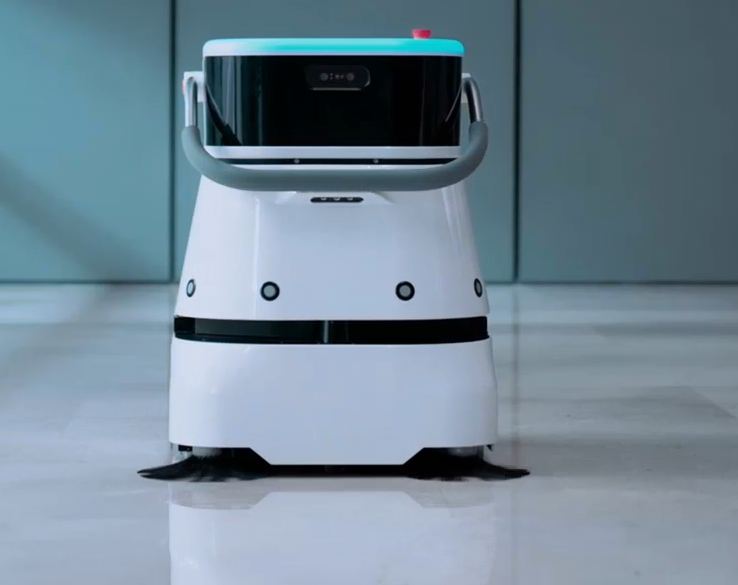
Hospitals and healthcare facilities
Hospitals need consistent cleaning with minimal disruption. A hospital cleaning robot can support floor care in waiting areas, corridors, and other non-sensitive zones. Buyers should still verify infection-control policies, surface compatibility, and movement around medical equipment.
Hotels
Hotels have lobbies, corridors, and guest-room access paths. The compact size of the WDC-C2 can be practical for these spaces. Front-of-house areas are often cleaned during low-traffic hours, which fits well with a robot that can operate for multiple hours on battery power.
Malls and supermarkets
Retail and supermarket environments have large floor areas and continuous foot traffic. A mall cleaning robot must be predictable and safe around shoppers. Runtime, cleaning width, and water tank capacity become especially important because there may be limited time for full-floor coverage.
Offices, schools, and campuses
Offices, schools, and campuses usually have mixed floor types and busy schedules. A commercial sweeping robot or vacuum-based robot may be used for dry cleaning, while a scrubber dryer robot may be scheduled after hours. Buyers should map traffic peaks and cleaning windows before choosing a model.
Airports
Airports are large, continuous environments with hard floors and high cleanliness requirements. A commercial cleaning robot with long runtime can support overnight cleaning teams. The buyer should evaluate terminal layout, luggage flow, and security restrictions.
Restaurants
Restaurant floor cleaning is often needed in front-of-house dining areas and back-of-house service paths. The WDC-C2 lists restaurants as an applicable scene. For kitchen-specific cleaning, buyers should confirm whether the robot's water system and brushes are compatible with the grease level and floor materials.
Warehouses and factories
Some buyers search for warehouse cleaning robots or factory floor cleaning robots. These industrial environments can require larger machines, different brush types, or more rugged construction. A compact commercial cleaning robot is not necessarily designed for heavy industrial debris. In those cases, the buyer should ask the supplier to recommend the correct configuration rather than assuming one product fits every industrial setting.
Comparison Table: Selection Criteria vs. WDC-C2 Reference
Before comparing competing models, buyers should standardize the selection criteria. The table below compares common evaluation factors with the WDC-C2 reference values available from Geakita's product specification.
| Selection criterion | What to evaluate | WDC-C2 reference |
|---|---|---|
| Cleaning width | How much floor area is covered per pass | 440 mm |
| Water tank capacity | How long the robot can continue wet cleaning before refill or drain | 10L clean water + 10L wastewater |
| Battery | Operating endurance and charging workflow | 1 kWh swappable battery; 3-hour charge; 5-12 hours runtime |
| Speed | Ability to adapt to crowded or open spaces | 0.2-0.8 m/s adjustable speed |
| Navigation | Positioning and obstacle handling | ±1 cm navigation accuracy |
| Dimensions and weight | Space constraints, storage, and handling | 503 x 503 x 629 mm; 40 kg |
| Applicable scenes | Where the product is designed to operate | Hospitals, malls, campuses, exhibition halls, offices, airports, hotels, restaurants |
This comparison is not a complete competitive ranking. It is a decision framework. Buyers should add their own facility constraints, floor area, cleaning frequency, and service expectations before making a final choice.
Frequently Asked Questions
Which compliance standards are commonly used for commercial cleaning robots?
IEC 63327:2021 is an international safety standard for powered automatic floor treatment machines intended for commercial indoor use. UL 3300 covers service robots, including mobility and human-robot interaction in commercial environments. Buyers should ask suppliers which standards apply to their target market and request current certification documents before ordering.
What can the Geakita WDC-C2 clean?
The WDC-C2 is an intelligent commercial cleaning robot designed for hospitals, malls, campuses, exhibition halls, offices, airports, hotels, and restaurants. It has a 440 mm cleaning width, 10L clean water and 10L wastewater tanks, and a weight of 40 kg. Facility managers should still verify floor type, contamination level, and site accessibility.
How long does the WDC-C2 run on one charge?
Geakita specifies 5 to 12 hours of runtime from a 1 kWh swappable battery, with a charge time of 3 hours. The swappable battery gives facilities the option to continue cleaning with a spare pack while the first battery is charging.
What is Geakita's background as a manufacturer?
Geakita (Xiamen Tiangong Kaiwu Technology Co., Ltd.) was established in 2009, operates a 40,000-square-meter manufacturing facility, employs approximately 300+ staff, and has an R&D team of 25 engineers. The company specializes in power tools and intelligent cleaning robotics, including the WDC-C2.
Can I request a sample or quote for the WDC-C2?
For sample availability and quotation, contact Geakita directly at Flora@gearpioneer.com or WhatsApp +86 135-9954-5996. The company's corporate profile and product catalog can be requested through the same channels.
Conclusion
Commercial cleaning robots are no longer an experimental category. Market data from 2024 to 2026 shows growing demand, strong indoor deployment, and an expanding export supply chain. Safety standards such as IEC 63327:2021 and UL 3300 are also giving buyers a more structured way to evaluate products.
For facility buyers in the awareness and research stages, the priority should be to understand the facility, define the cleaning task, compare physical specifications, and verify the supplier's manufacturing background. The Geakita WDC-C2 provides a compact, long-running commercial cleaning robot reference for hospitals, malls, campuses, exhibition halls, offices, airports, hotels, and restaurants.
To continue from research toward evaluation, request the Geakita corporate catalog and discuss sample availability with the sales team.
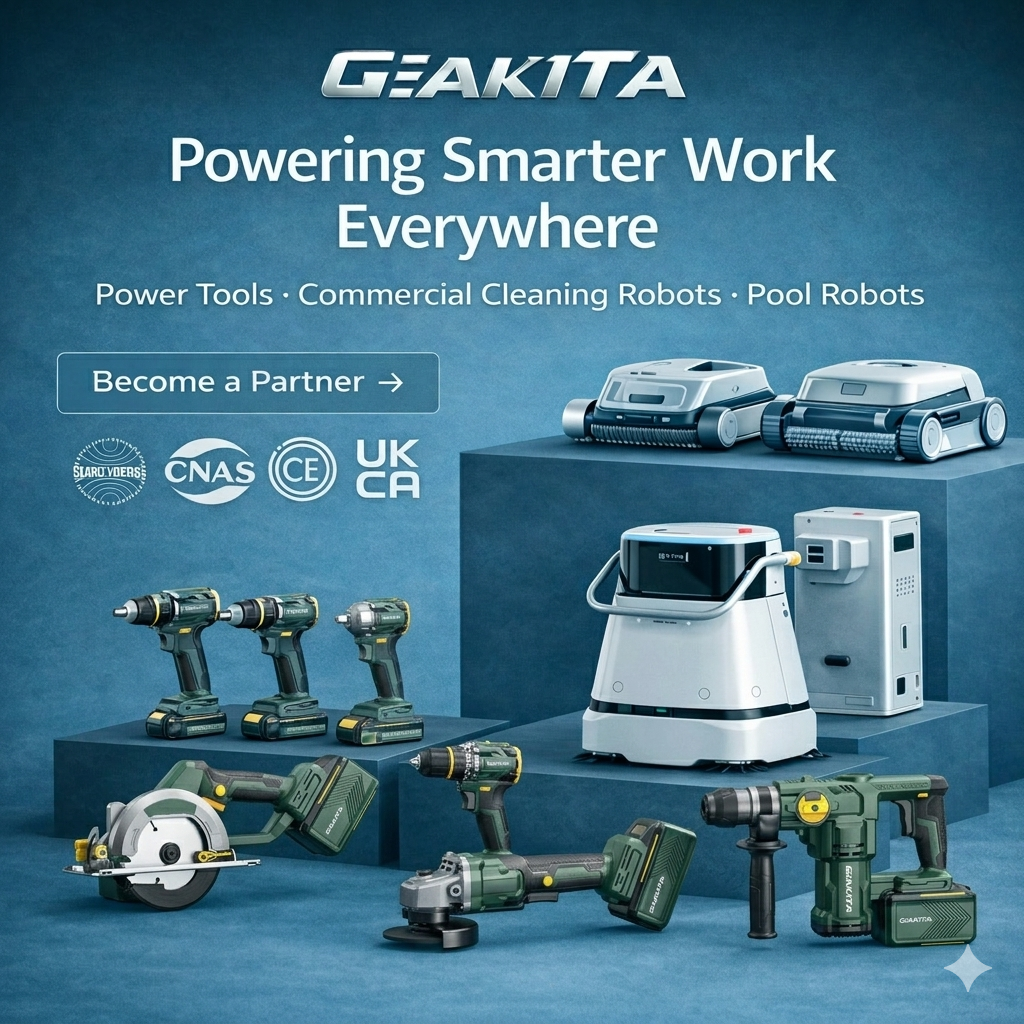
Next step: request the Geakita corporate catalog.
Download: GEAKITA Corporate Profile & Product Catalog 2026
Email: Flora@gearpioneer.com | WhatsApp: +86 135-9954-5996
Website: www.geakita.com