DESIGN PREVIEW Website preview · English edition
Powering Smart Work EveryWhere
Contact Us
English
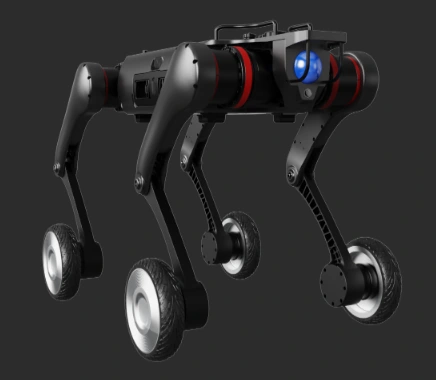
D30W wheel-foot quadruped robotD30W · WHEEL-FOOT
GEAKITA / QUADRUPED PLATFORM

D30W

Roll between tasks.
Step through transitions.

Choose wheel-foot when travel distance and inspection efficiency matter most. Configure the sensing, control and payload package for the mission.

Continuous payload
30 kg
Loaded operating time
30 kg: approx. 3 h
Battery energy
936 Wh
MODEL-SPECIFIC DATA

D30W technical specification.

Dimensions & structure

Selection factorD30W
Standing Dimensions (L × W × H)930×560×670 mm
Folded Dimensions (L × W × H)1026×730×200 mm
Weight (Including Battery)43.5 kg
Foot Type / Wheel Diameter190 mm · Honeycomb shock-absorbing rubber wheel

Payload & motion

Selection factorD30W
Continuous Payload30 kg
Instantaneous Standing Payload100 kg
Normal Travel Speed0–3 m/s
Maximum Sprint Speed (Laboratory)5 m/s
Maximum Single-Step Height30 cm
Continuous Stair Step Height20 cm
Maximum Climbing Angle45°

Endurance & battery

Selection factorD30W
No-Load Operating Time6 h
Approximate No-Load RangeApprox. 25.5 km
Loaded Operating Time30 kg: approx. 3 h
Approximate Loaded Range30 kg: approx. 12.5 km
Battery Energy (Current Series)936 Wh
Charging TimeApprox. 2.5 h
Optional Fast-Charging TimeApprox. 1 h
Quick Battery ReplacementSupported

Protection & computing

Selection factorD30W
Dust & Water ResistanceIP66
Operating Temperature-20℃ ~ +55℃
Base Computing PlatformRK platform / 8GB RAM / 64GB / 6 TOPS
Wide-Angle Cameras1 (130°)
LiDARNot guaranteed in base model; Pro upgrade available
Wi-Fi / Video TransmissionWi-Fi 6 / HD video transmission
External Power Output12V / 24V / battery output
Secondary DevelopmentSupports high-/low-level development and simulation interfaces

Runtime, range, speed, payload and terrain limits are measured separately. Deployment performance depends on site conditions, payload power consumption and the selected configuration.

Specifications describe the current D30 / D50 series. Agree the hardware, software and application modules as one project configuration.

HOW TO CHOOSE

Feet for stepping.
Wheels for route coverage.

POINT-FOOT / D30 & D50

Joint-driven walking

The leg joints position each foot and transfer support as the robot walks. The supplied manuals describe three joint motors per leg and twelve degrees of freedom on the point-foot platforms.

Evaluate this format for frequent steps, gravel and uneven ground. Route clearances and the payload centre of gravity remain part of the selection.

WHEEL-FOOT / D30W & D50W

Wheels combined with articulated legs

Wheel-equipped feet provide rolling movement on suitable surfaces, while the articulated legs support obstacle negotiation. The series sheet lists 190 mm wheels for D30W and 200 mm wheels for D50W.

Evaluate this format for longer paved routes and mixed-surface facilities. Wheel traction, turning space and obstacle transitions must be assessed on the actual route.

Continuous payload ≠ instantaneous standing payload.

The range lists 30 kg or 50 kg continuous payload. The 100 kg instantaneous standing figure is not a walking, lifting or transport rating.

BASE PLATFORM + APPLICATION MODULES

Specify what the system includes.

Platform reference

D30 / D30W: RK compute platform, 8 GB RAM, 64 GB storage, 6 TOPS, one 130° camera and two ultrasonic sensors.

D50 / D50W: RK3588, two cameras and one LiDAR listed in the current series sheet. All four list Wi-Fi 6, HD video transmission and development interfaces.

Project options

Define SLAM/navigation and Pro software scope separately. Options listed include Jetson Orin NX 8 GB / 70 TOPS, RTK, dual-spectrum PTZ, 5G and a charging dock.

D30-series LiDAR is not guaranteed in the base package. Automatic docking, application payloads and integration work are not included by default.

Hardware presence does not establish autonomous operation.

Specify sensors, navigation software, commissioning, network access and the operator workflow as one complete deployment scope.

APPLICATION-LED SELECTION

A mobile platform.
A clearly defined mission.

Choose the sensing and software around the task. A robot chassis alone is not a complete inspection or autonomous patrol system.

01 / INDUSTRIAL INSPECTION

Connect the route to the inspection point.

For plant walkways, equipment rooms and mixed floor levels, specify the route, observation positions and measurements required.

Configuration brief
Visible or thermal imaging, repeatable viewpoints, navigation and report integration.
Buyer value
A defined platform-and-sensor package that can be piloted against actual inspection tasks.
02 / FACILITY PATROL

Plan for the whole patrol route.

For campuses and large facilities, compare route distance, surface transitions and connectivity coverage before choosing feet or wheels.

Configuration brief
Video transmission, optional speaker, navigation, remote supervision and charging strategy.
Buyer value
A repeatable route proposal with clear operator responsibilities and coverage requirements.
03 / MATERIAL TRANSPORT

Count every kilogram on board.

Select the 30 kg or 50 kg continuous-payload class around the complete carried load, including brackets, boxes and sensors.

Configuration brief
Mounting arrangement, centre of gravity, route, gradients and loaded runtime.
Buyer value
Compare useful transport capacity rather than relying on a momentary standing-load figure.
04 / RESEARCH & INTEGRATION

Develop around accessible interfaces.

For robotics laboratories and system integrators, start with the motion-control scope, simulation interfaces and onboard compute requirements.

Configuration brief
SDK version, interface documentation, payload power, sensor data and optional compute upgrade.
Buyer value
A documented integration scope with hardware, software and acceptance responsibilities.
PLAN YOUR DEPLOYMENT

Bring the task.
Build the configuration.

Tell us where the robot will work, what it will carry and how it should be controlled. Build a project brief for technical review and a private quotation.

  1. Define the missionRoute, surfaces, payload and operating hours.
  2. Specify the systemRobot, sensing, connectivity, software and charging.
  3. Agree the pilotRepresentative route, success criteria and training.

Submit your requirements to GEAKITA. You will receive a reference number after successful submission.

BUYER QUESTIONS

Before you specify a robot.

Which model should I start with?

Start with the complete carried load: D30 / D30W list 30 kg continuous payload; D50 / D50W list 50 kg. Then compare route surfaces, stairs, dimensions and loaded endurance.

Does the robot include autonomous navigation?

Navigation / Pro software, mapping, commissioning and charging-dock scope must be specified separately. A camera or LiDAR in the hardware list does not by itself define an autonomous solution.

Can it work for six hours while carrying maximum payload?

Do not combine the no-load runtime with the continuous payload rating. Refer to the loaded-runtime row for the exact model and validate the intended duty cycle.

Can a standard tool battery be used?

No tool-battery compatibility is stated. D30-series battery energy is listed as 936 Wh; D50-series as 2081 Wh / 44 Ah. Robot batteries and chargers must match the exact supplied platform.

What can distributors or OEM partners request?

Submit target markets, application focus, branding and documentation needs, demo requirements, spare-parts planning and local service responsibilities. Scope, availability and commercial terms are agreed for the project.

What is needed before a pilot?

Supply the route, payload, site restrictions, connectivity plan and required outputs. Agree acceptance measurements for mission completion, runtime, sensor results and operator intervention under representative conditions.

YOUR NEXT PRODUCT OPPORTUNITY

Let’s build your
product range.

PLAN YOUR NEXT STEP

Your product inquiry

Submit your requirements to GEAKITA. You will receive a reference number after successful submission.